
Loss of Power Repair Example for Drivers
A car that suddenly feels flat is hard to ignore. You press the accelerator, expect it to pull, and nothing much happens. This loss of power repair example shows how the fault is usually traced properly, why guessing often wastes money, and what the right fix looks like in a real garage.
A real loss of power repair example
We often see this issue when a driver says the car still starts and runs, but it will not accelerate properly, struggles uphill, or feels stuck in limp mode. In some cases the engine warning light is on. In others, there are no warning lights at all, which makes the fault harder to judge from the driver’s seat.
A typical example is a diesel car coming in after a few days of poor performance. The owner may have noticed it first on a dual carriageway, where the car would not pick up speed as normal. Fuel economy might have dropped as well. Sometimes there is extra smoke, sometimes not. The problem feels serious, but the cause is not always obvious.
This is where proper diagnostics matter. Loss of power can come from air flow problems, fuel delivery faults, turbo issues, DPF trouble, sensor errors, split hoses, blocked filters, or electrical faults. Replacing parts on guesswork can get expensive very quickly.
What the driver noticed first
In one common scenario, the car arrives with three clear complaints. It lacks power under acceleration, it occasionally goes into limp mode, and the engine warning light has appeared on and off. The driver may have already tried a fuel additive or had a quick look under the bonnet, but nothing obvious stands out.
That tells us something useful straight away. If the fault comes and goes, it can point to a sensor reading outside the normal range, a sticking component, or a pressure leak that only shows up under load. If the power is poor all the time, the issue may be more mechanical or related to a blocked system.
Either way, the next step is not to fit random parts. The next step is to test it properly.
How we diagnose loss of power properly
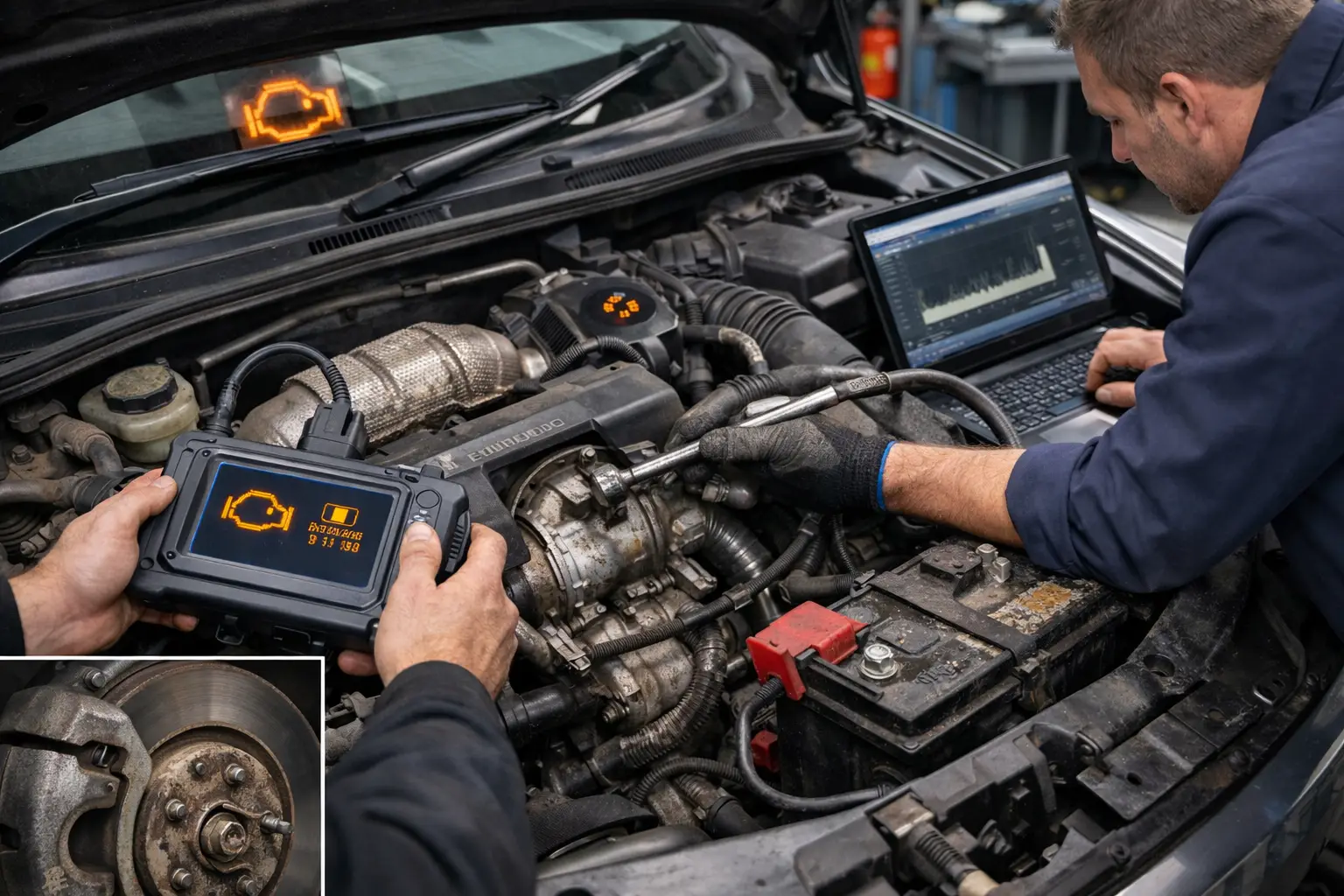
We start with the basics. That means confirming the customer’s complaint, checking for warning lights, scanning for stored fault codes, and looking at live data. Fault codes help, but they do not always give the full answer. A code can point to the area of the problem without identifying the failed part.
After that, we inspect the parts that commonly cause loss of power. On many vehicles, this includes boost hoses, vacuum lines, intake components, the air filter, turbo control parts, DPF readings, and fuel pressure data. We also check whether the car has dropped into a protection mode because the system has detected something out of range.
In most cases, a road test is part of the process. A vehicle can behave differently when stationary than it does under load. Live readings during a drive often show whether the turbo is building pressure properly, whether airflow is believable, and whether the engine is being restricted.
That matters because two cars can feel equally slow for completely different reasons.
The actual cause in this repair example
In this example, the scan showed an air flow related fault and underboost readings. That might sound like the turbo has failed, but that would be too quick a conclusion. We checked the turbo system first and found a split boost hose.
This usually happens because hoses weaken over time with heat and pressure. Once there is a split, the engine cannot build the air pressure it needs under acceleration. The result is poor performance, hesitation, and sometimes limp mode. The vehicle may still idle fine, which is why some drivers are surprised the problem is more than just “bad fuel” or a temporary glitch.
A split hose is a good example of why diagnostics save money. If someone had guessed and fitted a new sensor first, the real problem would still be there. If someone had assumed the turbo itself was faulty, the repair bill could have gone far higher than necessary.
The repair and what changed after
Once the damaged hose was identified, the fix itself was straightforward. The faulty hose was replaced, the system was checked for any other leaks, and the fault codes were cleared. After that, the car was road tested again while monitoring the live data.
The difference was immediate. Boost pressure returned to normal, the car accelerated properly again, and limp mode did not return. That is the kind of repair drivers want – clear fault found, clear fix, and proof that the problem is gone.
Not every loss of power job is that simple, though. Some are a one-part repair. Others take more testing because there can be more than one issue at the same time.
Other common causes of loss of power
A blocked DPF is a big one, especially on cars used for short trips. If the filter cannot regenerate properly, exhaust flow gets restricted and performance drops. The car may also show a DPF warning light or engine warning light. In those cases, forcing a regeneration without checking the reason behind the blockage is not always enough. If a pressure sensor, temperature sensor, or driving pattern problem has caused the issue, it can come back.
Fuel system faults are another possibility. Low fuel pressure, blocked fuel filters, or injector problems can all leave a car feeling sluggish. This often shows up more when accelerating hard or carrying extra load. Petrol and diesel engines can both suffer from this, but the symptoms vary.
Air intake faults are also common. A blocked air filter, faulty mass airflow sensor, sticking EGR valve, or vacuum leak can upset the air-fuel balance and reduce performance. In some cases the car runs rough as well. In others it simply feels flat.
Then there is the turbo system. A failed actuator, sticking vanes, control solenoid fault, or leak in pipework can all stop the engine producing the power it should. Drivers often fear the worst when they hear “turbo”, but sometimes the fix is far smaller than expected.
Why warning lights matter, but are not the whole story
A warning light helps, but it is not a diagnosis on its own. Some faults trigger a light straight away. Others may store a code without showing a warning on the dash. And some mechanical issues do not flag up clearly until they become more severe.
We often see this with small leaks and intermittent electrical faults. The car may drive badly one day and almost normally the next. That does not mean the problem has gone away. It usually means the fault has not fully developed yet, or only appears in certain conditions.
If your car has lost power, it is better to get it checked sooner rather than later. Leaving it too long can turn a smaller repair into a larger one.
When you should stop driving and get it looked at
If the car is struggling to reach speed, dropping into limp mode, producing excessive smoke, or showing multiple warning lights, it is best not to ignore it. The car may still move, but that does not mean it is safe to keep using normally.
There is also the practical side. A loss of power fault rarely improves on its own. If it leaves you unable to join traffic properly or complete your usual journeys, it becomes a reliability and safety problem as much as a repair issue.
For drivers around Lowestoft and nearby areas, the quickest route is usually a proper diagnostic check rather than replacing parts based on internet advice.
What to expect from a proper repair process
A good garage should be able to explain the fault in plain English. That means what the problem is, what is causing it, what needs to be tested, and what the likely repair path looks like. If more than one issue is possible, they should say that as well.
That honest approach matters because loss of power faults can vary. Sometimes the answer is a split hose or blocked filter. Sometimes it is a sensor fault. Sometimes it is a DPF issue that needs more than a quick reset. What you want is the root cause, not just the symptom cleared for a day or two.
At AutoFix4u, that is how we handle these jobs – diagnostics first, clear advice, and repairs that are meant to last.
If your car feels flat, slow, or stuck in limp mode, do not keep hoping it sorts itself out. Book it in, get the fault identified properly, and you will know exactly where you stand.

