Post MOT Repair Service That Gets You Back On Road
Failing an MOT is frustrating, but the bigger problem is what happens next. You still need the car for work, school runs or daily errands, and the failure sheet often leaves people unsure what actually needs doing first. A good post MOT repair service should take that stress away, explain the faults clearly, and get the right repairs done without wasting time or money.
At our garage, we see this most often with brakes, suspension, tyres, lights and emissions faults. Sometimes the issue is obvious. Sometimes the MOT fail points to a symptom, but the real cause needs proper checking before any parts are fitted. That is why the next step after a failed test matters just as much as the test itself.
What a post MOT repair service should actually do
A lot of drivers assume post-MOT repairs are just a case of replacing whatever is listed on the failure notice. In some cases, that is true. If a tyre is below the legal tread limit or a bulb has failed, the fix is straightforward.
But many MOT failures are not that simple. Worn brake pads may also mean damaged discs. A suspension fault might be caused by a broken spring, but it could also be linked to worn bushes or a failed shock absorber. An emissions fail can point to anything from a sensor issue to a DPF problem or poor engine performance.
A proper post MOT repair service starts by checking the failed items properly, confirming the cause, and then recommending the repair that will sort the issue for the long term. That saves repeat visits and avoids replacing parts that were not the real problem in the first place.
The most common MOT failures we see
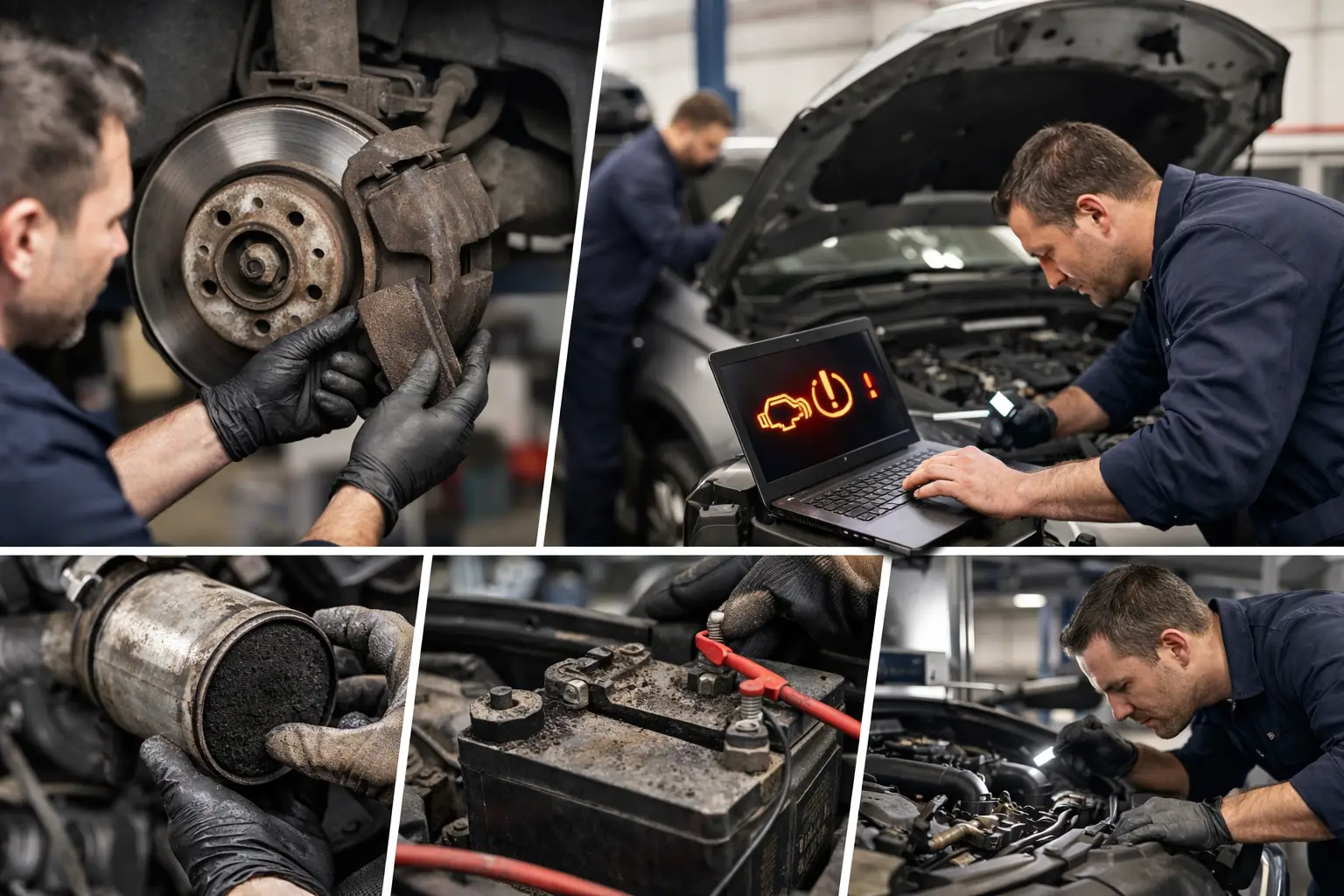
In most cases, MOT failures fall into a few common areas. Brakes are one of the biggest. Drivers often notice squeaking, grinding, a soft pedal or vibration, but sometimes there are no clear signs until the test picks it up. If the pads, discs, hoses or brake balance are not right, the car may fail on safety grounds.
Suspension faults are also common, especially on cars used daily on rough roads or speed bumps. We often see broken springs, worn drop links, tired shock absorbers and damaged arms or bushes. These faults can make the car feel unsettled, noisy or uneven, but not every driver notices it straight away.
Tyres are another regular issue. Low tread, sidewall damage or uneven wear can all cause a fail. Uneven wear is worth paying attention to because it usually happens for a reason. It may be poor alignment, worn suspension parts or incorrect tyre pressures over time.
Lighting and electrical problems are often quick to fix, but they still need checking properly. A failed bulb might be just that, or it could point to wiring faults, moisture in a unit or charging issues.
Then there are emissions failures. These are the ones that usually need more than a quick guess. If the engine warning light is on, the car has lost power, or the DPF is blocked, the MOT fail is often just the final sign of a problem that has been building for a while.
Why proper diagnosis matters after an MOT fail
This is where some garages get it right and some do not. Replacing parts based only on the fail sheet can work for simple faults, but it is not always enough.
We often see this issue when a car fails on emissions. Someone has already tried a sensor, an additive or a quick fix, but the vehicle still has the same fault. That usually happens because the root cause was never identified. The problem might be a pressure sensor, a split hose, injector issues, a thermostat fault or a DPF that cannot regenerate properly.
The same applies to brakes and suspension. If a car fails on worn front brakes, you still need to check the condition of the discs, sliders and callipers. If it fails on a spring, you also want to inspect the matching side and look for any related wear. The aim is simple – fix the car properly, not just enough to scrape through and come back with the same issue a few weeks later.
How post MOT repairs usually work
Once the vehicle has failed, the first step is to review the failure notice and inspect the reported faults. Some repairs can be confirmed quickly. Others need more time, especially if the problem involves warning lights, engine management, DPF issues or electrical faults.
After that, the garage should explain what has failed, why it has failed, and what needs doing now. Plain English matters here. Most people do not want a technical lecture. They want to know if the car is safe, what the likely repair is, and how soon it can be sorted.
The next part is the repair itself. A dependable workshop will use quality parts, fit them properly, and tell you if there is anything else worth dealing with while the car is already in. That is not upselling when it is relevant. For example, if both front tyres are worn unevenly because of a suspension fault, there is no point fixing the suspension and ignoring tyres that will still fail or feel unsafe.
Once the work is complete, the vehicle can go back for retest if needed. In many cases, fast turnaround makes all the difference, especially when the car is your only transport.
Post MOT repair service for urgent problems
Some MOT failures can wait a day or two. Others should not. Brake faults, dangerous tyre damage, steering play, severe corrosion and certain suspension failures need attention quickly because they affect safety straight away.
If the car is undriveable, has gone into limp mode, or the warning lights suggest a deeper fault, it is best not to keep using it and hope for the best. We often speak to drivers who were planning to “get a few more days out of it” before booking it in. Sometimes that works. Sometimes it turns a repairable issue into a bigger job.
That is why speed matters, but so does doing the job properly. Same-day solutions are possible for many common MOT failure repairs, depending on parts availability and workshop space. More involved faults may take longer, especially if diagnostics are needed first. Honest timescales are better than vague promises.
What to look for in a local garage after an MOT fail
The best garage for post-MOT work is not always the one that simply says yes fastest. You need somewhere that will check the fault properly, explain it clearly and give you a realistic plan.
Look for a workshop that talks in plain English, gives clear pricing before work starts, and tells you when a fault is simple versus when it needs more investigation. If a garage cannot explain why the car failed or what the repair will achieve, that is usually a bad sign.
It also helps to choose a local independent garage that understands how urgent these repairs are for everyday drivers. Around Lowestoft, many customers rely on one vehicle for commuting, family use and everything in between. If the car is off the road, life gets awkward quickly. That is why a practical, local service matters.
When an MOT fail points to a bigger issue
Not every fail is just wear and tear. Sometimes the MOT picks up a sign of a deeper mechanical problem.
For example, repeated bulb failures can be linked to electrical faults. Uneven brake performance can point to sticking callipers or hose issues. Emissions problems can be tied to poor combustion, turbo faults or DPF trouble. Uneven tyre wear may suggest suspension wear or alignment problems rather than just old tyres.
This is where experience counts. A garage that works on faults every day will usually spot patterns quickly. That means less guesswork, fewer unnecessary parts and a better chance of getting the car back to normal without repeat visits.
If you need a post MOT repair service around Lowestoft, the best next step is simple. Get the failure sheet checked, find out what is actually causing the problem, and book the right repair before a small issue becomes a bigger one. A clear answer and a proper fix will always save more time than hoping the warning signs sort themselves out.


