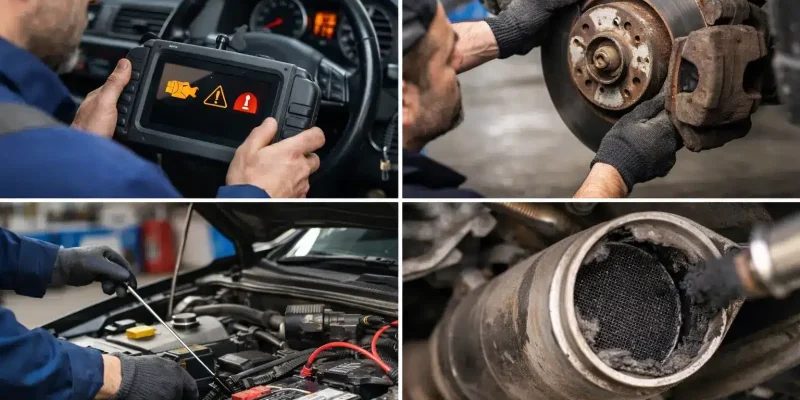

A motorway breakdown rarely starts with a dramatic failure. More often, it starts with something small that has been ignored: a tyre losing pressure, a weak battery, a warning light that came on last week, or coolant slowly dropping below the minimum mark. The best checks before long journeys give you a chance to deal with those issues at home, rather than on the hard shoulder or halfway through a family holiday.
At AutoFix4u, we often see cars arrive after a trip with faults that could have been picked up in a few minutes. A long run puts more load on the engine, tyres, brakes and cooling system than the usual school run or commute. A quick, sensible check can make the journey safer and help avoid an unexpected repair bill.
The best checks before long journeys
You do not need to be a mechanic to carry out the basics. Park on level ground, give yourself enough time, and do not check fluids immediately after a hot drive. If something looks wrong, smells unusual or does not feel right, get it checked before you set off.
Check tyres properly, not just by looking at them
Tyres are one of the biggest causes of avoidable trouble on longer journeys. A tyre can look fine while being underinflated, and low pressure causes excess heat, poor handling and faster wear. It can also increase fuel use.
Check all four tyre pressures when the tyres are cold, using the pressure listed in your vehicle handbook or on the sticker inside the door shut or fuel flap. If the car is loaded with passengers, luggage or a roof box, there may be a higher recommended setting. Do not forget the spare wheel if you have one.
Look across the tyre tread for cuts, bulges, nails and uneven wear. A bulge in the sidewall needs immediate attention. It can mean the tyre has internal damage, often from a pothole or kerb strike. Uneven wear may point to worn suspension parts, incorrect wheel alignment or a tyre pressure problem. Replacing a tyre without fixing the cause can mean the new one wears out early too.
Make sure brakes feel normal
Before a long trip, pay attention to how the brakes feel during normal driving. The pedal should feel firm and the car should pull up in a straight line. Grinding, squealing, vibration through the pedal or steering wheel, or a car pulling to one side are all signs worth checking.
In most cases, a squeal does not automatically mean the brakes are dangerous. It may be surface rust or a pad wear indicator. But if the noise is constant, braking feels weaker, or a brake warning light appears, do not assume it will improve on a motorway run. Brake pads, discs and calipers need inspecting to find the actual cause.
Also check the brake fluid level. If it is low, do not simply top it up and carry on. Brake fluid normally drops gradually as pads wear, but a sudden drop can indicate a leak or another fault that needs proper diagnosis.
Check oil, coolant and other essential fluids
Low engine oil is one of the simplest problems to prevent and one of the most expensive to ignore. Check the oil level with the dipstick, or use the vehicle display if your car does not have one. The car should be on level ground and the engine should have been off long enough for the oil to settle.
If oil is below the minimum mark, top up with the correct grade. Do not overfill it. If you need to add oil regularly, there may be a leak or the engine may be using more oil than it should. That is something to investigate before a long journey, particularly if you will be towing or carrying a full load.
Check coolant only when the engine is cold. The level should sit between the minimum and maximum marks on the expansion tank. Low coolant can lead to overheating, loss of heater performance and possible engine damage. If the level keeps falling, there is usually a reason, such as a hose leak, radiator issue, water pump fault or a problem elsewhere in the cooling system.
Screenwash is less serious mechanically, but it matters for visibility. Motorway spray, insects and dirty roads can quickly leave a windscreen smeared. Fill the reservoir with suitable screenwash, especially in colder weather, rather than plain water alone.
Do not set off with a warning light you do not understand
A dashboard warning light is the car telling you a fault has been recorded. Sometimes the issue is minor. Sometimes it is the early sign of a problem that can leave the car in limp mode or cause a breakdown under load.
An engine warning light may relate to emissions, sensors, ignition, fuelling or an air leak. On diesel vehicles, it can also be linked to a DPF issue. If the DPF warning has appeared, a longer steady run may help only if the vehicle is otherwise able to regenerate properly. If there is another fault stopping regeneration, repeated motorway driving will not fix it. It can make the problem worse and may lead to loss of power.
Red warning lights need more caution. Oil pressure, coolant temperature, brake system and battery charging warnings should not be ignored. Stop safely if one appears while driving and seek advice. Continuing can turn a repairable fault into major damage.
A diagnostic check before travelling gives a clearer answer than guessing. It reads the fault codes, but more importantly, it helps identify why the code appeared in the first place. Clearing a light without finding the cause is not a repair.
Test the battery, lights and wipers
A battery can seem fine on short trips and then struggle after an overnight stop, especially if it is older, the weather is cold or the car has been doing mainly short runs. Slow cranking, dim headlights or electrical messages on the dashboard can all point to a weak battery or charging fault.
Check that headlights, brake lights, indicators, reversing light and number plate lights are working. It is easier with someone helping, but reflections in windows or a wall can help you check on your own. Replace worn wiper blades too. Streaky blades are frustrating in light rain and genuinely unsafe in heavy spray.
If the battery light is on with the engine running, the issue may be the alternator, drive belt or wiring rather than the battery itself. Do not assume a jump start solves that problem. The car may start, but it may not keep charging as you travel.
A quick pre-trip check is not the same as servicing
A vehicle can have a valid MOT and still develop a fault afterwards. An MOT is a test of roadworthiness on the day. It does not replace regular servicing, fluid checks or investigating new noises and warning lights.
Equally, a recent service does not mean you should ignore something that has changed since then. If the clutch has started slipping, the steering feels vague, the engine lacks power or there is a new smell from the engine bay, it needs attention based on the symptom, not the date on the service book.
For a long journey, think about what is different from normal use. More motorway speed, more weight in the car, more stop-start traffic, hotter weather and longer periods with the engine running can expose a weakness that has not shown itself locally.
When to book a check before travelling
Book the car in if you have a warning light, a noise you cannot explain, fluid loss, a starting problem, vibration, poor braking or any loss of power. It is particularly sensible if the car is overdue a service, has recently failed an MOT, or you are heading away with children, luggage or a caravan.
For drivers in Lowestoft and the surrounding area, AutoFix4u can inspect the issue, explain the cause in plain English and give you a clear repair plan before you travel. Where possible, we aim for a same-day solution, with no surprise extras and no unnecessary work.
A few minutes spent checking the car before you leave can save hours at the roadside. If something does not look, sound or feel right, deal with it while you still have time to choose the repair, rather than letting the journey choose it for you.