
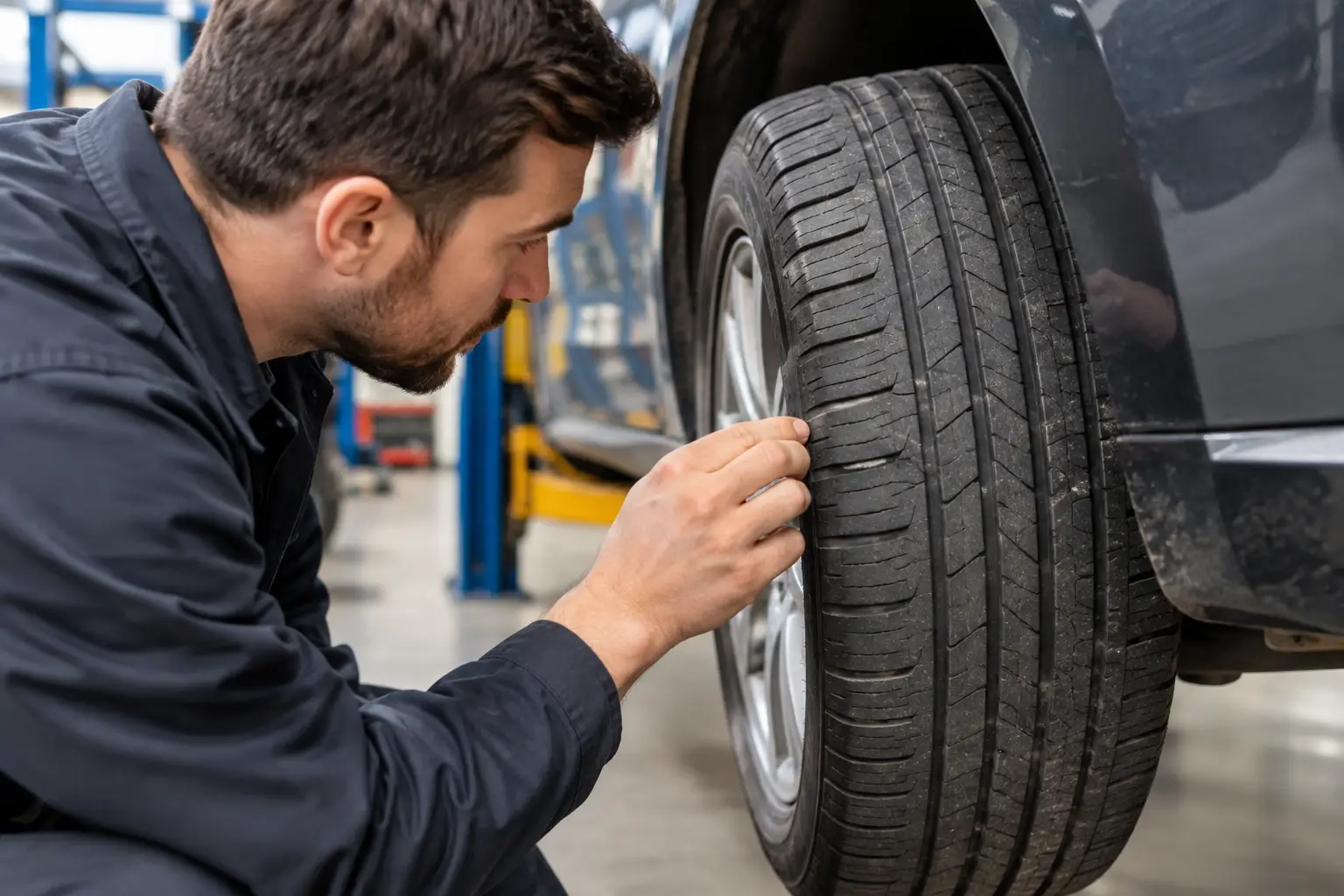
How to Inspect Tyre Tread Before It Costs You
Your tyres may look fine from a distance. However, a closer inspection can reveal worn edges, damaged rubber or tread that is close to the legal limit.
Knowing how to inspect tyre tread helps you identify safety problems before they affect braking or road grip. It may also help you avoid an MOT failure.
At AutoFix4u Garage Lowestoft, we help drivers check tyre condition and investigate unusual wear.
This guide explains how to measure tread depth, recognise tyre damage and decide when replacement is necessary.
How to inspect tyre tread at home
A basic tyre inspection only takes a few minutes. However, you need to check every tyre carefully.
Step 1: Park your vehicle safely
First, park on level ground away from traffic.
Switch off the engine and apply the parking brake.
Then make sure the vehicle cannot move while you inspect the tyres.
For the front tyres, you can turn the steering wheel to improve visibility before switching off the engine.
Do not crawl underneath an unsupported vehicle.
Step 2: Check all four tyres
Start by looking across the full width of each tyre.
Do not inspect only the outer edge.
The inside shoulder can wear faster than the rest of the tread.
Therefore, use a torch if you cannot see the tread clearly.
Also, look around as much of the tyre as you can safely inspect.
Step 3: Look for visible damage
Check for:
- Deep cuts or cracks.
- Sidewall bulges.
- Exposed cords.
- Nails or screws.
- Uneven tread wear.
- Missing pieces of rubber.
- Signs of repeated pressure loss.
A sidewall bulge may indicate internal tyre damage.
Do not drive on a tyre with a bulge, exposed cords or serious structural damage.
Instead, arrange professional assistance.
Step 4: Measure the tread depth
Use a tyre tread-depth gauge for the most reliable home measurement.
Place the gauge into a main tread groove.
Then record the depth in millimetres.
Repeat the measurement across several grooves and around the tyre.
This matters because wear may differ between the centre and shoulders.
Step 5: Check the tyre pressures
Finally, check the pressure when the tyres are cold.
Use the vehicle manufacturer’s recommended figures.
You can normally find these in the handbook or on a vehicle information label.
Incorrect pressures can affect handling, tyre life and braking performance.
What is the legal tyre tread depth in the UK?
For most cars and light vans, the legal minimum is 1.6mm.
This requirement applies across the central three-quarters of the tread width and around the entire circumference.
However, the legal limit is not a target for good wet-weather performance.
As the tread becomes shallower, the tyre has less room to move water away from the road.
Consequently, the risk of losing grip on wet surfaces can increase.
Should you replace tyres before 1.6mm?
Many drivers choose to consider replacement around 3mm, particularly before wet winter weather.
However, 3mm is a precautionary guideline rather than the general UK legal minimum.
The correct decision also depends on tyre condition, performance and driving needs.
If you are unsure, arrange a professional inspection.
Our New Tyres Lowestoft service offers replacement options for cars and vans.
How to inspect tyre tread with a depth gauge
A tread-depth gauge gives you a numerical reading.
Therefore, it offers a clearer assessment than simply looking at the rubber.
Measure several grooves
Start with one of the main tread grooves.
Insert the gauge according to its instructions.
Then measure other grooves across the tyre.
Do not rely on a single reading.
Check different points around the tyre
One section may have more wear than another.
For example, braking or suspension problems can contribute to uneven patterns.
Therefore, check several positions around the circumference.
If you cannot safely see part of the tyre, ask a garage to inspect it.
Record the measurements
Write down the approximate depth for each tyre.
This can help you monitor wear over time.
However, never rely on an old measurement if you notice new damage or changes in handling.
Can you use a 20p coin to check tyre tread?
A 20p coin can provide a quick visual guide.
Place the coin into one of the main tread grooves.
If the outer border remains visible, the tread may be approaching the legal limit.
However, the coin test is not a precise measurement.
It cannot reliably confirm that every section meets the legal requirement.
Therefore, use a proper depth gauge when you need an accurate reading.
A professional tyre inspection is the safest option when wear looks uneven or close to the limit.
How do tyre tread wear indicators work?
Most modern tyres have small raised bars inside the main grooves.
These are tread wear indicators.
As the tread wears down, its surface gets closer to the bars.
Once the tread reaches the indicator level, the tyre has reached its wear threshold.
However, you should not wait for the indicator before checking tyre condition.
A tyre can become damaged or wear unevenly while some grooves still have acceptable depth.
Therefore, inspect the entire tyre regularly.
What causes uneven tyre tread wear?
Different wear patterns can reveal useful clues.
However, no single pattern proves the cause without further checks.
Wear on both outer edges
Heavy wear on both shoulders may indicate under-inflation.
Low pressure changes how the tyre carries the vehicle’s weight.
As a result, the shoulders may experience more wear.
Check the pressure using the manufacturer’s specifications.
Wear through the centre
Heavy centre wear may indicate excessive inflation.
However, tyre design and driving conditions can also influence wear.
Therefore, compare the pressure and tread measurements before drawing conclusions.
Wear on one side
A heavily worn inner or outer shoulder may point to wheel geometry problems.
For example, a pothole impact can affect alignment or damage a suspension component.
You may also notice the steering wheel sitting off-centre.
However, replacing the tyre alone may not solve the underlying problem.
AutoFix4u does not currently provide wheel alignment. Nevertheless, we can inspect relevant tyres, steering and suspension components.
If alignment measurements or adjustment are necessary, we can explain the next step.
Patchy or cupped wear
Uneven patches can sometimes result from suspension wear or wheel imbalance.
For example, worn shock absorbers may affect how the tyre maintains contact with the road.
You might also notice vibration or unusual tyre noise.
Our Suspension Repair Lowestoft service can investigate worn or damaged suspension components.
Meanwhile, our Tyre Balancing Lowestoft service may help where wheel imbalance contributes to vibration.
What tyre damage should you never ignore?
Tread depth is only one part of tyre safety.
A tyre may have plenty of tread but still be unsafe.
Sidewall bulges
A bulge can indicate damaged internal structure.
This may happen after a hard pothole or kerb impact.
Do not continue driving on a tyre with a sidewall bulge.
Deep cracks or cuts
Rubber can deteriorate as tyres age.
However, deep cracks or cuts may affect safety even when the tread remains deep.
Visible cords or serious damage require immediate professional assessment.
Nails and screws
A nail or screw may cause a slow puncture.
However, removing it yourself can turn a slow leak into rapid pressure loss.
If you notice an object in the tyre, arrange a professional inspection.
Our Puncture Repair Lowestoft service can assess whether the tyre meets the conditions for safe repair.
Repeated pressure loss
If you regularly add air to one tyre, something may be wrong.
For example, the problem could involve a puncture, valve or wheel rim.
Therefore, investigate the cause instead of repeatedly inflating the tyre.
Why does tyre tread matter in wet weather?
Tyre grooves help move water away from the road contact area.
This allows the rubber to maintain better contact with the surface.
However, as tread depth decreases, the tyre becomes less effective at clearing water.
Under some conditions, the tyre may start riding on top of the water.
Drivers call this aquaplaning.
You may notice light steering or reduced control.
If this happens, ease off the accelerator smoothly and avoid sudden steering or braking inputs.
For more advice, read our Best Tyres for Wet Roads guide.
The right tyre choice and suitable tread depth can improve wet-weather safety.
Can uneven tyre wear cause an MOT failure?
Yes, tyre condition can affect the MOT result.
A tyre may fail if its tread does not meet the legal requirements.
Serious tyre damage can also create an MOT defect.
However, uneven wear alone does not always mean an automatic failure.
The inspector considers the actual tread depth, damage and applicable inspection rules.
If your vehicle has an MOT advisory for tyre wear, arrange a check before the problem becomes more serious.
AutoFix4u Garage Lowestoft provides MOT-related repairs, but we do not carry out MOT tests.
You can explore our MOT Repair Lowestoft service for repair support.
How often should you inspect tyre tread?
Regular checks can help identify wear early.
A monthly inspection is a useful habit.
However, check the tyres sooner if you notice unusual handling or pressure loss.
Before a long journey
Check tread condition and tyre pressures before travelling.
Also, inspect the spare tyre if your vehicle has one.
After hitting a pothole
A hard impact may damage the tyre, wheel or suspension.
Therefore, check for visible damage and unusual handling.
Before an MOT
Inspect your tyres before the MOT appointment.
This may help you identify worn or damaged tyres that need attention.
When the car pulls to one side
Steering pull may result from tyres, brakes or suspension faults.
However, alignment problems can also contribute.
Our Car Pulling Sideways Guide explains the possible reasons.
What happens during a professional tyre inspection?
A mechanic starts by checking tyre condition.
This includes visible damage, tread depth and pressure.
Next, the mechanic looks for uneven wear.
If the wear suggests another fault, further inspection may be necessary.
For example, the mechanic may check relevant steering and suspension components.
The aim is to identify whether the tyre simply needs replacing or another problem requires attention.
At AutoFix4u Garage Lowestoft, we explain the findings before recommending work.
When should you replace your tyres?
Tyre replacement may be necessary when:
- The tread reaches or falls below the legal limit.
- The tyre has serious structural damage.
- Sidewall bulges or exposed cords appear.
- Wear becomes unsafe or excessive.
- A puncture does not meet safe repair requirements.
- The tyre no longer suits the vehicle’s safety needs.
However, not every puncture requires a new tyre.
A professional inspection can determine whether repair is possible.
If replacement is necessary, our Tyre Fitting Lowestoft service can help you select and fit suitable tyres.
We can also explain the tyre size and rating requirements for your vehicle.
Book a tyre inspection in Lowestoft
Knowing how to inspect tyre tread can help you identify problems before they become expensive.
However, unusual wear may indicate a fault beyond the tyre itself.
At AutoFix4u Garage Lowestoft, we inspect tyre condition and help drivers understand their replacement options.
Whether your vehicle has low tread, a slow puncture or uneven wear, we can explain the appropriate next step.
Visit our Tyre Fitting Lowestoft page for more information.
Call: 07778 979802
WhatsApp: Message AutoFix4u Garage Lowestoft
Request an estimate: Get a Free Estimate
Address: Unit 4, 10 Battery Green Road, Lowestoft, NR32 1DE.
Regular tyre checks can help protect road grip, reduce unnecessary tyre costs and improve driving safety.


