How to Diagnose Limp Mode Properly
One minute the car feels normal. The next, it will not pull properly, the revs seem limited, and getting above a modest speed feels like hard work. If you are wondering how to diagnose limp mode, the first thing to know is this: limp mode is not the fault itself. It is the car protecting itself because something has gone wrong.
We see this quite often with drivers who think the engine has suddenly become weak or the turbo has failed completely. In most cases, the car has detected a fault and reduced power on purpose. That can happen for several reasons, and some are much more straightforward than people expect. The key is to diagnose the actual cause, not just clear the warning and hope it stays away.
What limp mode actually means
Limp mode is a safety setting built into the engine management system. When the vehicle sees a reading that is out of range, or a fault that could cause damage if ignored, it limits performance. That usually means reduced acceleration, restricted revs, poor gear changes on some automatics, and an engine warning light or other dashboard message.
This usually happens because the engine control unit has spotted something it does not like. It could be low boost pressure, overboost, a fuel issue, a sensor fault, a blocked DPF, an EGR problem, or even a gearbox-related fault depending on the vehicle.
The important point is that limp mode is a symptom of another issue. Treating it like the main problem often wastes time and money.
How to diagnose limp mode without guessing
A proper diagnosis starts with the symptoms, then checks the fault codes, then confirms the cause with testing. Skipping that order is where people come unstuck.
Start by paying attention to when the problem happens. Does it go into limp mode only under hard acceleration? Only when the engine is hot? Only on longer journeys? Does switching the ignition off and back on temporarily restore power? These details matter because they point you in different directions.
If the loss of power comes with black smoke, that can suggest an air or fuel issue. If it happens after a run and the cooling fan is behaving oddly, overheating or sensor readings may be involved. If there is a DPF warning light as well, the fault may be tied to exhaust back pressure or a failed regeneration.
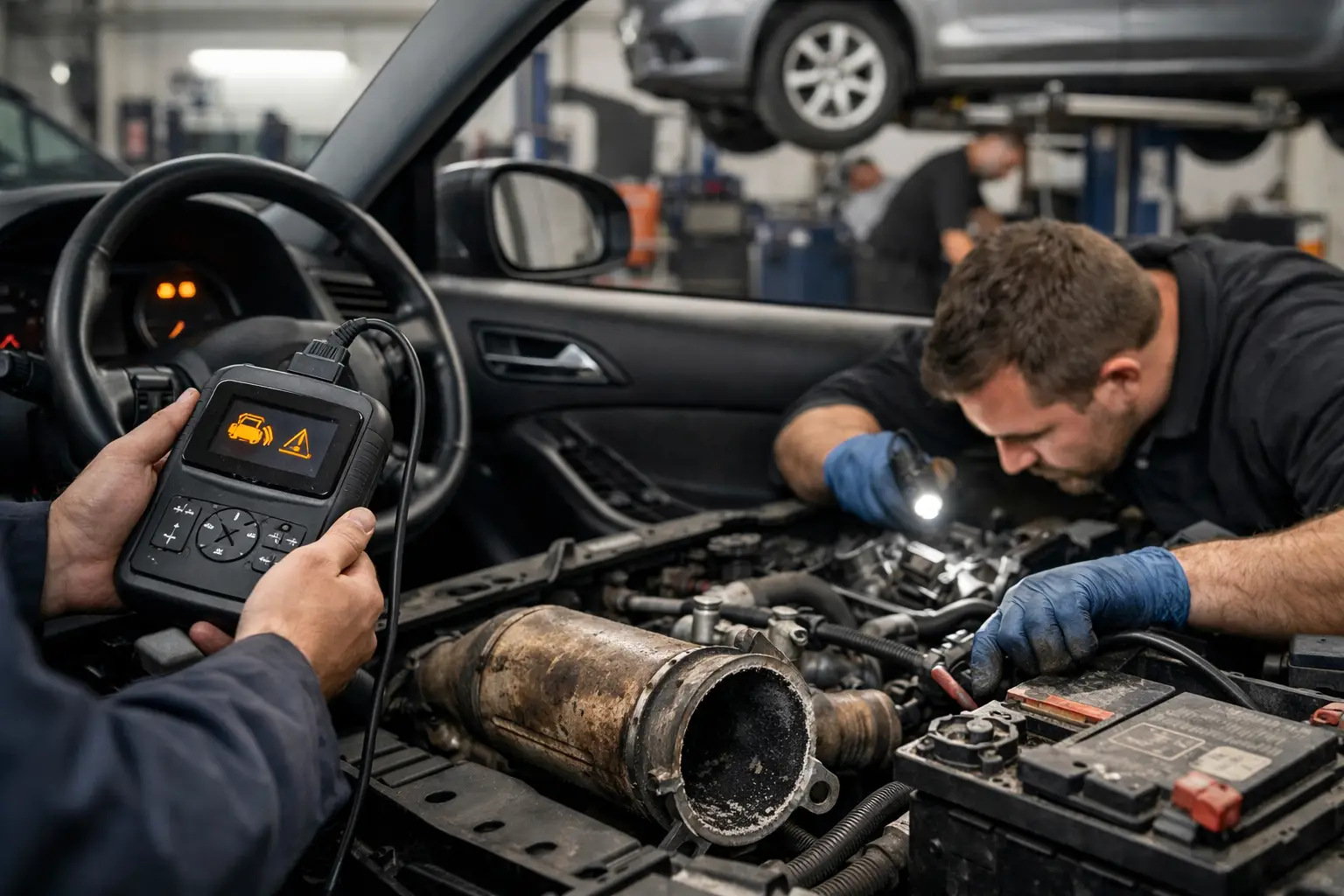
After that, the next step is diagnostic scanning. Fault codes give you a direction, but they do not always give you the final answer. For example, a code for low turbo boost does not automatically mean the turbocharger itself has failed. We often see this issue when a split hose, sticking actuator, vacuum leak or faulty sensor is the real cause.
That is why live data matters. Reading what the car is doing in real time helps confirm whether the reported fault matches what is actually happening.
Common causes we see in the workshop
Loss of power and limp mode can come from several systems. Some are engine-related, some are emissions-related, and some are electrical.
Turbo and boost faults
This is one of the most common causes. If the car is not making the boost pressure it expects, or it is making too much, the system may cut power. That could be down to a boost leak, faulty boost pressure sensor, sticking turbo vanes, a vacuum issue, or an actuator problem.
The reason this catches people out is simple. The car feels flat, so many assume the turbo is finished. Sometimes it is. Quite often it is not.
DPF blockage or failed regeneration
Modern diesel vehicles can go into limp mode if the DPF becomes heavily restricted. Short journeys, repeated interrupted regenerations, and underlying faults such as failed pressure sensors can all bring this on.
In most cases, a blocked DPF is not something to ignore and keep driving through. If the filter becomes too full, it can lead to more expensive repairs and may stop the car from regenerating at all.
EGR valve problems
A stuck or heavily carboned-up EGR valve can upset airflow and trigger reduced performance. This can feel like hesitation, poor throttle response, smoke, or rough running alongside limp mode.
Fuel system issues
Low fuel pressure, injector faults, a failing pump or even a badly restricted fuel filter can all cause the engine to limit power. This is especially common when the vehicle struggles more under load or at higher speeds.
Sensor and electrical faults
Sometimes the problem is not mechanical at all. A faulty mass airflow sensor, boost sensor, crank sensor, throttle position sensor or wiring issue can send incorrect readings to the ECU. The car reacts to the bad information by protecting itself.
This is why clearing codes without finding the reason they appeared is risky. The fault often comes straight back.
Why warning lights matter when diagnosing limp mode
If you are trying to work out how to diagnose limp mode, dashboard warnings give useful clues. An engine warning light, glow plug light on some diesels, DPF light, gearbox warning, or traction-related fault can all point towards the affected system.
Still, warning lights are only part of the picture. Two cars with the same light can have completely different faults behind it. One may need a sensor. Another may need a wiring repair. Another may have a blocked exhaust system. That is why proper testing saves guesswork.
Can you keep driving in limp mode?
Sometimes you can drive slowly and carefully to a garage. Sometimes you should not.
It depends on how severe the symptoms are. If the car has very limited power but is running smoothly and there are no signs of overheating, smoke, harsh noises or flashing warnings, a short trip for diagnostics may be reasonable. If the engine is rattling, smoking heavily, overheating, struggling to change gear, or repeatedly cutting out, it is better to stop and get advice.
Driving for too long in limp mode can make a smaller issue more expensive. A minor boost leak is one thing. Continuing to force a blocked DPF or an overboost fault is another.
What a proper garage will check
A decent diagnosis should not stop at plugging in a machine and reading a code. At AutoFix4u, the real work starts after the scan.
Fault codes and freeze-frame data
This shows what code was logged and under what conditions it happened. That can help narrow down whether the fault appears at start-up, under load, or at operating temperature.
Live data readings
This lets the technician compare expected readings against actual ones. Airflow, boost pressure, fuel pressure, exhaust pressure and temperature readings all help build the picture.
Physical checks
We often find obvious causes during inspection – split boost pipes, loose clips, damaged wiring, blocked filters, sticking components or signs of leaks. A code reader alone will not spot those.
System-specific testing
Depending on the fault, the next step may be smoke testing intake pipes, checking vacuum supply, testing sensors, assessing DPF saturation levels, or inspecting the EGR and turbo control system.
That is how you get from symptom to cause, then cause to repair plan.
What not to do
The biggest mistake is replacing parts based on guesswork. Limp mode can make everything feel like a major engine fault when the real issue is a sensor, hose, wiring fault or blocked filter.
The second mistake is assuming that because the car drives normally again after restarting it, the problem has gone away. In many cases, the reset is temporary. The fault is still there and will usually return under the same conditions.
The third mistake is ignoring a DPF or engine warning light because the car still starts and moves. That often ends in a bigger bill and more downtime.
When to book diagnostics
If the car has gone into limp mode once, it needs checking. If it has done it more than once, do not leave it.
The right time to book diagnostics is as soon as you notice repeated loss of power, warning lights, poor acceleration, failed regeneration, or a pattern where the car resets after being switched off. These are all signs the vehicle is storing faults and protecting itself for a reason.
For drivers around Lowestoft and nearby areas, fast diagnostics usually make the difference between a straightforward fix and a longer repair. In many cases, once the root cause is identified properly, the repair is much more manageable than people fear.
If your car has suddenly lost power and you need a clear answer, the next step is simple. Book a diagnostic check, get the fault explained in plain English, and fix the cause before it turns into something bigger. Same-day slots may be available.
A car that goes into limp mode is asking for attention, not guesswork. The sooner you get the right diagnosis, the sooner you get your normal car back.


5 thoughts on “How to Diagnose Limp Mode Properly”