Same Day Diagnostics Oulton Broad
When your car starts playing up on a work day, school run or trip across town, you usually need answers quickly, not a lecture. That is why same day diagnostics Oulton Broad matters. If a warning light has come on, the engine has lost power or the car just does not feel right, the first step is finding the fault properly before it turns into a bigger repair.
At a local garage, we see this all the time. A driver notices the engine warning light, ignores it for a few days, then the car drops into limp mode or refuses to start. In most cases, the problem was there early on, but without proper testing it is impossible to know whether it is a simple sensor fault, a DPF issue, an electrical problem or something more serious.
Why same day diagnostics in Oulton Broad helps
Most people who book diagnostics are not doing it out of curiosity. They need the car for work, family, shopping or getting the children where they need to be. Waiting several days just to find out what is wrong is frustrating, especially when the fault could be getting worse every time the car is driven.
Same-day diagnostic work helps in two ways. First, it gives you a proper answer quickly. Second, it can stop guesswork. Replacing parts without testing the fault first often costs more in the long run. We often see cars that have already had a battery, sensor or coil fitted elsewhere, only for the original problem to still be there.
A proper diagnostic check looks at the fault from the start. That means reading fault codes, checking live data, testing likely causes and matching the results to the symptoms you are actually seeing. Fault codes on their own do not tell the whole story. They point you in a direction, but the real job is working out why the fault has appeared.
The problems we often see
Warning lights that need proper checking
The most common reason people ask for same day diagnostics Oulton Broad is a warning light on the dashboard. It may be the engine warning light, ABS light, airbag light or a DPF warning. Some lights come on without any obvious change in how the car drives. Others show up alongside rough running, poor fuel economy or reduced power.
This usually happens because the car has detected something outside its normal range. That could be a failing sensor, low system pressure, an emissions issue or an electrical fault. Sometimes the fix is straightforward. Sometimes the warning light is only the symptom of a deeper problem. That is why scanning and clearing codes without checking the cause is rarely enough.
Loss of power and limp mode
If your car suddenly feels flat, struggles to accelerate or will not go beyond a certain speed, it may have gone into limp mode. We often see this issue when there is a turbo fault, boost leak, DPF blockage, EGR problem or fuel system issue.
Drivers sometimes assume the engine is finished, but that is not always the case. Some power loss faults are relatively contained if caught early. The trade-off is that continuing to drive with reduced power can turn a manageable problem into a more expensive one. If the car feels unsafe or barely responds, it is best to stop using it until it has been checked.
Starting faults and electrical problems
A car that clicks, turns over slowly or does nothing at all can have several different causes. It may be the battery, starter motor, alternator, wiring or an immobiliser issue. In colder weather, these faults often show up more clearly, but they can happen at any time.
This is where proper diagnostics saves time. Fitting a new battery might seem like the obvious answer, but if the charging system is faulty, the new battery will simply run flat again. We always look at the full picture before recommending a repair.
DPF and emissions issues
Around Lowestoft and the surrounding areas, many drivers do short journeys, which is one reason DPF faults are common. If the filter cannot complete a proper regeneration, soot builds up and eventually the car may bring on a warning light or lose power.
In most cases, a DPF problem is not just about the filter itself. There is usually a reason it has blocked. It could be driving style, but it could also be a sensor fault, glow plug issue, pressure reading problem or another engine fault stopping regeneration. Fixing the root cause matters just as much as clearing the blockage.
What happens during a same-day diagnostic appointment
A good diagnostic appointment should leave you with clear answers, not more confusion. The first thing we do is listen to the symptoms. That matters more than many people realise. Does the fault happen only when the engine is cold? Does it come and go? Did it start after fuel was added, a battery change or a long run? Those details can point us in the right direction straight away.
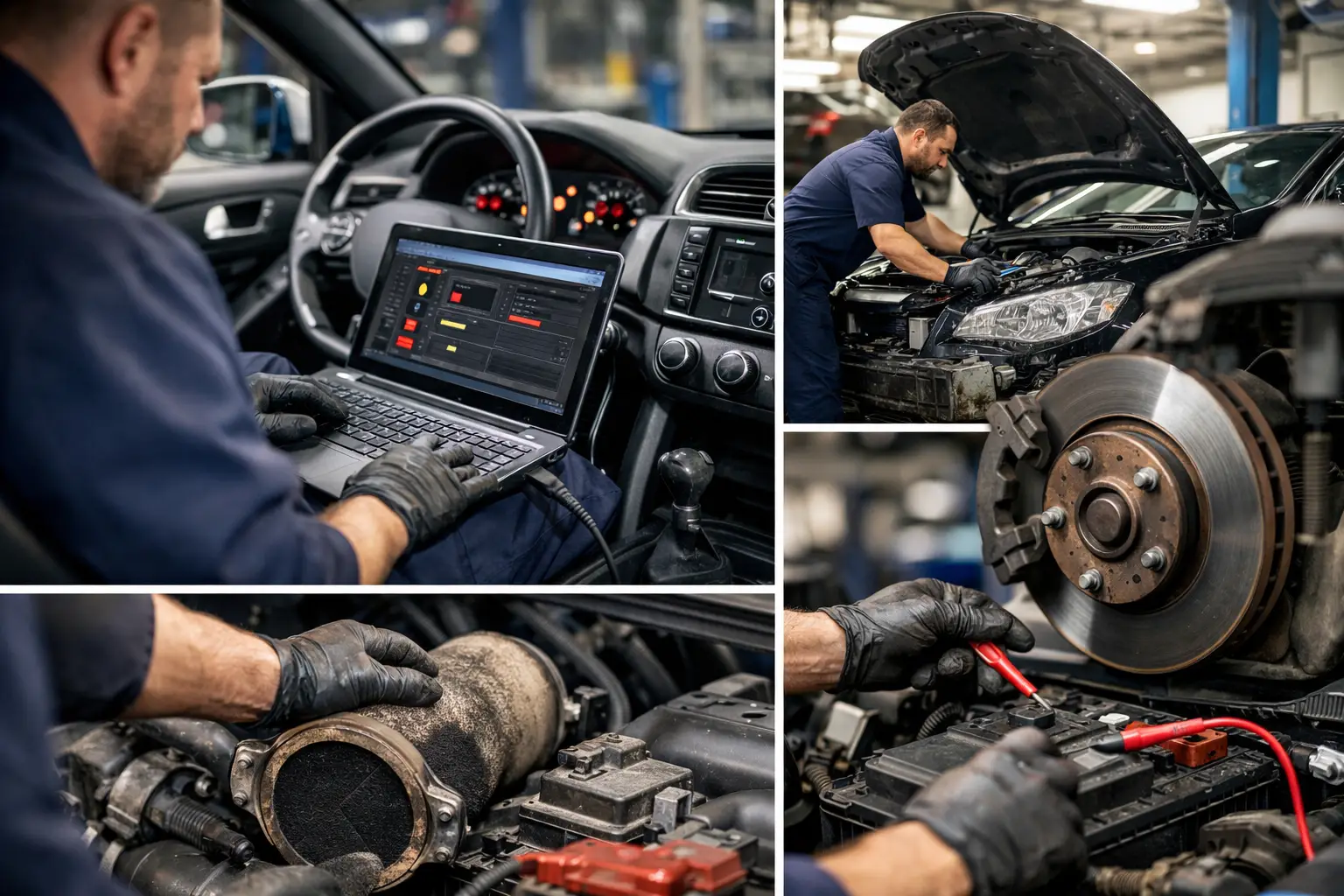
We then carry out the relevant checks on the vehicle systems involved. That may include fault code reading, live data analysis, battery and charging tests, sensor checks, visual inspection and road testing where appropriate. The goal is not just to find what part the system mentions, but to understand why the issue is happening.
After that, the next step is simple. You should be told what has been found, whether more testing is needed, what the likely repair involves and whether it can be done the same day. Some faults are quick to confirm and fix. Others take longer, especially if wiring faults or intermittent issues are involved. Honest diagnostics means saying that clearly rather than pretending every problem has an instant answer.
When same-day repair is possible
Many car faults can be repaired on the same day once the problem has been identified. That often applies to battery replacement, sensor faults, some brake issues, certain air conditioning faults and common electrical problems. If the parts are available and the issue is straightforward, getting you back on the road quickly is usually possible.
But it depends on the fault. A clutch issue, major DPF problem, gearbox fault or deeper engine issue may need more time. The key thing is knowing where you stand. Clear advice matters just as much as fast service. Most drivers can deal with bad news if it is explained properly. What they do not want is vague updates or surprise extras.
That is where a diagnostic-first approach helps. Instead of guessing, the garage identifies the problem, explains it in plain English and gives you a repair plan based on what the car actually needs.
Choosing a local garage for diagnostics
If you are looking for diagnostics around Oulton Broad, local knowledge does make a difference. A nearby independent garage sees the same types of daily-use vehicle problems again and again – short-trip DPF issues, MOT-related faults, battery trouble, warning lights and power loss on cars that people depend on every day.
That kind of experience helps speed up the process. It also means the advice tends to be more practical. You want to know whether the car is safe to drive, whether the repair is urgent and what happens next. You do not need a long technical breakdown filled with jargon.
A good local garage should be straightforward from the start. Clear communication, proper fault-finding and transparent pricing all matter. So does accountability. When you deal with a family-run local workshop, you are speaking to people who know the area, know their customers and know that trust is built on getting the job right.
When to book diagnostics straight away
Some faults can wait a day or two. Others should be checked as soon as possible. If your engine warning light is flashing, the car is misfiring, the brakes feel wrong, the engine is overheating or the vehicle has gone into limp mode, it is best not to keep driving and hope it clears itself.
Even if the car still runs, unusual noises, poor starting, heavy smoke, rough idling or sudden loss of power are all signs that something needs attention. In most cases, early diagnosis keeps the repair smaller than it would be if left too long.
For drivers in and around Oulton Broad, that usually means booking in as soon as the symptoms start rather than waiting for a breakdown. AutoFix4u handles real-world faults every day, from warning lights and DPF trouble to battery, brake and engine performance issues, with a clear focus on same-day answers where possible.
If your car is not driving as it should, get it checked properly. A quick, honest diagnosis now is often the difference between a simple repair and a much bigger problem next week.

