
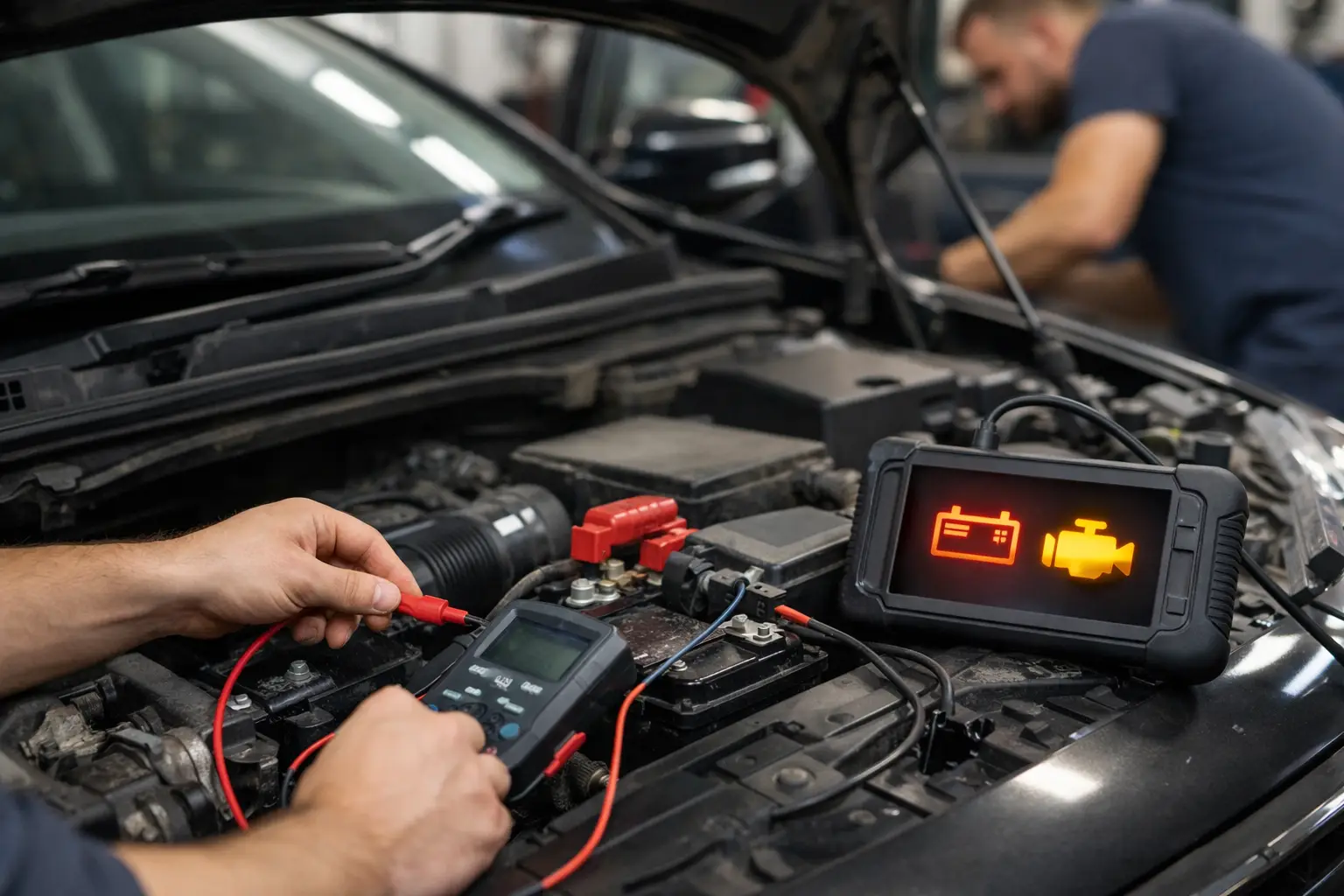
How to Diagnose Car Battery Drain at Home
A car that starts perfectly one day and has a flat battery the next is more than an inconvenience. It can leave you late for work, unable to do the school run, or stuck outside the supermarket. Knowing how to diagnose car battery drain helps you separate a worn-out battery from an electrical fault that needs proper attention.
In most cases, the problem comes down to one of three things: the battery is no longer holding its charge, the alternator is not charging it properly while you drive, or something is using power after the ignition is switched off. The symptoms can look similar, but the repair is very different.
Start by confirming it really is battery drain
A slow or non-starting car is not always caused by a drain. If the engine turns over slowly, you hear repeated clicking, or the dashboard lights fade when you try to start it, the battery is likely low. If the engine cranks normally but will not fire up, the issue could be fuel, ignition, immobiliser or another engine fault instead.
Think about when the problem happens. A battery that goes flat after the car has been parked overnight or for a couple of days may have a drain. One that struggles every morning, even after a decent journey, may be old or undercharged. If it only happens after short trips in cold weather, the charging system may be fine but the battery may not be getting enough time to recover.
We often see this issue when a driver has had several jump starts and assumes the battery is the only fault. A jump start gets you moving. It does not tell you why the battery went flat in the first place.
Check the simple causes first
Before testing anything electrical, look for the obvious. Check that interior lights, map lights and vanity mirror lights are switching off. Open and close each door, then look through the window after a minute or two. A faulty door switch can leave a cabin light on without being noticed.
Check the boot as well. A boot light that stays on because the latch switch has failed is a common cause of an overnight flat battery. The same applies to glovebox lights. You may not see them unless you deliberately check.
Aftermarket accessories are another regular cause. Dash cameras, mobile phone chargers, sat-nav leads, Bluetooth adapters and added alarms can all draw power when wired incorrectly. A dash cam designed to run in parking mode needs a proper hardwire kit with low-voltage protection. Plugging it into a permanently live socket can drain an older battery surprisingly quickly.
Also inspect the battery terminals. They should be tight, clean and free from heavy white or blue-green corrosion. Loose connections can stop the battery charging properly and can create starting problems that feel like battery drain. Do not tighten or remove terminals with the engine running.
Check the battery condition and charging system
A healthy battery needs more than enough charge on the day it is tested. It must also hold that charge under load. Batteries wear out over time, especially if the car mainly does short journeys, sits unused, or has been repeatedly run flat.
If you have a multimeter and know how to use it safely, test the battery after the car has been switched off for a few hours. Around 12.6 volts usually suggests a fully charged battery. Around 12.2 volts is partly discharged, while 12 volts or below means it needs charging and testing. These figures are a guide, not a final diagnosis.
With the engine running, many vehicles will show roughly 13.8 to 14.7 volts at the battery terminals. That generally indicates the alternator is charging. However, modern smart charging systems can vary their voltage depending on temperature, battery condition and electrical demand, so one reading does not prove everything is working correctly.
A battery can show a sensible voltage and still fail when asked to start the engine. That is why a proper battery and charging test is more useful than replacing parts on guesswork. It checks the battery’s starting ability, its condition and whether the alternator can keep up with demand.
How to diagnose car battery drain with a parasitic draw test
A parasitic draw is the small amount of electrical power a car uses while parked. The clock, alarm, central locking memory and control units all need a little power. That is normal. The problem starts when the draw is too high or a module does not switch off when it should.
A proper drain test needs patience. Modern cars do not go to sleep as soon as you turn the key off. Locking the car, opening a door, or moving the key nearby can wake up control units and give a false reading. Depending on the vehicle, it can take 20 to 45 minutes for systems to shut down fully.
A technician measures the current being drawn from the battery once the vehicle is asleep. If the reading is too high, they then narrow it down by checking circuits and fuses methodically. Removing a fuse that causes the current to drop points towards the circuit causing the issue. From there, the fault might be a light, stereo, body control module, wiring fault or accessory.
It is possible to attempt this with a multimeter, but it is easy to blow the multimeter fuse or damage a reading if it is connected incorrectly. Opening a door at the wrong point can also wake the car and confuse the test. For most drivers, the sensible approach is to carry out the simple checks at home, then book diagnostics if the fault continues.
Common causes of a battery going flat overnight
There is no single answer because cars have different electrical systems, but several faults come up regularly in the workshop:
- A boot, glovebox or interior light staying on because of a faulty switch or latch.
- An aftermarket dash cam, audio system, tracker or alarm drawing power while parked.
- A control module that does not enter sleep mode after the car is locked.
- An alternator with a faulty diode, allowing current to drain back when the engine is off.
- Damaged wiring, water ingress or corrosion creating an unwanted electrical path.
- A tired battery that cannot hold charge, particularly after cold nights or repeated jump starts.
An alternator diode fault is worth mentioning because it can be missed. The alternator may appear to charge while the engine runs, but it can still drain the battery when the car is parked. This usually needs testing rather than visual inspection.
Do not ignore repeated flat batteries
Repeatedly jump starting a car puts extra strain on the battery and can mask the actual fault. If the alternator is weak, you may get only a short distance before the car loses electrical power again. Warning lights, dim headlights, slow wipers and unusual messages on the dashboard can all point to low system voltage.
Avoid the old advice of disconnecting the battery while the engine is running to test the alternator. On modern vehicles, this can cause voltage spikes and damage sensitive electrical components. It is not a reliable test and it can turn a straightforward charging fault into a more expensive electrical problem.
If the battery is swollen, leaking, badly corroded or gives off a strong sulphur smell, do not keep charging or jump starting it. Arrange for it to be checked and replaced safely.
When to book a battery drain diagnostic
Book a proper test if the battery goes flat more than once, particularly after being charged or replaced. You should also get it checked if you have no obvious lights left on, the car needs regular jump starts, or electrical faults appear alongside the starting issue.
At AutoFix4u, we test the battery, charging system and parked electrical draw to find the root cause rather than simply fitting a battery and hoping for the best. For drivers in Lowestoft and nearby areas, this means clear fault findings, honest recommendations and a repair plan before work goes ahead.
A flat battery is often fixable quickly, but the right fix depends on what is actually draining it. If your car is repeatedly letting you down, arrange diagnostics before the next no-start leaves you stranded.