Car Wont Start Diagnosis: What to Check
You turn the key or press the start button, and nothing happens. Or it cranks but will not fire. That is where a proper diagnosis for a car that won’t start matters. Guessing usually wastes time and money. In most cases, the fault is something straightforward, but you need to identify the real cause before replacing parts.
We see this problem regularly with daily drivers that need to get to work, do the school run or manage family travel. Sometimes it is just a flat battery. Sometimes it is a starter motor, a fuel supply issue, an immobiliser problem or an electrical fault that has been building for a while. The symptoms matter, because they tell you where to look first.
Car won’t start diagnosis starts with the symptom
The first question is simple. What does the car actually do when you try to start it? That makes a big difference.
If there is no crank at all, the engine does not turn over, and you may hear a single click or complete silence. This usually points to the battery, battery connections, starter motor, starter wiring or immobiliser system.
If the engine cranks but will not start, the starter is doing its job, but the engine is not getting what it needs to run. That could mean fuel, spark, air, compression or a sensor fault stopping the ECU from allowing it to fire properly.
If it starts and then cuts out straight away, we often see issues with immobilisers, key recognition, crankshaft sensors, fuel pressure or severe air intake problems.
That is why a proper diagnosis always starts with the exact behaviour, not with assumptions.
The most common causes of a non-start
A weak or flat battery is still one of the most common causes. Short journeys, cold weather, a battery nearing the end of its life or an alternator not charging properly can all leave you stranded. Even if the dashboard lights come on, that does not mean the battery is strong enough to crank the engine.
Battery terminal issues are also common. If the terminals are loose, corroded or dirty, the car may have power for lights but not enough for starting. This usually happens because the connection cannot handle the higher load needed by the starter motor.
Starter motor faults are another regular one. You may hear a click, repeated clicking, or nothing at all. In most cases, the battery gets blamed first, but if the battery and connections test fine, the starter needs checking properly.
Fuel problems can stop the engine from firing. That might be low fuel pressure, a failed fuel pump, a blocked fuel filter or an electrical issue affecting the pump circuit. On diesel cars, air in the fuel system or glow plug related issues can also play a part, especially in colder conditions.
Ignition faults matter too. Petrol engines rely on spark plugs and ignition coils to start. If those are failing, the engine may crank strongly but never catch. Sometimes it will try to fire unevenly. Sometimes it will not fire at all.
Then there are sensor and ECU issues. A failed crankshaft position sensor is a good example. The engine may crank, but without the right signal, the ECU does not know when to inject fuel or trigger spark. To the driver, it just feels like the car suddenly refuses to start.
What you can check safely before calling a garage
There are a few basic checks that can save time. If the car has been slow to crank recently, check whether the battery is the obvious problem. Dim lights, slow turning and repeated clicking all point in that direction.
Look at the battery terminals if you can access them safely. If they are heavily corroded or clearly loose, that may be the issue. Do not start taking things apart if you are unsure. Modern vehicles can be sensitive, and getting it wrong can create a bigger electrical problem.
Check the fuel level as well. It sounds obvious, but faulty fuel gauges are not rare, and a car parked on a slope can sometimes catch drivers out when fuel is very low.
If you have a spare key, try it. We often see this issue when the key transponder or immobiliser recognition is at fault. The car may crank and stop, or not respond properly at all.
Also pay attention to warning lights or dashboard messages. An engine warning light, immobiliser symbol or battery light can help narrow things down. Even so, they do not always tell the full story. Fault codes need reading in context, not just cleared and ignored.
When jump starting helps and when it does not
A jump start can be useful if the battery is simply too weak to start the car. If the vehicle starts normally once connected, that suggests a battery or charging issue rather than a starter or fuel fault.
But a jump start is not a cure. If the battery is failing, the car may stop again later. If the alternator is not charging properly, the battery will run flat again even if the car starts today. And if the engine cranks strongly but still will not fire, adding more battery power is unlikely to solve it.
That is why we always look beyond the immediate restart. The real question is why it failed in the first place.
Why modern cars need proper diagnostics
Older vehicles were often simpler to narrow down. Modern cars are different. Starting problems can involve the battery monitoring system, key coding, immobiliser, fuel pressure sensors, crank and cam sensors, fuse boxes, relays and ECU communication.
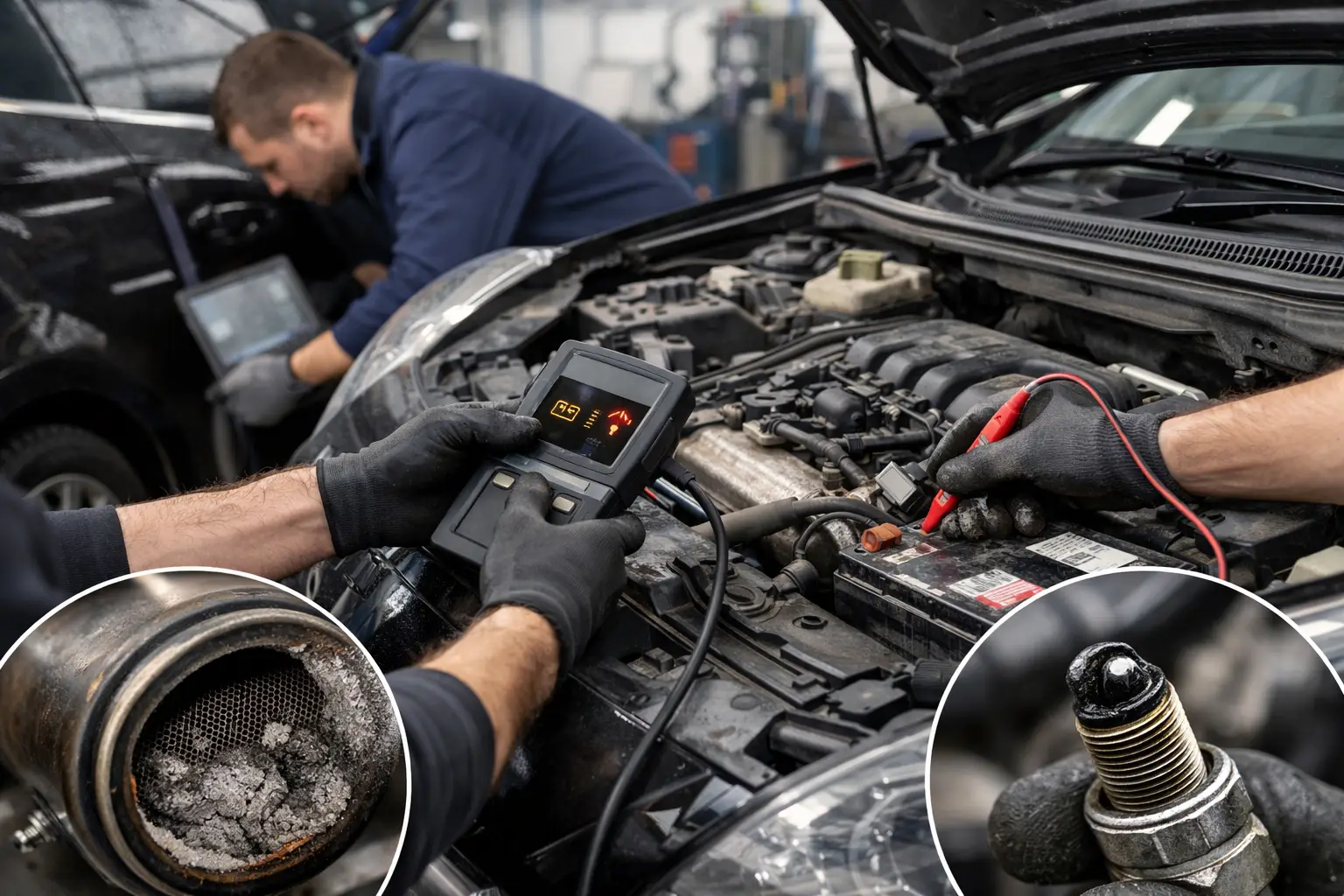
A scan tool helps, but fault codes alone are not enough. We often see cars where parts have already been changed because of an online guess or a code reading from elsewhere, yet the original fault is still there. A proper diagnosis means testing the battery, charging system, live data, power supply, earth connections and component operation in the right order.
That is how you avoid changing a battery when the real issue is the alternator, or replacing a starter motor when the actual fault is a poor earth or corroded cable.
Car won’t start diagnosis at the garage
When a non-start comes into the workshop, the first step is to confirm the exact symptom. No crank, slow crank, crank no start, or start and stall. From there, the checks are more focused.
Battery condition and voltage are tested first, along with charging performance if the car can be started. Connections, fuses and main power feeds are checked because many starting faults are caused by poor electrical supply rather than a failed major part.
If the engine cranks but does not start, the next job is to see what is missing. Fuel pressure, spark, injector pulse and sensor signals all need checking. On diesel vehicles, glow system faults, fuel delivery and air leaks in the system may need investigating. On some cars, DPF and engine management issues can also contribute if the engine has been struggling beforehand.
The point is to work through the fault logically. Problem, cause, solution. That is faster than guesswork and usually cheaper in the long run.
When not to keep trying
If the car will not start after a few attempts, stop there. Repeated cranking can flatten the battery, flood a petrol engine, overheat the starter motor or put extra strain on an existing fault.
If there is a burning smell, smoke, rapid clicking, flickering dash or obvious wiring damage, do not keep trying at all. The same applies if the vehicle cut out while driving and now refuses to restart. That needs proper inspection before any more attempts.
The next step if your car will not start
If your car has suddenly stopped starting, the best move is to get it checked properly rather than guessing. A quick battery test may confirm a simple fix. If not, a full diagnostic approach will pinpoint whether the issue is electrical, fuel related, sensor related or mechanical.
For drivers around Lowestoft and nearby areas, that usually means less downtime and fewer wasted costs on parts the car did not need. Same-day slots may be available depending on the fault and recovery situation. Call now, explain what the car is doing, and get a clear plan with transparent pricing and no surprise extras.
A non-start is frustrating, but most faults become much easier to deal with once the right checks are done from the start.


2 thoughts on “Car Wont Start Diagnosis: What to Check”