Can I Drive With ABS Light On?
You start the car, glance at the dash, and there it is – the ABS warning light. The first question most drivers ask is simple: can I drive with ABS light on? In most cases, yes, the car will still drive and the brakes will still work. But that does not mean it is safe to ignore, especially if you rely on the car every day or the roads are wet, loose, or busy.
The short version is this. If only the ABS light is on, the car will usually still have normal braking, but the anti-lock braking system may not step in during hard braking. That means under emergency braking, the wheels can lock more easily and you may lose some steering control. So the car may still be drivable, but it is not something to leave for weeks.
Can I drive with ABS light on safely?
It depends on what else is happening with the car. We often see vehicles come in with the ABS light on and no obvious change in day-to-day braking. Around town, at lower speeds, many drivers do not notice much difference at all. The problem shows up when you need the system most – sudden braking, slippery roads, standing water, gravel, or a sharp stop in traffic.
If the brake pedal feels normal, the car stops properly, and no other warning lights are on, you can usually drive it carefully for a short trip to a garage. Keep your speed down, leave extra stopping distance, and avoid harsh braking where possible.
If the red brake warning light is also on, or the pedal feels soft, spongy, very hard, or the car is pulling under braking, stop using it until it is checked. That points to more than just an ABS fault. At that stage, it is a braking system issue, not just a warning light issue.
What the ABS light actually means
ABS stands for anti-lock braking system. Its job is to stop the wheels locking up under heavy braking. If a wheel locks, the tyre can skid across the road surface instead of gripping it. That makes it harder to steer and can increase stopping distance in some conditions.
When the ABS light comes on, the system has detected a fault and usually switches itself off. This is a safety design. The car falls back to standard braking instead of trying to run a system with bad information.
That is why many drivers say, “The brakes still seem fine.” They often are, right up until the point where ABS would normally help.
Common reasons the ABS light comes on
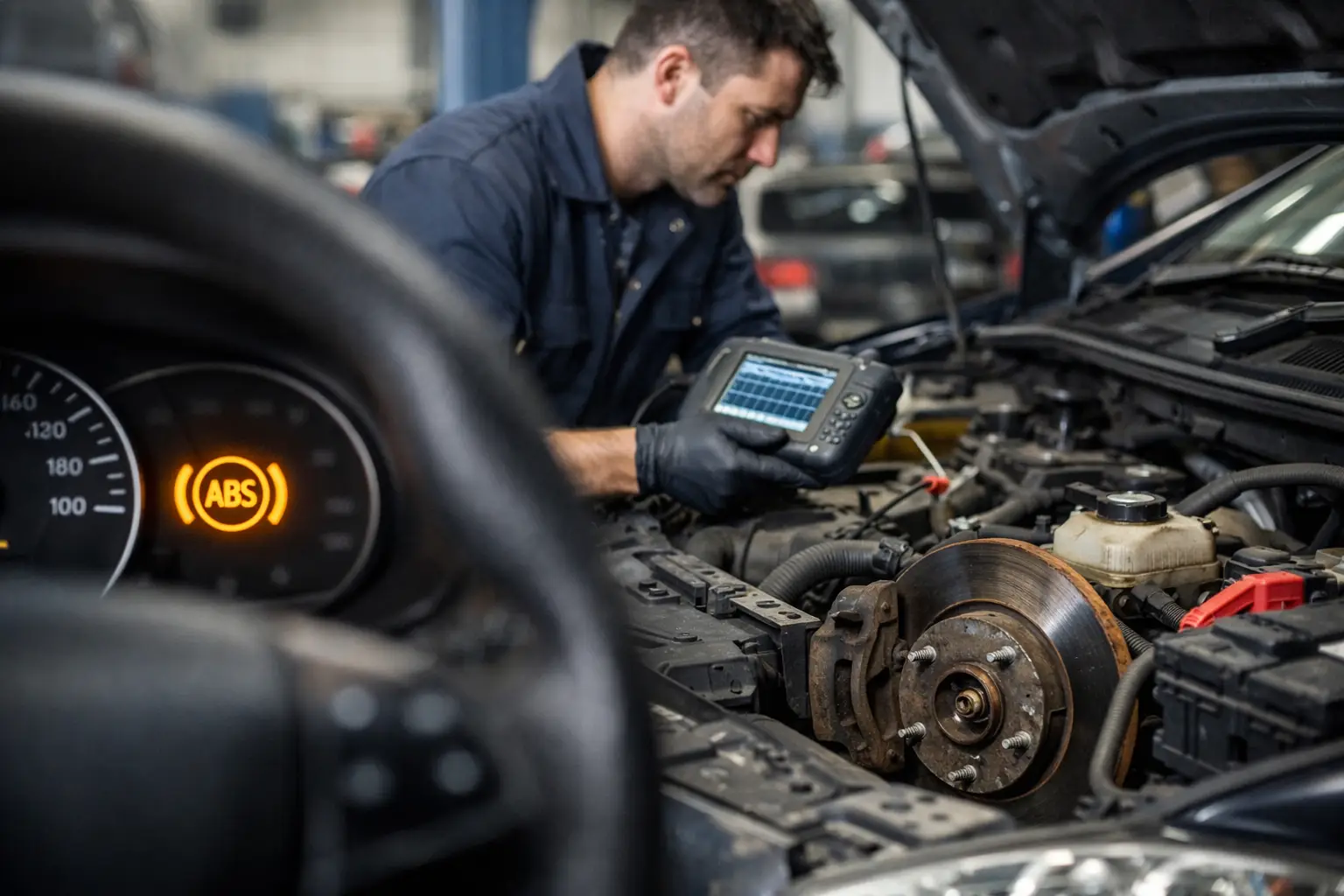
In a working garage, we see a few causes come up again and again. One of the most common is a failed wheel speed sensor. Each wheel has a sensor that tells the car how fast that wheel is turning. If one sensor gives a weak signal, drops out, or gets covered in dirt or rust debris, the ABS module can flag a fault.
A damaged reluctor ring is another common cause. That is the toothed ring the sensor reads from. If it cracks or corrodes, the reading becomes unreliable.
Wiring faults also cause plenty of ABS problems. Cables near the wheels live in a harsh area – road salt, water, potholes, and general wear all take their toll. Sometimes the issue is as simple as a broken wire or poor connection.
Less often, the fault sits in the ABS pump or control module itself. That tends to be a bigger repair, but proper diagnostics matter here. Guessing and changing parts usually costs more in the end.
Low battery voltage can also trigger warning lights on modern cars. We sometimes see ABS faults appear alongside other electrical issues after a weak battery, failed alternator, or jump start problem.
When you should not keep driving
This is where the detail matters. The answer to can I drive with ABS light on changes if other symptoms are present.
Do not keep driving if the red brake warning light is on with it. Do not keep driving if the pedal suddenly feels wrong, the car takes longer to stop, there is grinding from the brakes, or the steering feels unstable when braking. The same applies if the ABS light comes on with traction control or stability control faults and the car feels unsettled on the road.
You also need to think about conditions. A short careful trip on a dry day is one thing. A motorway run in heavy rain, school traffic, or a rural road with loose surfaces is another. The car may be technically drivable, but that does not always make it a sensible risk.
Can I drive with ABS light on and still pass an MOT?
Usually not. In most cases, if the ABS warning light is on and indicates a fault in a system fitted as standard, it can lead to an MOT failure. Drivers are often caught out by this because the car still feels fine on the road.
We often see this issue when someone books an MOT and assumes a dashboard light is only a minor electrical fault. It is better to deal with it before the test rather than risk a failure and the extra hassle that comes with it.
What it feels like when ABS is not working
Most of the time, during normal driving, it feels like nothing has changed. That is why it gets ignored.
The difference comes in a sudden stop. In a car with working ABS, the system rapidly pulses brake pressure to stop the wheels locking. Without it, one or more wheels can skid. You may feel the car slide more than expected, and steering control can reduce because a skidding tyre does not grip the road properly.
On dry roads, the change may be manageable if you stay calm and brake progressively. On wet roads, painted junction markings, mud, or loose surfaces, the risk goes up quickly.
What to do next
The sensible next step is a proper diagnostic check. Not just clearing the light and hoping it stays off, and not fitting parts one by one until the warning disappears.
A good diagnostic process should identify which wheel or circuit is causing the fault, whether the signal is missing or implausible, and whether the issue is sensor related, wiring related, or module related. From there, you can get a clear repair plan instead of a guess.
At AutoFix4u, this is exactly the sort of fault we deal with regularly. Warning lights are easy to shrug off when the car still moves, but they nearly always become more inconvenient at the wrong time – before work, before an MOT, or when the weather turns.
Is it an expensive fix?
Sometimes yes, often no. A wheel speed sensor or wiring repair is usually far more straightforward than drivers expect. If the fault turns out to be the ABS pump or control unit, the repair can be more involved. That is why diagnosis comes first.
This usually happens because dashboard lights all get lumped together as “something electrical”. In reality, some ABS faults are relatively simple. Others need more time to trace properly. The key thing is finding the root cause before money is spent.
A practical rule to follow
If only the ABS light is on, the brakes feel normal, and you are making a short journey, you can usually drive carefully to get it checked. Leave more space, avoid sudden stops, and do not treat it like a problem that can wait indefinitely.
If the brake warning light is also on, the pedal feels unusual, or the car does not feel safe, stop driving it and arrange help. That is the difference between a reduced safety feature and a possible braking fault.
Most warning lights do not come on for no reason. The ABS light is one of the ones worth taking seriously, not because the car will instantly stop on the spot, but because the safety margin is reduced when you need it most.
If your ABS light has come on and you are not sure whether it is safe to keep using the car, get it checked sooner rather than later. A quick diagnosis now is usually easier than dealing with a failed MOT or a brake scare later. If you are in Lowestoft or nearby and need a clear answer fast, call now or book a diagnostic check – same-day slots may be available.


3 thoughts on “Can I Drive With ABS Light On?”