Same Day Warning Light Check Near You
A warning light rarely comes on at a convenient time. It usually happens when you are heading to work, doing the school run, or about to make a trip you cannot easily cancel. If you need a same day warning light check, the main thing is not to guess. Some lights mean you can drive carefully for a short distance. Others mean stop the car and get it checked before more damage is done.
In most cases, the light itself is only the starting point. The real issue could be a sensor fault, a battery problem, a blocked DPF, a misfire, low oil pressure, a braking fault, or something electrical. The job is to find the actual cause properly, explain it clearly, and work out whether it needs fixing straight away.
What a same day warning light check actually tells you
A dashboard light is your car’s way of saying something is outside normal limits. That does not always mean a major repair, but it does mean the system has picked up a fault. We often see this issue when drivers have already searched online, read five different answers, and still do not know if the car is safe to use.
A proper warning light check is more than plugging in a code reader and reading out a number. Fault codes point you in a direction, but they do not always tell the full story. For example, an engine warning light may show a fault linked to emissions, but the root cause could be a failing sensor, an air leak, injector trouble, or a DPF issue causing back pressure.
That is why a diagnostic-first approach matters. First identify the fault, then confirm the cause, then decide what repair is actually needed. It saves time, avoids changing parts that were not the problem, and gives you a clear answer instead of guesswork.
Which warning lights need urgent attention
Not all warning lights carry the same level of risk. Some can wait a short time if the car is driving normally. Some should be treated as urgent.
A red warning light usually means stop as soon as it is safe. Oil pressure, coolant temperature, brake system warnings, or charging system faults can quickly lead to breakdown or engine damage if ignored. If the vehicle feels wrong as well – poor braking, overheating, rough running, loss of power – do not keep pushing on.
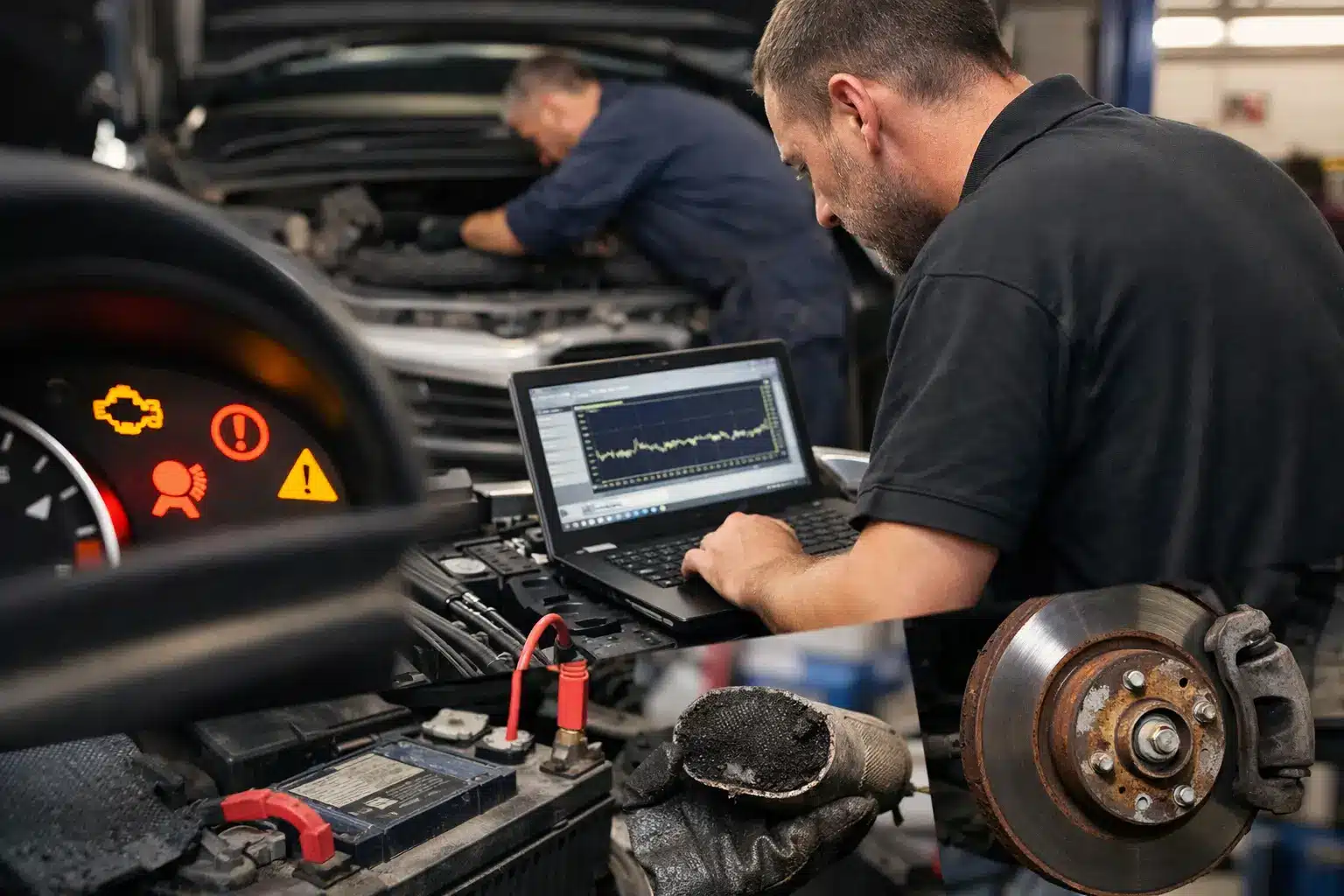
Amber lights are often less immediate, but they still need checking. Engine warning lights, DPF lights, ABS warnings, airbag lights, and traction control faults can affect performance, fuel use, emissions, or safety systems. The car may still move, but that does not mean the issue is minor.
If the light is flashing rather than steady, that usually points to a more active problem. A flashing engine warning light, for example, often means a misfire severe enough to risk damaging the catalytic converter. That is something we would advise getting looked at without delay.
Common reasons drivers book a same day warning light check
Most people do not book diagnostics just because a light appeared. They book because something changed. The car feels different, sounds different, or starts behaving unpredictably.
We often see warning lights alongside loss of power, limp mode, difficult starting, poor fuel economy, rough idling, or a message on the dash telling the driver to check emissions or service the vehicle. On diesel cars, DPF and glow plug warnings often come with regeneration problems or repeated short journeys. On petrol cars, engine warning lights are commonly linked to ignition faults, sensors, or air and fuel mixture issues.
Sometimes the fault is simple. A battery that is getting weak can trigger multiple warning lights at once. We also see wheel speed sensor faults bring on ABS and traction control warnings. Other times, the issue is more involved and needs testing rather than assumptions.
That is why speed matters, but so does accuracy. A fast booking is useful. A rushed answer that misses the real fault is not.
How a proper same day warning light check works
When a car comes in with a dashboard warning, the first step is to understand the symptoms. Is the vehicle driving normally? Has the light come on before? Did it happen after a jump start, motorway run, heavy rain, or failed start? Those details often help narrow things down.
From there, diagnostics can be carried out to read stored fault codes and live data from the affected systems. That might include engine management, ABS, airbag, battery charging, DPF values, or other control modules depending on the warning shown. If needed, further checks are done on wiring, sensors, battery health, charging output, fluid levels, or mechanical components.
This usually happens because the code alone is not enough. A fault may say there is a low boost issue, but the real cause could be a split hose, stuck actuator, leaking pipework, or DPF restriction. A good diagnostic process separates the symptom from the cause.
Once the fault is confirmed, the next step should be simple. You should know what is wrong, whether the car is safe to use, and what needs doing next. Clear pricing and honest recommendations matter here. Some problems can be repaired the same day. Others may need parts ordered first. Either way, you should not be left guessing.
Why ignoring warning lights often costs more
A lot of drivers hope the light will go off on its own. Sometimes it does, but that does not always mean the issue has gone away. Intermittent faults are common, especially with sensors, wiring, and emissions systems. The warning may disappear for a few days, then come back worse.
The bigger risk is secondary damage. A small misfire can become a catalytic converter problem. A DPF warning can turn into a blocked filter and limp mode. A charging fault can leave you stranded with a flat battery. Brake and ABS faults can affect stopping performance, especially in poor weather.
That does not mean every warning light leads to a major bill. It means early diagnosis gives you more control. You can catch smaller faults before they become breakdowns, MOT failures, or larger repairs.
Local drivers usually want the same three things
When someone calls about a warning light, they are normally asking three questions. Is the car safe? What is causing it? Can it be sorted quickly?
Those are the right questions. Most drivers in and around Lowestoft are not looking for a technical lecture. They need the car for daily life. They want plain English, a realistic timescale, and no surprise extras.
That is why a local garage can make a difference. You are speaking to the people actually working on the vehicle, not a call centre or booking system that cannot tell you much. If same-day testing is possible, that saves you waiting around and worrying whether the problem is getting worse.
When you should stop driving straight away
There are times when booking in is not the first step. If the car is overheating, the oil warning light is on, the brakes feel weak, the engine is knocking, or there is heavy smoke, stop driving and get advice before carrying on. The same applies if the car has gone into limp mode and will barely accelerate, or if multiple warning lights appear after a serious running fault.
In those cases, trying to make it home or complete the journey can turn a manageable repair into a much bigger one. Recovery or transport help is often the safer option.
If the light is amber and the car feels normal, it may be safe to drive a short distance for checks, but it depends on the fault. That is why it helps to describe exactly what the vehicle is doing when you call.
What to do next if a warning light comes on
Do not clear the fault and hope for the best. Do not keep driving for days just because the car still starts. And do not assume a quick code scan from a handheld tool gives the full answer.
Get the vehicle checked properly, especially if the warning is new, the car is running differently, or you rely on it every day. In many cases, acting early means a simpler repair, less downtime, and a clearer plan.
If you are in Lowestoft or nearby and need a same day warning light check, call now and explain what light is showing and how the car is behaving. Same-day slots may be available, and you will get a straight answer on the next step. A warning light is much easier to deal with when it is checked before it becomes a breakdown.


2 thoughts on “Same Day Warning Light Check Near You”