Your engine warning light comes on during the school run, so you plug in a small code reader and see a number on the screen. That can feel like an answer, but garage diagnostics versus code reader is often the difference between finding a clue and finding the actual fault. A code reader can point you in the right direction. Proper diagnostics explain why the warning appeared, whether it is safe to drive, and what needs repairing.
For most drivers, the main question is simple: do you need to book the car in, or can you deal with it yourself? It depends on the warning light, how the car is running, and what the code says. Here is how we look at it in a working garage.
What a code reader can tell you
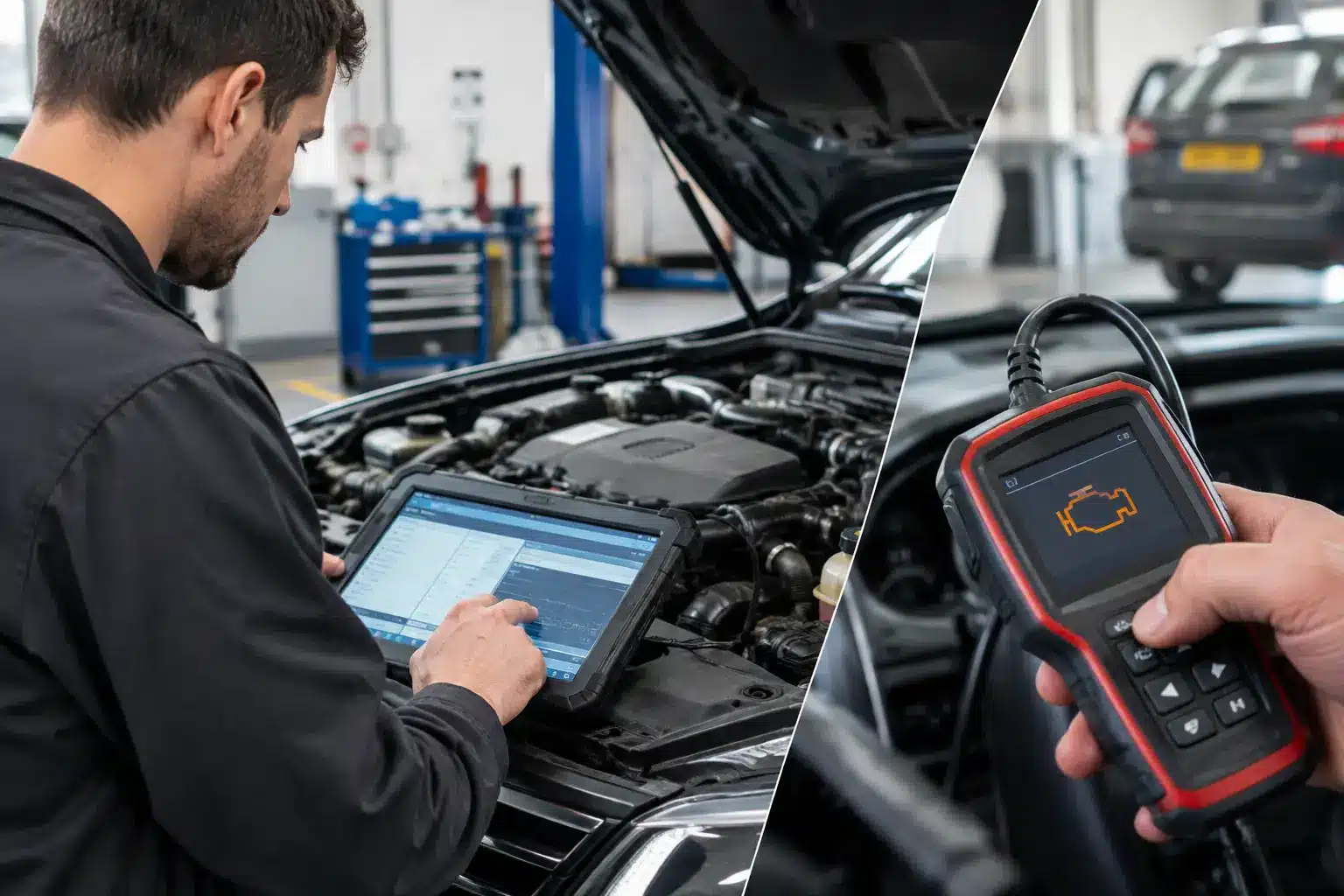
A basic code reader plugs into the car’s diagnostic socket, usually under the dashboard. It reads stored fault codes from the engine control unit. These codes can relate to emissions, sensors, misfires, fuel pressure, DPF problems and many other systems.
That information is useful. If the code says there is an issue with an oxygen sensor circuit, for example, you know the engine management system has detected something outside its normal range. Some readers can also clear the engine warning light after the code has been read.
The problem is that the code does not always name the failed part. It reports what the control unit has noticed. An oxygen sensor code might be caused by the sensor itself, but it could also be caused by damaged wiring, an air leak, poor fuel mixture, an exhaust leak, or a fault elsewhere that is affecting the readings.
We often see customers replace a part based on a code, only for the light to return a few days later. The car has then had money spent on a guess rather than a confirmed repair.
Clearing a code is not the same as fixing it
Clearing a fault code switches the warning light off temporarily. It does not repair the cause. If the fault is still present, the control unit normally sees it again once the car has been driven through its checks.
This can cause extra problems before an MOT. If the warning light comes back or the system has not completed its self-checks after the codes were cleared, the vehicle may still fail. More importantly, clearing the code can remove useful evidence that helps a technician trace an intermittent fault.
What garage diagnostics involve
Proper diagnostics start with the fault code, but they do not stop there. A garage diagnostic tool can access more vehicle systems and show live data while the engine is running. That allows a technician to compare what the car is reporting with what it should be doing.
For example, if a car has gone into limp mode with a loss of power, a code reader may show a turbo boost fault. The cause could be a split hose, a sticking actuator, a vacuum issue, a sensor giving incorrect readings, or a problem with the turbo itself. Fitting a turbo without checking the rest would be an expensive mistake.
A proper inspection may include checking wiring and connectors, battery voltage, charging voltage, vacuum lines, fluid levels, leaks, mechanical condition and live readings from relevant sensors. Depending on the problem, it may also involve a road test or checks with specialist equipment.
The aim is not to make the job sound complicated. It is to avoid charging you for parts that do not solve the problem. At AutoFix4u, the approach is straightforward: identify the fault properly, explain it in plain English, then provide a clear repair plan before work goes ahead.
Garage diagnostics versus code reader: the real difference
Think of a code reader as a first message from the car. It says, “Something is wrong in this area.” Garage diagnostics are the investigation that proves what has gone wrong and why.
That difference matters most when one fault creates another. A weak battery, for instance, can trigger a range of warning lights and communication errors. Replacing every sensor named by the codes would not help. Testing the battery and charging system first can reveal the real cause quickly.
The same applies to DPF warnings. A code reader may identify excessive soot loading or an interrupted regeneration. It cannot tell you with certainty whether the issue is short journeys, a failed temperature sensor, an engine fault producing too much soot, a pressure sensor problem, or a DPF that needs professional cleaning. Regenerating or cleaning a filter without resolving the underlying cause can mean the warning returns.
Garage diagnostics also give you context. A single historic code on a car that is driving normally may only need monitoring. A flashing engine warning light, a misfire, smoke, overheating, poor braking or sudden loss of power needs attention sooner. The code alone does not make that judgement for you.
When a code reader is enough
There are times when a code reader is a sensible first step. If you are confident around cars and the vehicle has a minor issue, it can give you useful information before deciding what to do. It can also help confirm whether a warning light is likely to be engine-related rather than a service reminder.
It is most useful when you treat the result as information, not a diagnosis. Write the code down before clearing anything. Note when the light came on, whether the engine was cold or warm, how the car was driving and whether any other warning appeared. Those details can save time if you need professional help later.
Do not rely on a code reader alone if the vehicle is misfiring, struggling to start, overheating, making unusual noises, smelling of fuel, losing power or displaying a red warning light. Stop somewhere safe if necessary and arrange for the car to be checked. Carrying on can turn a repairable issue into more serious engine, exhaust or electrical damage.
Common faults where guessing gets costly
Misfires are a good example. A code may identify a particular cylinder, which makes people assume the ignition coil or spark plug has failed. Sometimes that is exactly the cause. But an injector fault, wiring problem, air leak, low compression or fuel issue can produce a similar result. Replacing parts one by one is rarely the quickest route to a reliable fix.
Air conditioning faults work much the same way. No cold air does not automatically mean the system simply needs a regas. It could be low refrigerant due to a leak, but it could also be a compressor, pressure sensor, electrical or blower fault. Checking the system first prevents a regas being wasted.
For MOT failures, diagnostics can also be worthwhile before replacing parts. An emissions failure may be linked to a sensor, ignition fault, air leak, DPF issue or the way the engine is running generally. The goal should be to repair the reason the car failed, not just clear a light and hope for the best.
What to do when the engine warning light comes on
First, stay calm and check how the car feels. If the light is steady and the vehicle is driving normally, avoid hard acceleration and unnecessary long journeys until you can have it checked. A steady light often means an emissions or engine-management issue, but it still needs investigating.
If the engine warning light is flashing, the engine is shaking, there is a major loss of power, or another serious warning appears, do not keep pushing the car. A flashing light can indicate a misfire that may damage the catalytic converter. Arrange help and get proper advice before driving further.
When you contact a local garage, tell them the make and model, registration, dashboard warnings, symptoms and whether the car is safe to move. If you have used a code reader, share the code, but do not assume it confirms the repair. That gives the technician a useful starting point without skipping the checks that matter.
Book the right level of help
A basic code read can be useful for a quick indication. A diagnostic appointment is the better choice when the car has a persistent warning light, a running problem, limp mode, DPF fault, electrical issue or repeated MOT concern. It is usually the more economical route because it reduces guesswork.
If you are in Lowestoft, Oulton Broad, Carlton Colville, Beccles or nearby, book diagnostics while the symptoms are still present where possible. Bring any notes from your code reader, explain what changed, and let the garage test the vehicle properly. A clear answer and the right repair plan are far more useful than a warning light that has only been switched off.


