
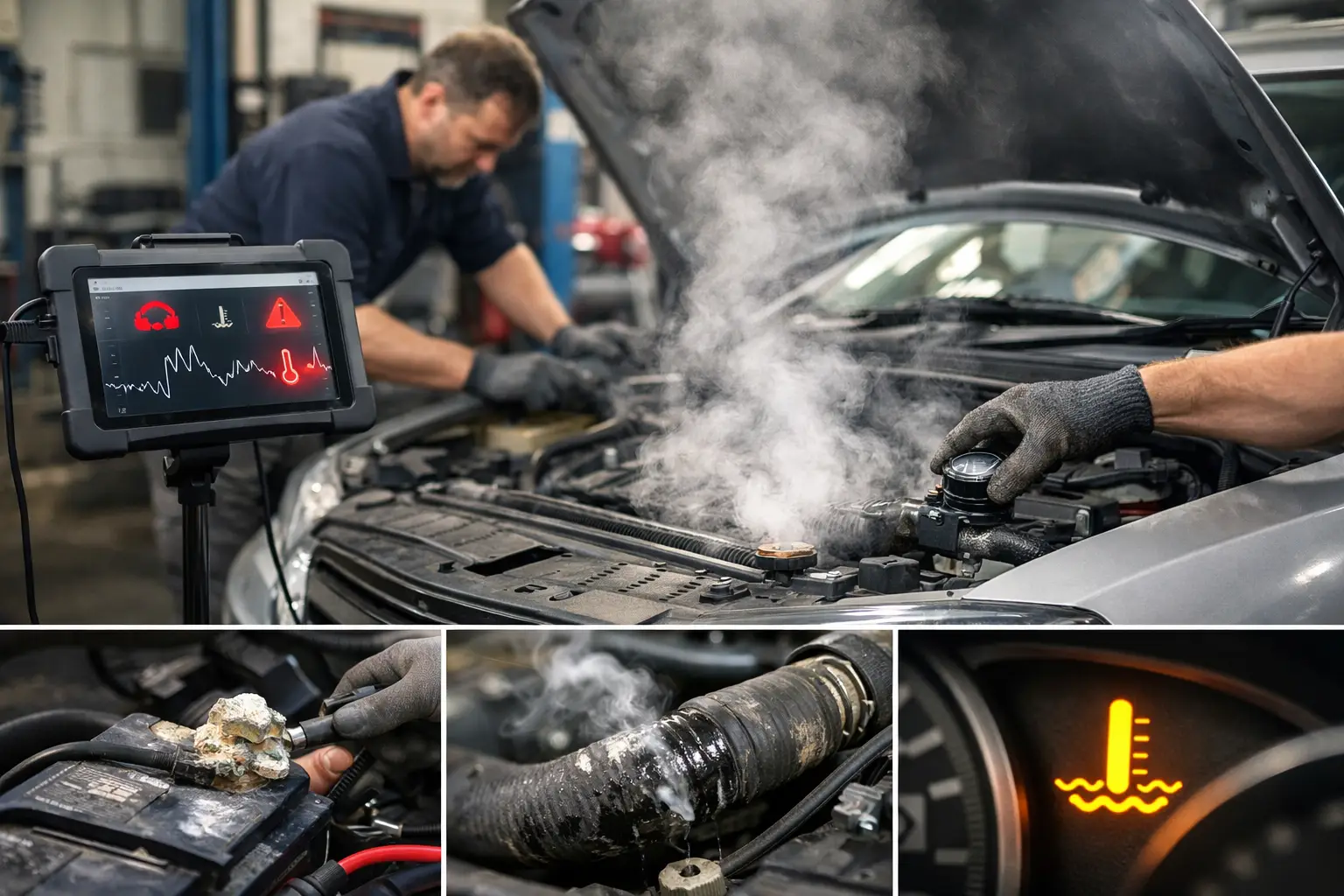
Why Is My Car Overheating Suddenly?
You are driving as normal, then the temperature warning comes on, steam starts showing, or the heater suddenly blows cold air. If you are asking, why is my car overheating suddenly, the short answer is that something in the cooling system has stopped doing its job. In most cases, it is not a fault that fixes itself. The longer you keep driving, the higher the risk of engine damage.
We often see this after a customer has ignored one early sign because the car still seemed fine. Then it gets worse very quickly. Overheating is one of those faults where a small leak, failed fan or stuck thermostat can turn into a much bigger repair if it is left too long.
Why is my car overheating suddenly? The usual causes
A car engine runs hot by design, but it should stay within a safe temperature range. That only happens if coolant is circulating properly, heat is being carried away through the radiator, and the cooling fan cuts in when needed.
If the temperature rises suddenly, the most common cause is low coolant. This usually happens because there is a leak somewhere in the system. It might be a split hose, a cracked expansion tank, a leaking radiator or a water pump seal starting to fail. Sometimes the leak is obvious. Sometimes it is slow enough that you only notice once the engine gets too hot.
Another common fault is a thermostat stuck closed. The thermostat controls when coolant flows through the radiator. If it sticks shut, the hot coolant stays trapped in the engine instead of cooling down. That can make the temperature climb very quickly, even on a short trip.
A failed water pump can do the same thing. The pump moves coolant around the system. If it is worn, leaking or has failed internally, the coolant does not circulate properly. The engine then overheats because the heat has nowhere to go.
We also often see radiator fan faults. If the fan does not switch on in traffic or while idling, the engine may be fine at speed but start overheating when stationary. That can be caused by the fan motor, a sensor, wiring or a control issue.
There are other causes too. A blocked radiator, air trapped in the cooling system, a failed coolant cap or, in more serious cases, head gasket trouble can all lead to overheating. The point is that the warning light or high temperature reading is the symptom. The real job is finding the exact cause before replacing parts.
What sudden overheating can look like
Not every car gives the same warning. Some drivers notice the temperature gauge climbing. Others get a dashboard message, steam from under the bonnet, or a smell of hot coolant. Sometimes the first sign is poor heater performance. If the heater goes cold while the engine is hot, that can mean the coolant level is too low or circulation is poor.
You may also notice the engine warning light, reduced power or the car going into limp mode. Modern vehicles can limit performance to protect the engine when temperatures rise too far. That is useful, but it does not mean it is safe to carry on driving.
If the car has overheated once and then seems normal again, do not assume the problem has gone away. We see this a lot with small leaks or fan issues that only show up in certain conditions. The fault is still there. It just has not fully shown itself yet.
What to do if your car starts overheating
First, do not ignore it. If the temperature warning comes on or the gauge goes into the red, pull over somewhere safe as soon as you can. Switch the engine off and let it cool down. Do not remove the coolant cap while the engine is hot. The system is pressurised and can cause serious burns.
If you are stuck in traffic and cannot stop immediately, turn the heater on full hot. It is not comfortable, but it can help pull some heat away from the engine for a short time. That is only a temporary measure to help you reach a safe place to stop.
Once the engine has cooled fully, you can check the coolant level if you know how. If it is empty or very low, that tells you there is likely a leak or another fault in the system. Topping it up may help in the moment, but it is not a repair. If the coolant has disappeared once, it will usually disappear again.
If there is steam, coolant loss, a strong smell, or the temperature shot up very quickly, recovery is often the safest option. It is better than risking a warped cylinder head or full engine damage.
Why it happens suddenly when the car seemed fine before
This catches a lot of people out. The car may have driven normally all week, then overheated without warning. In reality, the fault often starts earlier but stays hidden.
A hose can weaken over time, then split properly on one journey. A water pump can start leaking slowly and then fail more badly. A thermostat can stick only now and then before locking up completely. Electric cooling fans can work intermittently before stopping altogether.
Weather and driving conditions also matter. A marginal cooling system might cope on cooler days or on open roads, but fail in heavy traffic, warmer temperatures or longer journeys. That is why overheating can feel sudden even when the underlying fault has been building for a while.
Can you drive an overheating car?
In most cases, no. Not any further than needed to stop safely.
This is where being practical matters. If the gauge has only just moved up and you are seconds from a safe lay-by, that is different from trying to drive ten more miles home. The risk is that overheating can damage the head gasket, cylinder head or engine block. What starts as a coolant leak can become a much more expensive repair.
If the car has overheated, it needs to be checked properly. Guessing and replacing random parts often wastes time and money. A proper diagnostic approach matters here because several different faults can produce the same symptom.
How we diagnose overheating problems properly
When a car comes in with overheating issues, the first step is not to assume. We check the basics, but we also look for the root cause.
That usually means checking coolant level and condition, pressure testing the system for leaks, inspecting hoses and the radiator, checking fan operation, testing thermostat behaviour and looking for signs of water pump failure. If needed, we also check for combustion gases in the coolant to rule out head gasket problems.
This matters because the right fix depends on the actual fault. A leaking radiator needs a different repair from a wiring fault stopping the cooling fan. If air is trapped in the system after previous work, the system may simply need bleeding correctly. If the head gasket has failed, masking the symptoms will not solve anything.
At a local garage like AutoFix4u, that hands-on approach saves time. It also means you get a clear explanation in plain English, not vague advice or a list of maybes.
Why quick action saves money
Overheating is one of those faults where waiting usually costs more. A small coolant leak is one job. Driving until the engine runs too hot is another.
We often speak to drivers who hoped it was just a one-off. Sometimes they topped the coolant up and carried on. Sometimes they ignored a warning because the car still started and drove. The trouble is, engines do not tolerate overheating for long. Even one bad episode can do real damage.
That does not mean every overheating issue is catastrophic. Many are straightforward when caught early. A thermostat, radiator hose, expansion tank or fan fault is usually far easier to deal with than the damage caused by repeated overheating.
When to book diagnostics
If your car has overheated once, is losing coolant, smells hot, shows a temperature warning, or the heater keeps going cold, book it in. The same applies if you have topped up coolant more than once in a short period. Coolant does not just vanish.
For drivers around Lowestoft and nearby areas, the best next step is a proper inspection before the problem turns into a breakdown. Same-day slots may be available depending on workload, and if the fault is caught early, there is often a much better chance of a quicker repair.
Clear pricing, honest recommendations and no surprise extras matter most when the car is your daily transport. If you are dealing with sudden overheating, get it checked properly and get a clear repair plan. That is the safest way to protect the engine and get back on the road with confidence.


