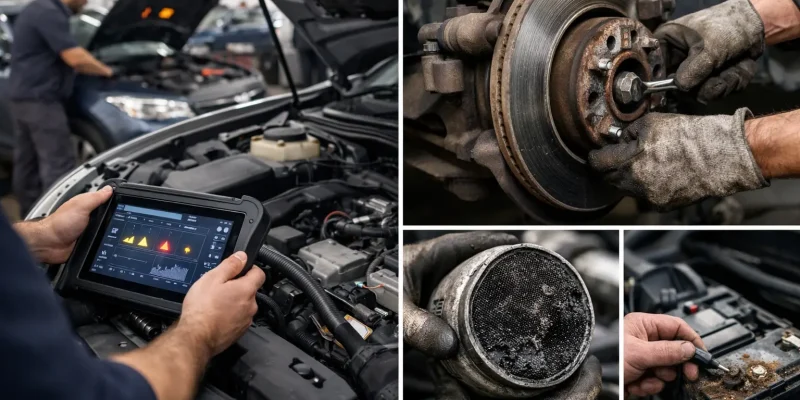

MOT Repair Beccles After Your Car Fails Its Test
An MOT failure can feel like a major problem when you need the car for work, school runs or getting around Beccles. In many cases, though, MOT repair Beccles drivers need is straightforward once the failure points have been properly explained. The key is knowing what has failed, why it has failed and whether it is safe or legal to drive before the repairs are done.
At AutoFix4u, we see plenty of cars that have failed an MOT over issues the driver had not noticed: worn brake pads, a tyre close to the legal limit, a broken spring, a blown bulb or an engine warning light. We start with the fault, not assumptions, then give you a clear repair plan and transparent pricing before work goes ahead.
What an MOT failure actually means
Your MOT certificate will list each issue as either a dangerous fault, a major defect, a minor defect or an advisory. These categories matter because they affect what you should do next.
A dangerous fault means the vehicle should not be driven on the road. This is usually linked to a serious safety risk, such as badly worn tyres, ineffective brakes, excessive steering play or a suspension component that is at risk of failing. Arrange recovery or transport assistance rather than taking a chance driving it.
A major defect means the car has failed its MOT and needs repair before it can be issued with a pass certificate. It may still be possible to drive it to a pre-booked repair or retest appointment if the vehicle remains roadworthy, but that is not the same as being automatically legal to use normally. If you are unsure, ask before setting off.
Minor defects and advisories do not fail the MOT. They still deserve attention. An advisory for brake wear, corroded pipes, tyre wear or a leaking shock absorber can become a failure before next year, often at the most inconvenient time.
Common MOT repairs in Beccles
Brakes, tyres and steering faults
Brakes and tyres are common MOT failure items because they do the hard work every day. A car may still feel normal on a short journey even when brake pads are low, discs are heavily worn or a tyre has worn unevenly on the inner edge.
We often see uneven tyre wear when alignment is out, a suspension joint is worn or a tyre has been run at the wrong pressure. Simply fitting a new tyre may get the car through the test, but it will not fix the cause if the suspension or tracking needs attention. This is why a proper inspection matters.
Steering and suspension faults can show up as knocking over bumps, vague steering, pulling to one side or a rattling noise on rough roads. Common causes include worn drop links, ball joints, bushes, springs and shock absorbers. A snapped spring is particularly common after pothole damage and can sometimes go unnoticed until the MOT inspection.
Lights, wipers and visibility
Small faults can still stop an MOT. A failed headlamp bulb, incorrect beam alignment, damaged lamp lens, ineffective washer jet or worn wiper blade can all lead to a fail.
These repairs are often quick, but do not assume it is only a bulb if a light is not working. Water inside a lamp, damaged wiring, a poor connection or a control module fault can cause the same symptom. We check the reason before replacing parts, especially when a fault keeps returning.
Warning lights and emissions problems
An illuminated engine warning light will usually cause an MOT failure. The same applies to ABS, airbag and electronic stability warnings. Turning a warning light off without finding the cause is not a repair. If the fault remains, it is likely to return and can leave you with another failed retest.
For petrol cars, emissions failures may come from a misfire, tired spark plugs, an air leak, a sensor problem or a failing catalytic converter. For diesel vehicles, DPF problems are a regular cause of warning lights and emissions concerns. Short journeys can prevent the filter from completing regeneration, but there can also be an underlying sensor, pressure or engine-running issue.
Proper diagnostics identify the fault codes and, more importantly, what caused them. Replacing parts at random is a costly way to deal with an MOT failure.
Exhaust, leaks and underbody corrosion
A noisy exhaust is not always just an annoyance. A leak can affect emissions, while an insecure or damaged exhaust can fail the MOT. The repair could be a clamp, a section of pipe, a mounting or a more substantial replacement. It depends on where the damage is and the overall condition of the system.
Corrosion is another area where the wording on the MOT sheet matters. Surface rust is not automatically a failure. The concern is corrosion that has weakened a structural area or is close to a braking, steering or suspension mounting point. A garage should show you the affected area and explain whether it needs welding, a component replacement or monitoring.
Bring the MOT failure sheet with you
The failure sheet gives a useful starting point, but it does not always tell the full story. For example, it may state that a brake is binding, but the cause could be seized caliper slides, a sticking caliper piston, a damaged hose or an issue with the handbrake mechanism.
Bring the sheet or send the details when you ask for a quote. This helps us plan the inspection and order parts where appropriate. We will still check the vehicle ourselves before confirming the repair because the right fix depends on what we find on the ramp.
This approach keeps the job clear. You know what is required for the MOT, what is recommended for safety or reliability, and what can reasonably wait. There is no point adding work that does not solve a problem, but ignoring a clear risk can cost more later.
Can you get a same-day MOT repair?
Sometimes, yes. Bulbs, wipers, tyres, brake pads, minor exhaust repairs and some suspension components can often be dealt with quickly if parts are available and the workshop has space. Same-day repair is less likely where diagnostics are needed, corrosion requires welding or a specialist part has to be ordered.
The best way to improve the chances of a fast turnaround is to contact the garage as soon as the car fails. Explain the symptoms, share the MOT failure points and say when the retest is booked. If the car is unsafe to drive, mention that too so recovery or transport can be considered.
A quick repair should still be the right repair. If a warning light or braking issue needs diagnosis, taking time to confirm the cause is better than fitting a part that does not cure it.
Do not wait for the retest deadline
Most MOT stations offer a free partial retest within a set period, commonly 10 working days, when the vehicle is repaired and returned to the same station. The exact arrangement can vary, so check with the test centre. If you leave repairs too late, you may lose the retest option and need another full test.
Do not wait until the day before your retest if the car has brake, steering, suspension, warning-light or emissions faults. Parts availability and diagnostic time can affect the schedule. Booking early gives you more options and avoids rushed decisions.
Get a clear repair plan before work starts
A good MOT repair service should not leave you guessing. You should be told what has failed, what caused it where that can be confirmed, what work is needed and what it will cost before the repair begins. If further faults are found during strip-down, you should be contacted before any extra work is carried out.
For drivers in Beccles and the surrounding area, AutoFix4u offers practical MOT failure repairs, diagnostics and clear communication from our local workshop near Lowestoft. If your car has failed, call now or request a quote with the failure details. We will help you work out the sensible next step and get the vehicle safe, roadworthy and ready for its retest.