
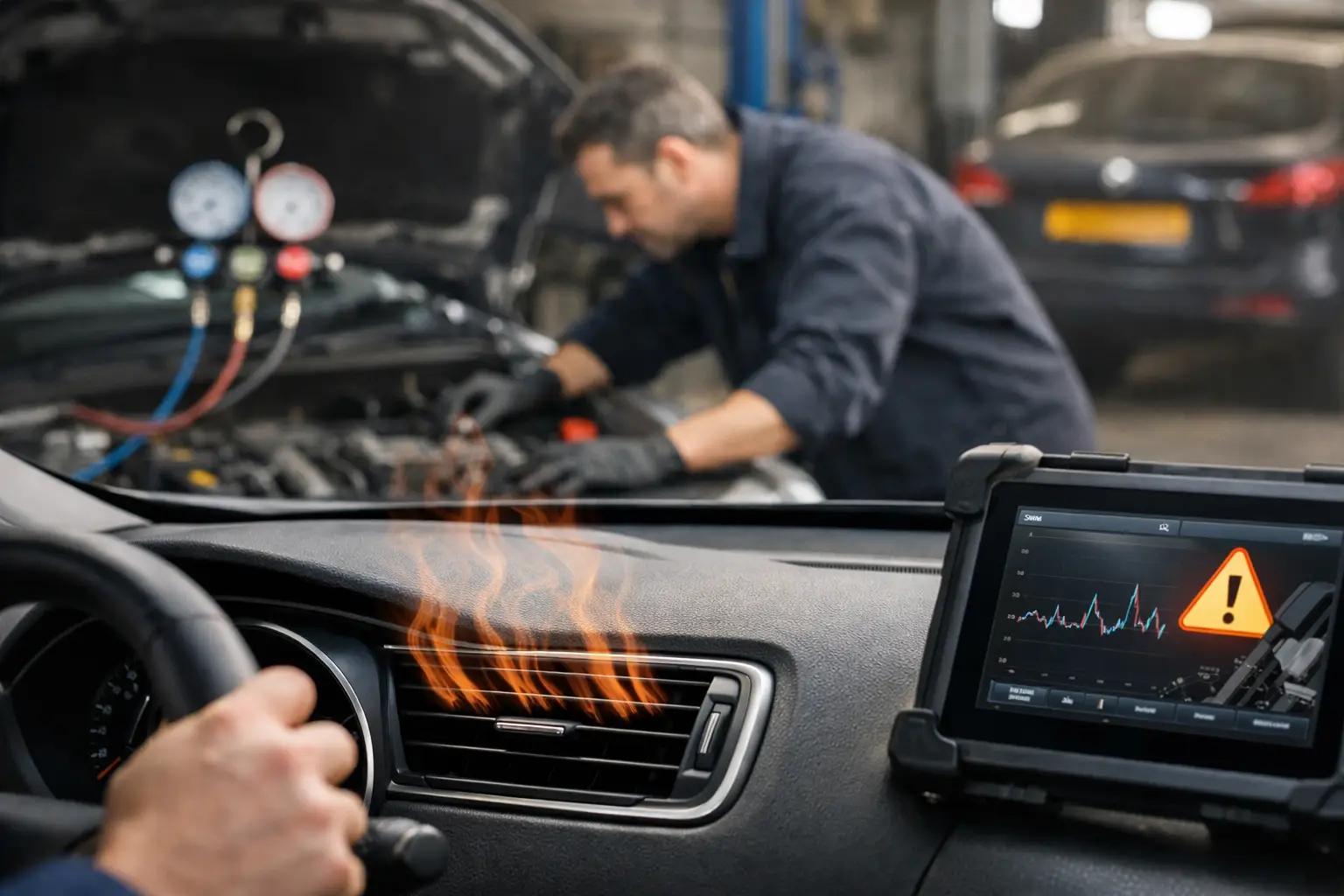
Why Is Air Con Blowing Warm in Your Car?
A hot day, a long queue of traffic, and the air con is blowing warm air through the vents. It is frustrating, but the question of why is air con blowing warm usually has a clear answer. In most cases, the system has lost refrigerant, a component has failed, or the controls are not telling the system to cool properly.
Car air conditioning is not just a comfort feature. It helps clear misted windows in wet or cold weather, which matters for visibility and safety. If it has stopped working, a proper diagnostic check is the quickest way to find the fault and avoid paying for work that will not fix it.
Why Is Your Air Con Blowing Warm?
Your car’s air conditioning works by circulating refrigerant through a sealed system. The refrigerant absorbs heat from the cabin, then releases it outside the vehicle. For that to happen, the compressor, condenser, pipes, cooling fan, pressure sensors and electrical controls all need to work together.
When one part is not doing its job, the vents may blow air that feels only slightly cool, changes between cold and warm, or stays completely warm. We often see this issue when a driver has had a regas in the past without the underlying leak being found. The system may work for a while, then gradually lose its cooling again.
The fault is not always obvious from the driver’s seat. That is why simply adding more gas is not always the right repair.
The Most Common Causes of Warm Air Con
Low refrigerant caused by a leak
This is one of the most common reasons for warm air. Refrigerant does not get used up in normal operation. If the level is low, it has usually escaped through a leak.
Leaks can develop at pipe joints, seals, valves, the condenser at the front of the car, or the evaporator behind the dashboard. A stone-damaged or corroded condenser is a regular issue, particularly on cars that have seen plenty of motorway miles and winter road spray.
A low charge can also stop the compressor from running. This is a built-in protection measure. The system detects incorrect pressure and prevents the compressor from being damaged. A proper air con inspection should include checking system pressures and leak testing before a regas is carried out.
A faulty air con compressor
The compressor is driven by the engine and circulates the refrigerant. If it fails, the air con cannot remove heat from the cabin.
You may notice warm air all the time, an unusual clicking or rattling noise when air con is switched on, or the engine revs changing slightly without the system cooling. Some compressors fail mechanically, while others have an electrical clutch or control valve fault.
Compressor replacement can be more involved than a regas. It may require the system to be cleaned through and the receiver drier replaced to protect the new part. This is why accurate diagnosis matters before any parts are ordered.
A damaged or blocked condenser
The condenser sits at the front of the vehicle, usually in front of the radiator. It needs a good flow of air to release heat from the refrigerant.
Because of where it sits, it can be damaged by road debris or corroded over time. It can also become clogged with leaves, dirt and insects. If it cannot lose heat properly, the air con will struggle, especially when the car is stationary or moving slowly.
Cooling fan problems
If your air con is cooler when driving but warm in traffic or when parked, the cooling fan is worth checking. The fan pulls air through the condenser when there is not enough natural airflow.
A failed fan motor, fuse, relay, wiring fault or fan control issue can cause this symptom. On some vehicles, an engine temperature issue may appear at the same time. Do not ignore an overheating warning or rising temperature gauge. Turn the air con off and arrange for the vehicle to be checked.
Electrical, sensor or control faults
Modern cars use sensors and control modules to manage the air conditioning system. A pressure sensor may give an incorrect reading, a fuse may have blown, wiring may be damaged, or a control module may have stored a fault code.
There can also be a problem inside the dashboard. The blend flap directs air through the heater or air conditioning side of the system. If that flap sticks in the warm position, the system may be producing cold air but warm air reaches the cabin.
This often needs diagnostic equipment alongside hands-on checks. Reading fault codes alone is useful, but it does not prove which component has failed. The codes need to be checked against live readings and the way the system behaves.
A Few Safe Checks You Can Make First
Before booking in, make sure the air con setting is actually switched on. Look for the A/C button or snowflake symbol, set the temperature to its lowest setting, and use the centre vents for your test. On some cars, ECON or Eco mode disables the compressor to reduce fuel use.
Then let the engine run for a few minutes with the air con on. The air should become noticeably cooler. If it only feels cool while you are driving, but goes warm in traffic, mention this when you contact the garage. It is a useful clue for diagnosing a fan or condenser problem.
Also check for obvious debris in front of the radiator grille and listen for unusual noises when switching the air con on and off. Do not attempt to release refrigerant or use DIY refill cans. Refrigerant is pressurised, and overcharging or using the wrong type can cause further faults. Many newer cars use a different refrigerant from older models, so the correct equipment is essential.
Is It Safe to Drive With Air Con Blowing Warm?
Usually, yes. A warm air con fault does not automatically mean the car is unsafe to drive. But it depends on the cause.
If there is a burning smell, smoke, a loud belt noise, an engine warning light, or the engine starts overheating, switch the air con off and stop driving when it is safe to do so. Those signs can point to a compressor, belt, cooling fan or electrical issue that needs prompt attention.
Even without those warning signs, do not leave it too long. A small refrigerant leak can become worse, and lack of use can allow seals to dry out. More importantly, a working air con system helps demist the windscreen quickly. That becomes a practical safety issue when the weather turns damp.
Regas or Repair: Which Do You Need?
A regas is the right answer when the refrigerant level is low and the system is otherwise sound. During a proper service, the old gas is recovered, the system is vacuum tested, the correct amount of refrigerant is added, and performance is checked.
However, a regas is not a permanent fix for a leaking pipe, damaged condenser or failed compressor. If the gas is low again within months, the leak needs to be located and repaired. Paying for repeated regasses may feel like the quicker option, but it usually costs more in the long run and leaves you without cold air again when you need it.
At AutoFix4u, we start with the fault rather than guessing. That means checking pressures, compressor operation, cooling fan performance and any related electrical faults, then explaining what has been found in plain English. You get a clear repair plan and transparent pricing before work goes ahead.
When to Book Air Conditioning Diagnostics
Book a check if the air con is warm, weak, intermittent, noisy, or only works at certain speeds. The sooner it is inspected, the better chance there is of dealing with a small issue before it develops into a larger repair.
For drivers in Lowestoft, Oulton Broad, Carlton Colville and the surrounding area, a local diagnostic check can save time and remove the guesswork. Same-day slots may be available, depending on workload. Call now or get a quote, explain exactly when the air con goes warm, and let a qualified technician find the cause before the next hot spell or misty morning catches you out.