
Air Conditioning Leak Detection Explained
You normally notice it on the first warm day when the car should be cooling quickly, but the vents are only blowing slightly cool or not cold at all. That is when air conditioning leak detection matters. In most cases, if your car air con has lost performance and needs repeated regassing, the gas is escaping somewhere and the leak needs finding properly before anything else.
A lot of drivers put up with weak air con far longer than they should. Some assume it just needs a top-up every summer. Others worry it will turn into a big, expensive job. The truth is usually simpler. If the system is low on refrigerant, there is a reason for it, and a proper diagnosis saves time, repeat visits and wasted money.
Why air conditioning leak detection matters
Your car’s air conditioning system is sealed. It should not be using up refrigerant like fuel or engine oil. So if cooling has dropped off, or it works for a short time after regas and then fades again, that usually points to a leak.
We often see this issue when a driver has had the system topped up elsewhere without the cause being checked first. The air con may feel better for a week or two, sometimes a few months, then it is back to warm air. At that point, the regas itself was never the real fix.
There is also the compressor to think about. The refrigerant carries oil through the system, and that helps lubricate moving parts. If the gas level gets too low, the system can stop working properly and extra strain can be put on components. Catching a leak early is usually better than waiting until more parts are affected.
Common signs your car has an AC leak
The main symptom is simple – the air is not cold enough. But there are a few patterns that point more strongly towards a leak rather than just poor general performance.
If the air con was cold before and now is not, that is one clue. If it gets cold for a short period after regassing and then fades, that is another. Sometimes the system will not engage at all because the refrigerant pressure has dropped too low. You may also notice the demisting is worse than normal, because air conditioning helps remove moisture from the cabin air.
In some cases, there can be staining around pipe joints or components where refrigerant oil has escaped. Drivers do not usually spot this themselves, but it is something we check during inspection. A musty smell from the vents is a separate issue in many cases, linked to bacteria or moisture, though it can appear alongside air con faults.
Where leaks usually happen
Leaks can happen in several places, and this is why guessing rarely works. On some cars, the condenser is the main problem. This sits at the front of the vehicle and can get damaged by road debris, corrosion and general wear. If your car does a lot of local mileage or sits outside year-round, that exposure can take its toll.
Pipe joints and seals are another common area. Rubber seals harden over time, and joints can start to seep. We also see leaks from corroded aluminium pipes, especially on older vehicles. Less often, the evaporator inside the dashboard can leak, which is more awkward to access and diagnose.
It depends on the age of the vehicle, the layout of the system and how the car has been used. That is why proper testing matters more than replacing parts based on hunches.
How air conditioning leak detection is carried out
Good air conditioning leak detection is about proving where the refrigerant is escaping from, not just confirming that it has gone low. There are a few ways to do that, and the best approach depends on the fault.
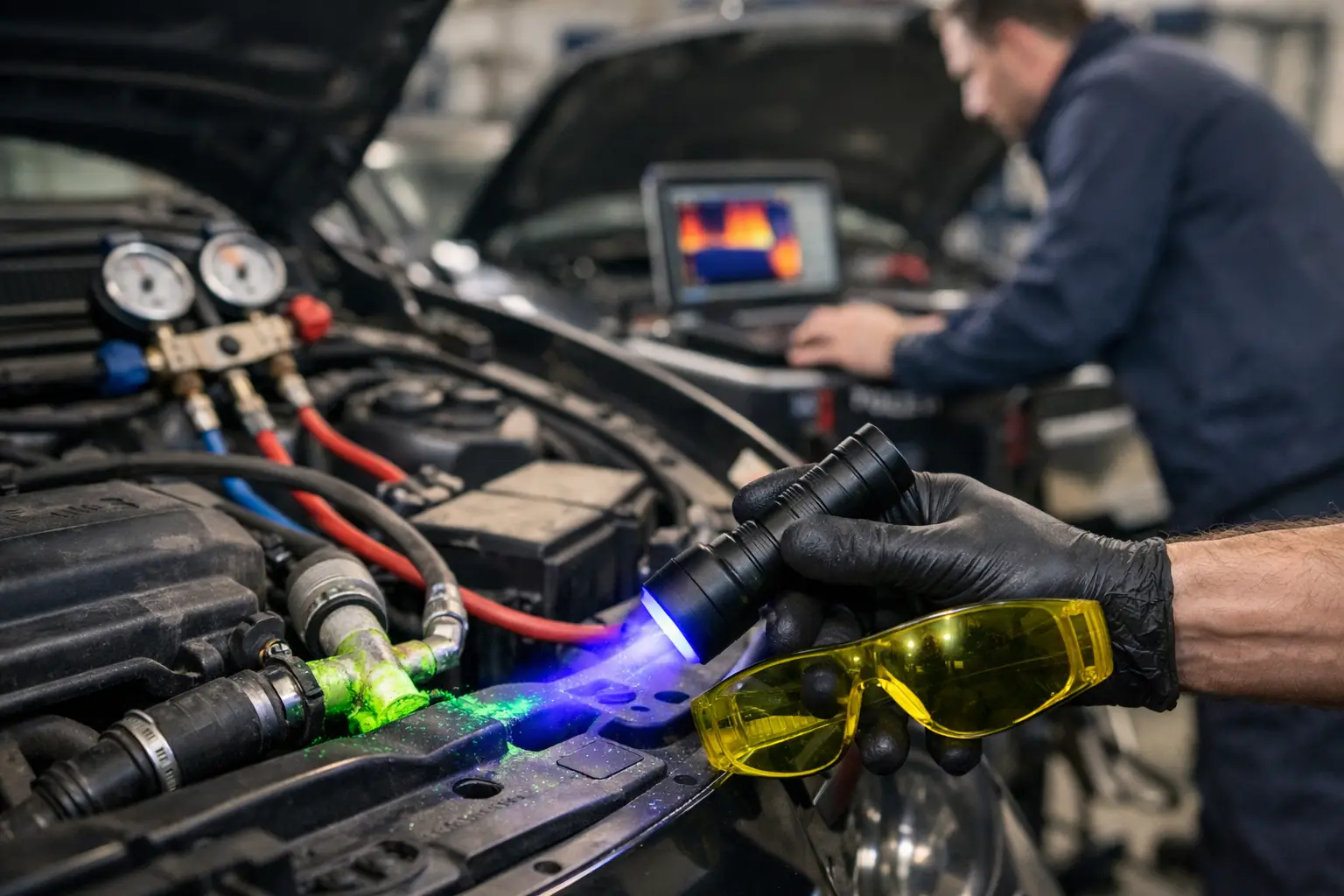
A pressure test is often the starting point. This helps show whether the system can hold pressure and whether there is a leak significant enough to affect performance. From there, a technician may use UV dye if the system contains it, or add dye during testing where appropriate. When refrigerant leaks out, the dye leaves a visible trace at the fault point.
Electronic leak detection can also be useful. This uses a sniffer tool that detects refrigerant around pipes, joints and components. It can help with smaller leaks that are not immediately obvious. In some cases, a combination of methods is needed, especially if the leak is intermittent or in a hard-to-see area.
The main thing is not to rush straight to regassing without checking the condition of the system first. If the leak is still there, the problem simply comes back.
Why a regas alone is not always the answer
A regas has its place. If the system is low and there is no sign of a significant leak, restoring the correct refrigerant level may get it working properly again. But if the gas has clearly escaped, a regas on its own is only a short-term result.
This is where some drivers get frustrated. They pay for cold air, then lose it again. In most cases, the better route is diagnosis first, repair second, then regas once the system is sealed. That way, you are paying to solve the cause rather than repeating the symptom.
There is also an environmental side to this. Refrigerant should not be escaping into the atmosphere. A leaking system needs proper attention, not repeated topping up.
What happens after the leak is found
Once the fault is identified, the next step depends on the component involved. A leaking condenser may need replacing. A failed seal or pipe can often be replaced more directly. If a valve or service port is at fault, that can be a simpler repair.
Some jobs are straightforward and can be turned around quickly. Others take longer, especially if parts are less accessible or if the leak is inside the dash area. The important part is knowing exactly what has failed before any work starts.
That is how we approach it at AutoFix4u – find the fault properly, explain it in plain English, and give a clear repair plan with no surprise extras. If the issue is minor, we will say so. If it is more involved, you will know why.
When to book air conditioning leak detection
If your air con has stopped blowing cold, book it sooner rather than later. The same applies if it was regassed recently and the cooling has already dropped off. Those are the clearest signs that the system needs testing rather than another top-up.
It also makes sense to get it checked if the compressor is not engaging, the windows are taking longer to demist, or you have noticed a sudden change in performance. You do not need to wait for summer. In fact, sorting air con faults before hot weather usually means less disruption and a more comfortable drive when you actually need it.
For drivers around Lowestoft, Oulton Broad, Carlton Colville, Beccles and nearby areas, quick diagnosis matters. If you rely on one vehicle for work, school runs or family travel, you want the problem identified properly the first time.
A practical word on costs and expectations
The cost depends on what is leaking. A simple valve issue is very different from an evaporator leak hidden behind the dashboard. That is why honest diagnostics matter. No garage can sensibly promise the full repair cost before testing the system.
What you should expect is a clear explanation, straightforward advice and a sensible next step. In some cases, the repair is well worth doing because the rest of the system is in good condition. In others, especially on older cars, it may be worth discussing the options before going further. That is not avoiding the issue. It is just being realistic.
If your car’s air con has gone warm, keeps losing gas or never seems to stay cold for long, the best next step is proper leak detection. Get the fault confirmed, get a clear quote, and deal with the actual cause so you are not back to the same problem a few weeks later. Call now or book diagnostics and get it checked properly.


One thought on “Air Conditioning Leak Detection Explained”