Mechanic Near Me Diagnostics for Warning Lights
That engine warning light can appear on the school run, on the way to work, or just before an MOT. The car may still feel normal, but guessing what it means can turn a small repair into a bigger one. If you are searching for mechanic near me diagnostics, you need more than someone to plug in a code reader. You need a local garage that can find the actual cause, explain it clearly and tell you what needs doing next.
At AutoFix4u, we see the same situation every week. A driver has been told there is a fault code, but not what caused it or whether the car is safe to use. Proper vehicle diagnostics are about tracing the fault back to its source, then giving you a practical repair plan with clear pricing and no surprise extras.
What a diagnostic check should actually do
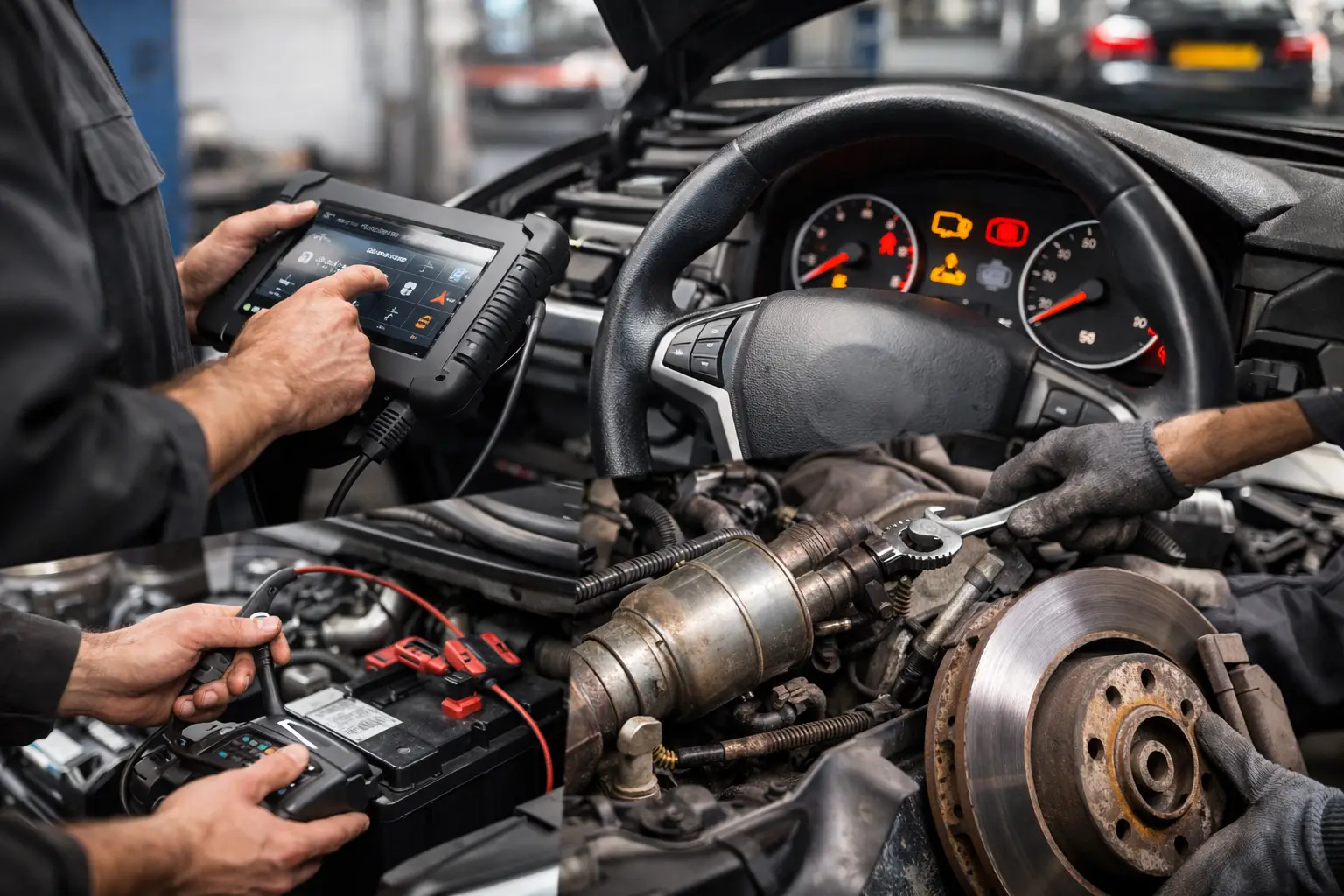
A diagnostic machine reads information stored by your car’s control units. This can point us towards faults in the engine, emissions system, electrics, brakes, air conditioning and other systems. It is a useful starting point, but it is not a repair answer on its own.
For example, a code may suggest an issue with an oxygen sensor. That does not automatically mean the sensor has failed. It could be responding to an air leak, damaged wiring, a fuel problem or another engine fault. Replacing parts based on the first code alone can waste time and money.
A proper diagnostic process starts with the symptoms you have noticed. Does the warning light come and go? Has the vehicle lost power uphill? Does it struggle to start when cold? Are there noises, smoke or changes in fuel use? We then read the stored fault information, check live data and carry out relevant physical checks. In most cases, that gives a much clearer picture before any repair work is recommended.
When to book mechanic near me diagnostics
Some faults need attention sooner than others. A red warning light, brake warning, overheating message, heavy smoke or a burning smell means you should stop safely and get advice before carrying on. Continuing to drive can cause damage or create a safety risk.
An amber engine warning light is often less urgent, but it should not be ignored. The car may enter limp mode, where it limits power to protect the engine or emissions system. You might notice poor acceleration, reduced pulling power or difficulty maintaining speed. This usually happens because the vehicle has detected a fault that could worsen if it is left unresolved.
Book diagnostics promptly if you notice a warning light, repeated battery problems, rough running, poor starting, misfiring, loss of power, reduced fuel economy or an MOT failure you do not understand. Early fault finding is normally simpler than waiting for a breakdown.
The car starts, so why does it need checking?
A car can drive reasonably well while a fault is developing. Modern vehicles can adjust around certain problems for a while, but that does not mean the issue has gone away. A small air leak, weak sensor signal or DPF pressure issue may only show up under load or on longer runs.
We often see customers clear a warning light and hope it stays off. If the underlying fault remains, it will usually return. Worse still, clearing the code can remove useful information that helps identify when and why the fault occurred. It is better to have it checked properly while the evidence is still there.
Common problems we find in the workshop
Warning lights can mean many different things, so there is no honest one-size-fits-all answer. However, some problems appear regularly in everyday cars around Lowestoft and the surrounding area.
DPF faults are common on diesel vehicles used mainly for short journeys. The diesel particulate filter is designed to trap soot, then burn it off during a regeneration cycle. If the vehicle does not get the right driving conditions, soot can build up. You may see a DPF light, engine warning light or loss of power. The solution depends on the cause. In some cases, a forced regeneration or professional DPF cleaning helps. In others, there may be a sensor fault, EGR issue or engine problem preventing regeneration.
Electrical faults can also be frustrating because they are not always visible. A flat battery may be caused by an ageing battery, a charging issue with the alternator, damaged wiring or a component drawing power after the car is switched off. Testing the system properly avoids replacing a battery when the real fault is elsewhere.
Engine performance faults often come down to air, fuel or sensor readings. A split hose, faulty boost control part, blocked filter or sensor issue can all cause reduced power. The symptoms can feel similar, which is why testing matters. We check the evidence before advising on parts.
Air conditioning issues need the same approach. If the air is not cold, the problem might be low refrigerant, but it could also be a leak, pressure sensor fault, compressor issue or electrical fault. Simply regassing a leaking system may provide a short-term improvement, but it will not fix the reason the gas was lost.
What to tell your local garage
The more detail you can give, the quicker we can narrow things down. You do not need technical knowledge. Plain descriptions are useful: when the light came on, whether it happens only at speed, if the car is worse when cold, and whether any work was done recently.
If you can safely do so, take a photo of the dashboard warning light or message. Do not ignore changes such as smoke, fluid leaks, loud knocking, clutch slip or a burning smell. These details can help us decide whether the vehicle should be driven in, recovered or inspected urgently.
Be honest about how the car is used too. A diesel doing short local trips has different likely causes from a vehicle that spends most of its time on the A-road. There is no judgement involved. It simply helps us diagnose the problem faster.
Clear advice before repairs begin
Finding a fault is only the first part of the job. Once we have identified the likely cause, we explain what we have found in plain English. You should know what needs repairing, why it matters and what could happen if you delay it.
Some repairs are safety-critical and should be dealt with straight away, such as brake faults, dangerous tyre damage or overheating. Other issues can sometimes be monitored for a short time, depending on the fault and how the car is behaving. We will tell you honestly where you stand rather than pushing unnecessary work.
If further testing is needed, we explain that too. Some intermittent electrical faults or complex engine problems take longer to trace because they only occur under certain conditions. Good diagnostics are not about rushing to a conclusion. They are about avoiding the cost and inconvenience of fitting the wrong part.
A practical next step when your car has a fault
If your warning light is on, your car has gone into limp mode or it just is not driving as it should, arrange a diagnostic check before the problem gets worse. AutoFix4u is a family-run local garage serving Lowestoft and nearby Suffolk and Norfolk areas, with same-day slots available where possible.
Call now to discuss the symptoms, get a clear next step and book your vehicle in. A fault does not always mean a major repair, but it does need a proper answer. The sooner you know what is causing it, the sooner you can get back to driving with confidence.


