DPF Cleaning Service Guide for Warning Lights
A DPF warning light can turn a normal school run or commute into a worry very quickly. This DPF cleaning service guide explains what the light usually means, why your car may have lost power, and what needs checking before anyone recommends a clean. In most cases, the filter is only part of the problem.
What a DPF does and why it blocks
The diesel particulate filter, usually shortened to DPF, sits in the exhaust system of modern diesel cars. Its job is to catch soot produced by the engine before it leaves the exhaust. Over time, that soot has to be burned away through a process called regeneration.
A normal regeneration happens when the engine is fully warm and the car is driven steadily enough for the exhaust temperature to rise. This is why regular short trips, slow town driving and stop-start journeys can cause trouble. The car may not get the conditions it needs to clear the soot.
But short journeys are not the only cause. We often see DPF faults linked to an underlying engine issue, such as a faulty sensor, split hose, EGR fault, injector problem or thermostat that is stopping the engine reaching the right temperature. If that fault is not put right first, a clean may only offer temporary relief.
The signs you may need DPF diagnostics
The first sign is often a DPF warning light or engine warning light. You may also notice the car feels flat when accelerating, uses more fuel than usual, or goes into limp mode. Limp mode is the car limiting power to protect the engine and exhaust system.
Some drivers also notice the cooling fan running after the ignition is switched off, a stronger smell from the exhaust, or an increase in engine oil level. These can happen when the vehicle has repeatedly tried, and failed, to regenerate the filter.
Do not ignore these signs for weeks. A lightly loaded filter can sometimes be dealt with before it becomes a major blockage. Keep driving with a warning light and reduced power, however, and the vehicle may eventually refuse to carry out a regeneration at all. At that stage, the repair can take longer and cost more.
Can a long drive clear the DPF?
Sometimes, yes. If the warning light has only just appeared, the vehicle is running normally, and there are no other faults stored, a sustained drive may allow an active regeneration to complete. The engine needs to be fully warm and driven at a steady road speed for long enough to maintain exhaust temperature.
This is not a guaranteed fix, and it is not the right answer if the car is already in limp mode, smoking, overheating or showing more than one warning light. It can also be unwise if the engine oil level is above the maximum mark. In those situations, stop guessing and arrange proper diagnostics.
DPF cleaning service guide: the proper process
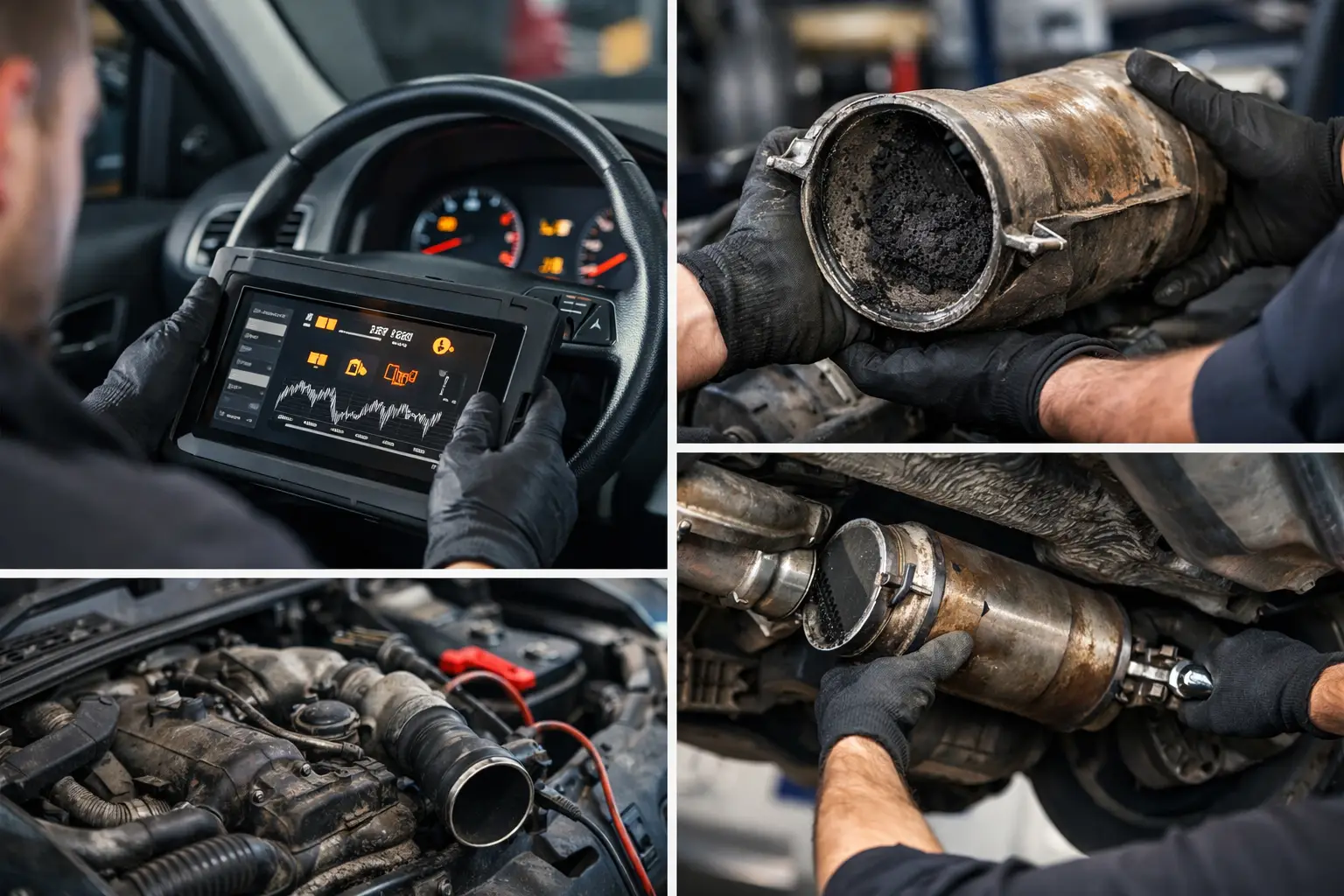
A proper DPF cleaning service starts with finding out how blocked the filter is and why it has happened. Plugging in a diagnostic machine is useful, but fault codes alone do not tell the whole story. We check the live data too, including soot load, ash load, exhaust pressure readings and temperature sensor information.
This helps separate a genuinely blocked filter from a faulty pressure sensor or wiring issue that is giving the ECU the wrong reading. It also helps us see whether the vehicle is safe and suitable for a forced regeneration.
Step 1: Check the fault, not just the light
The vehicle is scanned for stored codes and current readings. We look for related faults that can stop regeneration, including EGR issues, boost leaks, glow plug faults and temperature sensor faults. On some vehicles, even a thermostat that has failed open can cause repeat DPF problems because the engine never reaches normal operating temperature.
This diagnostic stage matters. Clearing the dashboard light without dealing with the cause is not a repair. It is likely to come back, often when you are least expecting it.
Step 2: Decide whether regeneration is appropriate
If readings show a manageable soot level and there are no faults preventing regeneration, a controlled regeneration may be the right option. This is a workshop procedure where the vehicle is monitored while it raises exhaust temperatures to burn off soot.
It is not suitable for every car. If the filter is too heavily blocked, or the data points to a mechanical or sensor fault, forcing a regeneration can create more heat and stress without solving the problem. We explain what the readings show and recommend the sensible next step rather than pushing a one-size-fits-all treatment.
Step 3: Clean or repair as needed
Where a filter needs cleaning, the method depends on its condition and the vehicle. Chemical cleaning can help remove soot deposits in suitable cases. More severe restrictions may require a more involved solution, while a damaged or ash-loaded filter may not respond to cleaning at all.
Soot can be burned off. Ash is different. Ash builds up gradually from normal engine oil additives and cannot be removed by a standard on-car regeneration. Higher-mileage vehicles can reach a point where cleaning is less effective and replacement becomes the more reliable option.
If a related component has failed, that needs repairing at the same time. A new sensor, hose repair or EGR repair may be the real answer to preventing the warning light from returning.
Step 4: Confirm the repair has worked
After the work, the system should be checked again. We confirm the fault codes are dealt with, readings have improved and the vehicle is responding as it should. Where possible, a road test helps confirm that power has returned and the car is no longer dropping into limp mode.
You should leave knowing what caused the issue, what was done, and whether there is anything to keep an eye on. Clear advice is more useful than a vague note saying the DPF has been ‘cleaned’.
What not to do when the DPF light comes on
Avoid repeatedly clearing the warning light with a basic code reader. The light will often return because the soot load and root cause are still there. It can also hide useful diagnostic information.
Be cautious with bottled fuel additives too. Some can be helpful as part of preventative maintenance, but they will not repair a failed sensor, a blocked pressure pipe or a filter that is already severely restricted. They should not be used as a substitute for diagnostics.
Do not keep trying hard motorway runs if the car has gone into limp mode or has a flashing warning light. Reduced power is the vehicle telling you there is a fault that needs attention. Pushing it harder may leave you stranded or lead to further damage.
How to reduce repeat DPF problems
If your driving is mostly short local journeys, give the engine an occasional longer run once it is warm. This is especially useful for diesel vehicles that rarely leave Lowestoft town traffic. It will not cure every issue, but it gives the DPF a better chance to regenerate normally.
Use the correct engine oil specification at servicing. DPF-equipped diesels require low-ash oil, and the wrong oil can add to ash build-up over time. Keep up with servicing, and deal with engine warning lights early rather than waiting for an MOT failure or loss of power.
If the car repeatedly shows a DPF warning light, there is usually a reason beyond your route to work. That is when diagnostic testing saves time and prevents repeated cleaning attempts.
When to book a DPF check
Book diagnostics promptly if your diesel has a DPF or engine warning light, reduced acceleration, limp mode, repeated regeneration messages, smoke from the exhaust or an oil level that is rising. The earlier the fault is checked, the more options there are likely to be.
At AutoFix4u, we take a diagnostic-first approach to DPF faults for drivers in Lowestoft and nearby areas. You will get a clear explanation of the problem, honest recommendations and a repair plan based on what the vehicle actually needs. Contact the garage to book a DPF diagnostic check or ask about same-day availability. A warning light does not always mean the worst, but it does deserve a proper answer before it becomes a breakdown.


One thought on “DPF Cleaning Service Guide for Warning Lights”