
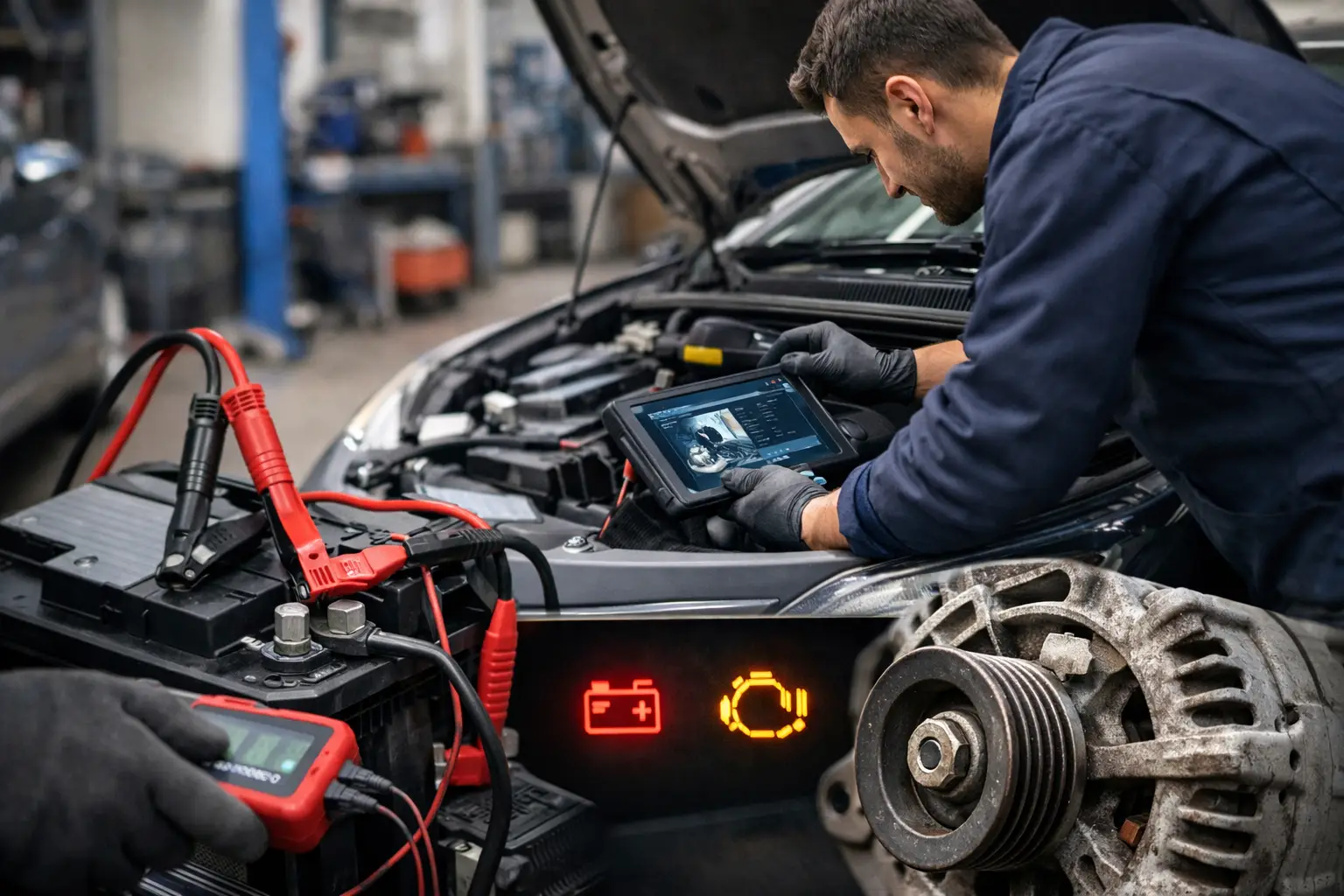
Car Not Starting Battery or Alternator UK
You turn the key or press the start button, but the engine will not start. Perhaps the dashboard lights come on, yet the engine barely turns over. Alternatively, the car starts after a jump start but fails again the next morning.
If you are searching for car not starting battery or alternator UK, the first step is understanding which component may be causing the problem.
A weak battery, faulty alternator, poor electrical connection or starter motor problem can produce similar symptoms. However, each fault needs a different repair.
At AutoFix4u Garage Lowestoft, we help drivers identify starting and charging faults through proper testing. Instead of replacing parts based on guesswork, we check the system and explain the findings.
Car Not Starting Battery or Alternator UK: Which Is More Likely?
The battery and alternator perform different jobs.
Your battery supplies electrical power when you start the engine. It also supports the vehicle’s electrical systems when the engine is not running.
Meanwhile, the alternator generates electricity while the engine runs. It supplies electrical power and helps recharge the battery.
If the battery cannot deliver enough power, the starter may struggle to turn the engine.
By contrast, a faulty alternator may allow the car to start initially. However, the battery can gradually discharge because the charging system cannot maintain its energy.
A battery problem is often the first possibility to investigate when a car will not crank. However, testing is the only reliable way to confirm the cause.
Common Signs of a Failing Car Battery
A weak battery can cause several noticeable symptoms.
Slow engine cranking
Does the engine turn over more slowly than normal?
This can happen when the battery cannot supply enough current to the starter motor.
Cold weather may make the problem more noticeable. In addition, older batteries can lose their ability to deliver sufficient starting power.
However, poor connections and starter motor faults can produce similar symptoms.
Clicking noises when starting
Rapid clicking often indicates that the electrical system cannot maintain enough power to operate the starter.
For example, the battery voltage may drop sharply when you attempt to start the car.
Loose or corroded battery connections can cause a similar problem.
Therefore, a technician should check both battery condition and electrical connections.
Dim lights or electrical problems
A weak battery may cause dashboard lights to dim during starting.
You might also notice problems with central locking or other electrical equipment.
However, these symptoms do not always prove that the battery itself has failed.
The battery may simply have lost charge because of another fault.
The car needs frequent jump starts
If your vehicle regularly needs a jump start, something requires attention.
Possible causes include a worn battery, charging problems or excessive electrical drain while the vehicle is parked.
A successful jump start does not identify the exact fault.
For more information, read our Car Won’t Start Diagnosis Guide.
Common Signs of a Faulty Alternator
Alternator problems often become noticeable while driving.
Unlike the battery, the alternator normally supplies electrical power while the engine runs.
Battery warning light while driving
A battery-shaped warning light can indicate a charging system problem.
However, the warning does not automatically mean that the alternator itself has failed.
A damaged drive belt, wiring fault or charging control issue may also affect the system.
If the warning appears while driving, arrange an inspection promptly.
Flickering headlights
Headlights that flicker or change brightness can indicate unstable electrical voltage.
Other equipment may also behave unusually.
For instance, the blower motor might slow down or multiple dashboard warnings may appear.
These symptoms can point towards charging system problems, but proper testing remains essential.
The engine stops unexpectedly
If the charging system fails completely, the vehicle may continue running for a limited period using battery power.
Eventually, the electrical supply may become insufficient.
As a result, the engine could stop or fail to restart.
If the battery warning light appears alongside serious electrical problems, stop in a safe place and arrange professional assistance.
A new battery keeps going flat
A replacement battery should not repeatedly discharge without explanation.
However, fitting a new battery will not solve a faulty charging system.
For example, the alternator may not supply enough current to maintain the battery’s charge.
Alternatively, an electrical component may continue drawing power while the car is parked.
That is why battery replacement should include suitable electrical system checks.
Battery vs Alternator: Understanding the Symptoms
The following comparison can help you identify where the problem might begin.
| Symptom | Possible battery issue | Possible alternator issue |
|---|---|---|
| Slow engine cranking | Common | Possible if charging has failed |
| Rapid clicking when starting | Common | Possible through battery discharge |
| Battery warning light while driving | Less typical | Common charging-system warning |
| Vehicle starts after a jump | Possible | Possible |
| Battery repeatedly goes flat | Possible | Possible |
| Electrical systems fail while driving | Possible | Often points towards charging trouble |
These patterns provide useful clues, but they are not a final diagnosis.
For example, a faulty alternator can flatten a healthy battery. Meanwhile, a poor earth connection can affect both starting and charging.
Therefore, a proper electrical inspection is the most reliable next step.
What If the Problem Is Neither the Battery Nor the Alternator?
Not every starting problem comes from these two components.
Several other faults can prevent the engine from starting.
Starter motor problems
A faulty starter motor may prevent the engine from turning over.
You could hear a single click or experience intermittent starting.
However, poor battery cables or electrical connections may create the same symptoms.
Therefore, checking the starter circuit is important before replacing the motor.
Loose or corroded connections
Battery terminals and earth straps carry electrical current between components.
Corrosion or loose connections can create resistance.
As a result, the starter may not receive sufficient electrical power.
These faults can sometimes resemble a failing battery.
Immobiliser or key problems
Modern vehicles rely on electronic security systems.
If the vehicle cannot recognise the key correctly, it may prevent starting.
Some vehicles display an immobiliser warning message.
Others may crank without starting or refuse to operate the starter.
Fuel and engine management faults
If the engine cranks normally but does not start, the fault may involve fuel delivery, sensors or ignition.
For example, a crankshaft position sensor problem can prevent the engine management system from controlling starting correctly.
In those cases, changing the battery or alternator is unlikely to solve the problem.
Our Engine Diagnostics Lowestoft service can help investigate these faults.
What Can You Check Safely Before Calling a Garage?
A few simple observations can help narrow down the issue.
Check what happens when you try to start
Pay attention to the exact behaviour.
Does the engine crank slowly, click repeatedly or remain completely silent?
Alternatively, does it crank normally without firing?
These details help the technician identify which system needs attention.
Look for dashboard warning lights
Check whether the battery warning light appeared before the vehicle stopped starting.
Also look for immobiliser warnings or other messages.
However, remember that dashboard lights alone cannot confirm the failed component.
Inspect visible battery connections
If you can access the battery safely, check for obvious corrosion or loose connections.
Do not touch damaged wiring or attempt electrical repairs without the correct knowledge.
If you notice burning smells, smoke or damaged cables, avoid further starting attempts.
Consider recent starting problems
Think about what happened before the failure.
Has the vehicle needed several jump starts?
Did it struggle during cold mornings?
Has the battery recently been replaced?
These details can help the garage choose the right tests.
Can a Jump Start Tell You Whether the Battery Is Faulty?
A jump start can help when the vehicle lacks enough electrical power to crank.
However, it does not prove that the battery needs replacing.
A vehicle may start with additional power even when another issue caused the battery to discharge.
For example, the alternator may not charge properly.
Alternatively, an electrical system may drain the battery overnight.
If the car starts with assistance but fails again later, the starting and charging systems need testing.
Never disconnect the battery while the engine runs to test the alternator. This outdated method can damage modern vehicle electronics.
For local assistance, contact AutoFix4u Garage Lowestoft to discuss the safest next step.
How Does a Mechanic Diagnose Battery and Alternator Problems?
A professional diagnosis starts by confirming the symptoms.
The technician then checks the relevant components.
Battery condition testing
A battery may show an apparently normal voltage while resting but still fail under load.
Therefore, a suitable battery test helps assess its condition and ability to supply starting current.
The technician may also check whether the battery needs charging before drawing a final conclusion.
Charging system testing
With the engine running, a technician checks charging performance using appropriate equipment.
However, modern charging systems can vary their voltage according to operating conditions.
Therefore, one voltage reading alone does not always confirm an alternator fault.
The technician must consider the vehicle’s charging system design.
Electrical connection checks
Loose terminals, damaged cables and poor earth connections can reduce starting performance.
In addition, voltage-drop testing may reveal electrical resistance that a basic visual inspection misses.
Starter motor testing
If the battery and main connections are healthy, the starter circuit may need further attention.
The technician can check power supply, control signals and starter operation.
Electrical drain testing
If the battery loses charge while the vehicle is parked, an excessive standby current draw may be responsible.
A suitable test can help identify whether an electrical component remains active when it should shut down.
For more information, see our Auto Electrical Repairs Lowestoft service.
Why Replacing Parts Without Testing Can Cost More
A car that fails to start does not automatically need a new battery.
Likewise, repeated flat batteries do not always mean that the alternator has failed.
For example, imagine a driver replaces a weak battery without checking the charging system.
If the alternator cannot maintain the charge, the replacement battery may soon discharge.
Another driver may replace the alternator when the real problem is a damaged earth cable.
Both repairs can waste money because the original fault remains.
That is why accurate testing matters.
At AutoFix4u Garage Lowestoft, we focus on identifying the underlying cause before recommending replacement parts.
When Should You Stop Trying to Start the Car?
Repeated starting attempts can place additional strain on the battery and starter motor.
Therefore, avoid excessive cranking if the engine refuses to start.
You should also stop immediately if you notice:
- Smoke or a burning smell
- Damaged or overheating electrical wiring
- Unusual mechanical noises
- Serious dashboard warnings
- An engine that stopped unexpectedly while driving
If the vehicle cannot start safely or has developed a serious electrical problem, arrange professional assistance.
How to Prevent Starting and Charging Problems
Regular vehicle checks can help identify problems before they leave you stranded.
For example, keep the battery connections in good condition and follow the manufacturer’s servicing schedule.
Also, pay attention to slower starting during cold weather.
If the vehicle mainly makes short journeys, its battery may not always recover the energy used during starting.
However, repeated charging problems require proper testing rather than regular jump starts.
Battery condition, alternator performance and electrical connections all deserve attention.
A timely inspection can often prevent an inconvenient breakdown.
Frequently Asked Questions About Battery and Alternator Faults
How do I know if my battery or alternator is faulty?
Slow cranking often suggests a battery or starting circuit issue.
Meanwhile, a charging warning light while driving may indicate an alternator or charging system fault.
However, professional testing is needed to confirm the cause.
Can a bad alternator stop my car from starting?
Yes. A faulty alternator may leave the battery without enough charge to start the engine.
However, the vehicle may start normally at first if the battery still holds sufficient energy.
Will a car start with a jump if the alternator is faulty?
It may start if the additional power allows the starter to operate.
However, the engine could stop again if the charging system cannot maintain the electrical supply.
Therefore, a successful jump start does not confirm a healthy alternator.
Can a new battery go flat overnight?
Yes. A charging problem, faulty battery or excessive electrical drain can cause repeated discharge.
The cause needs investigation before another replacement.
Is it safe to drive with the battery warning light on?
A battery warning light while driving can indicate a charging failure.
The vehicle may eventually lose electrical power and stop.
Therefore, stop safely and arrange professional advice rather than continuing a long journey.
Book Battery and Alternator Diagnostics in Lowestoft
If your car will not start, repeatedly needs a jump start or keeps losing battery charge, get the fault checked properly.
At AutoFix4u Garage Lowestoft, we help drivers investigate:
- Flat and weak batteries
- Charging system faults
- Alternator problems
- Starter motor faults
- Poor electrical connections
- Repeated battery discharge
- Vehicle electrical faults
We welcome enquiries from Lowestoft, Oulton Broad, Carlton Colville, Pakefield, Kessingland, Beccles and nearby areas.
Same-day appointments may be available, depending on workshop capacity.
For more details, visit our Auto Electrical Repairs Lowestoft service page.
Call: 07778 979802
WhatsApp: Message AutoFix4u Garage
Request a Quote: Contact AutoFix4u Garage
AutoFix4u Garage Lowestoft
Unit 4, 10 Battery Green Road, Lowestoft, NR32 1DE.
If your car is not starting, a proper diagnosis can help you avoid unnecessary replacement parts and repeated breakdowns. Get the battery, charging system and starter checked before deciding which repair you need.


