Car Making Knocking Noise Suspension UK
A knocking sound from the suspension usually starts small. You hear it over speed bumps, on rough roads, or when turning into a driveway, then it gets louder and harder to ignore. If your car is making a knocking noise from the suspension in the UK, there is usually a worn or loose part behind it, and it is best checked before it turns into uneven tyre wear, poor handling, or an MOT problem.
Car making knocking noise suspension UK – what it usually means
In most cases, a knock from the suspension is not just “one of those things”. It usually happens because a component that should hold the wheel, dampen movement, or keep everything tight has started to wear out.
We often see this issue when a drop link has play in it, a suspension arm bush has split, or a ball joint has worn. It can also be caused by top mounts, shock absorbers, anti-roll bar bushes, or even something simple like a loose fixing. The sound matters, but so does when it happens. A knock over potholes points to one type of fault. A knock when steering or reversing can point to another.
That is why guessing rarely helps. Two cars can make a similar noise for completely different reasons.
Common causes of suspension knocking noises
Worn drop links
Drop links are a very common cause of knocking. They connect parts of the suspension to the anti-roll bar and help control body movement. When the joints wear, they start to rattle or knock, especially on uneven roads.
This is one of the first things we check because the symptoms are so common. The noise can sound worse at low speed over rough surfaces, even if the car still feels mostly normal.
Split bushes
Bushes are rubber mounting points that absorb movement and vibration. Over time, they crack, soften, or pull away from the metal they support. Once that happens, the suspension can move more than it should and create a dull knock or thud.
This usually happens because of age, road conditions, and general wear. In the UK, potholes do not help. A worn bush may also cause vague steering or uneven tyre wear, not just noise.
Worn ball joints
Ball joints allow parts of the suspension and steering to move smoothly together. If they wear out, you can get knocking, clunking, and looseness through the front end.
This is one fault you do not want to leave too long. A badly worn ball joint affects safety and will often show up as an MOT failure if there is excessive play.
Top mounts and suspension struts
Top mounts sit at the top of the suspension strut and help cushion movement. When they wear, you may hear knocking when turning the steering or going over bumps.
Sometimes drivers describe this as a creak, a clonk, or a springy twang rather than a straight knock. That is normal. Suspension noises are not always neat and consistent.
Shock absorbers or loose fittings
If a shock absorber is leaking, worn, or loose at the mounting point, it can cause noise and poor control. The same goes for loose bolts or fittings around the suspension assembly.
This is why a proper inspection matters. The fault might be the main component, or it might be what holds it in place.
Is it safe to drive with suspension knocking?
It depends on the cause. A light knock from a mildly worn drop link is very different from a failing ball joint or damaged suspension arm. The problem is that you cannot tell which is which just from the driver’s seat.
If the car still drives straight and the noise is minor, you may be able to use it carefully for a short time. But if the knocking is getting louder, the steering feels loose, the car pulls to one side, or you notice uneven tyre wear, it needs checking as soon as possible.
You should also stop and get advice if the knock appeared after hitting a pothole or kerb. Impact damage can bend components, damage tyres, or knock the alignment out, even if the car still seems drivable.
When the knock happens tells you a lot
Knocking over bumps
This often points to drop links, bushes, shock absorbers, or top mounts. If the sound is sharper at low speeds on rough roads, worn joints or links are common.
Knocking when turning
This can suggest top mounts, ball joints, or steering-related wear. If you hear it more at parking speed, especially when going from lock to lock, that gives a useful clue.
Knocking when braking or pulling away
That can point to movement in a suspension arm bush or another component that should stay firm under load. The weight shift causes the worn part to move and make itself heard.
Knocking from one side only
If it is clearly front left, front right, rear left, or rear right, the inspection can be narrowed down faster. Even so, both sides should usually be checked because wear often builds up in pairs.
How we diagnose a knocking suspension noise
The right way to deal with a suspension knock is simple. Find the source properly before replacing parts.
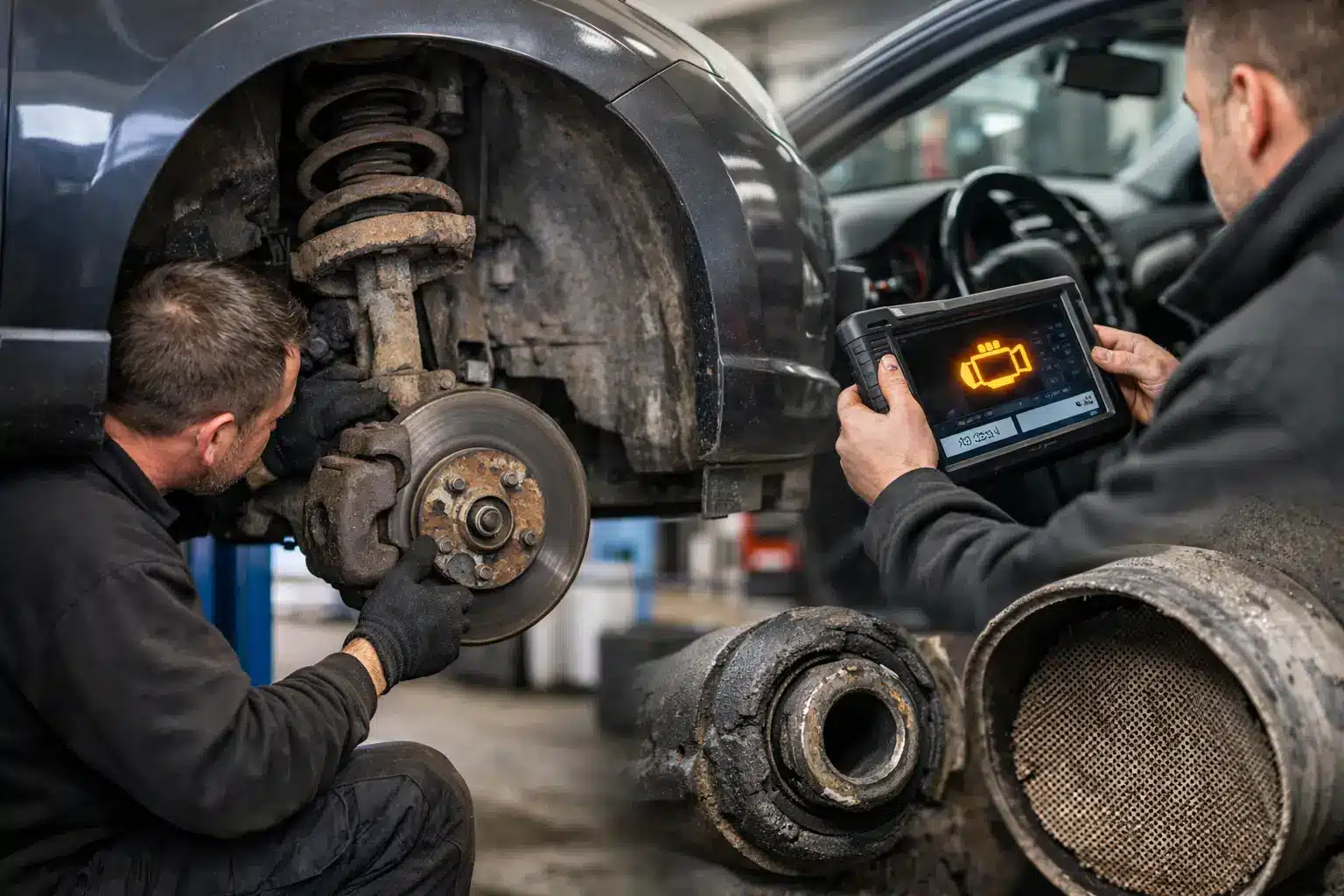
A good inspection starts with listening to the symptoms. Is it over bumps, on turns, under braking, or all the time? After that, the car needs to be checked physically for wear, looseness, split rubber bushes, leaking shocks, damaged springs, and excessive play in joints.
In many cases, the fault becomes obvious once the wheel is off and the suspension is tested under load. Other times, it takes a more careful check because the noise only appears in a certain position or under road conditions that are hard to copy in the workshop.
That is why throwing random parts at the problem can waste money. If one garage replaces drop links without checking the rest of the suspension, the noise may still be there because the real issue was a top mount or lower arm bush.
Can a suspension knock fail an MOT?
Yes, it can. The noise itself is not what fails the MOT, but the worn or damaged part causing it might. Excessive play in a ball joint, badly worn bushes, leaking shocks, broken springs, or insecure mountings can all lead to failure.
Even if the car passes, an advisory for suspension wear should not be ignored. Those parts do not usually fix themselves, and wear tends to get worse quickly once it starts.
If your MOT is coming up and you already know there is a knocking sound, it makes sense to get it checked first. That gives you a clear answer and avoids the usual guesswork after a fail.
What suspension repairs might be needed?
The repair depends on what is worn. In most cases, it is one or more of the following: drop links, suspension arm bushes, ball joints, top mounts, coil springs, shock absorbers, or anti-roll bar bushes.
Sometimes the fix is straightforward and can be done the same day, depending on parts and workshop space. Sometimes extra wear is found once the vehicle is inspected, especially if the noise has been present for a while.
The main thing is to fix the cause, not just the symptom. If a tyre has started wearing unevenly because of suspension play, it is worth checking alignment as well once the repair is done.
Car making knocking noise suspension UK – when to book it in
If the noise is recent, getting louder, or affecting how the car feels on the road, book it in sooner rather than later. The earlier the fault is identified, the less chance there is of it damaging tyres, affecting steering, or turning into a bigger repair.
For drivers around Lowestoft, Oulton Broad, Carlton Colville, Kessingland and nearby areas, this is the sort of problem worth diagnosing properly rather than living with. A local garage like AutoFix4u can check the suspension, explain the issue in plain English, and tell you what actually needs doing – with clear pricing and no surprise extras.
If your car is knocking over bumps or sounding loose at the front or rear, get it looked at before it gets worse. Call now, book a suspension check, and get a proper answer while the problem is still manageable.


One thought on “Car Making Knocking Noise Suspension UK”