Best MOT Failure Fixes Checklist
You do not need a long report full of garage jargon when your car has failed its MOT. What you need is a best MOT failure fixes checklist that tells you what has gone wrong, why it usually happens, and what needs sorting first so you can get the car back on the road.
In most cases, MOT failures come down to a small group of repeat faults. We often see worn tyres, brake problems, blown bulbs, suspension wear, poor visibility, and emissions issues. Some are quick fixes. Others need proper diagnostics first, especially if warning lights are on or the car has lost power.
Best MOT failure fixes checklist – start with the safety items
The first thing to look at is anything that affects safe driving straight away. If the MOT failure mentions tyres, brakes, steering or suspension, deal with that before worrying about anything cosmetic or minor.
Tyres are one of the most common failures because they are easy to overlook when life gets busy. The legal tread depth is 1.6mm across the central three-quarters of the tyre, but tyres can still be an MOT problem before they are fully worn out. Cracks in the sidewall, bulges, uneven wear and damage from potholes can all cause a fail. This usually happens because of high mileage, incorrect tyre pressures, poor wheel alignment or worn suspension parts. The fix may be as simple as replacing one or two tyres, but if the wear is uneven, it is worth checking the tracking and suspension at the same time. Otherwise the new tyres can wear out far too quickly.
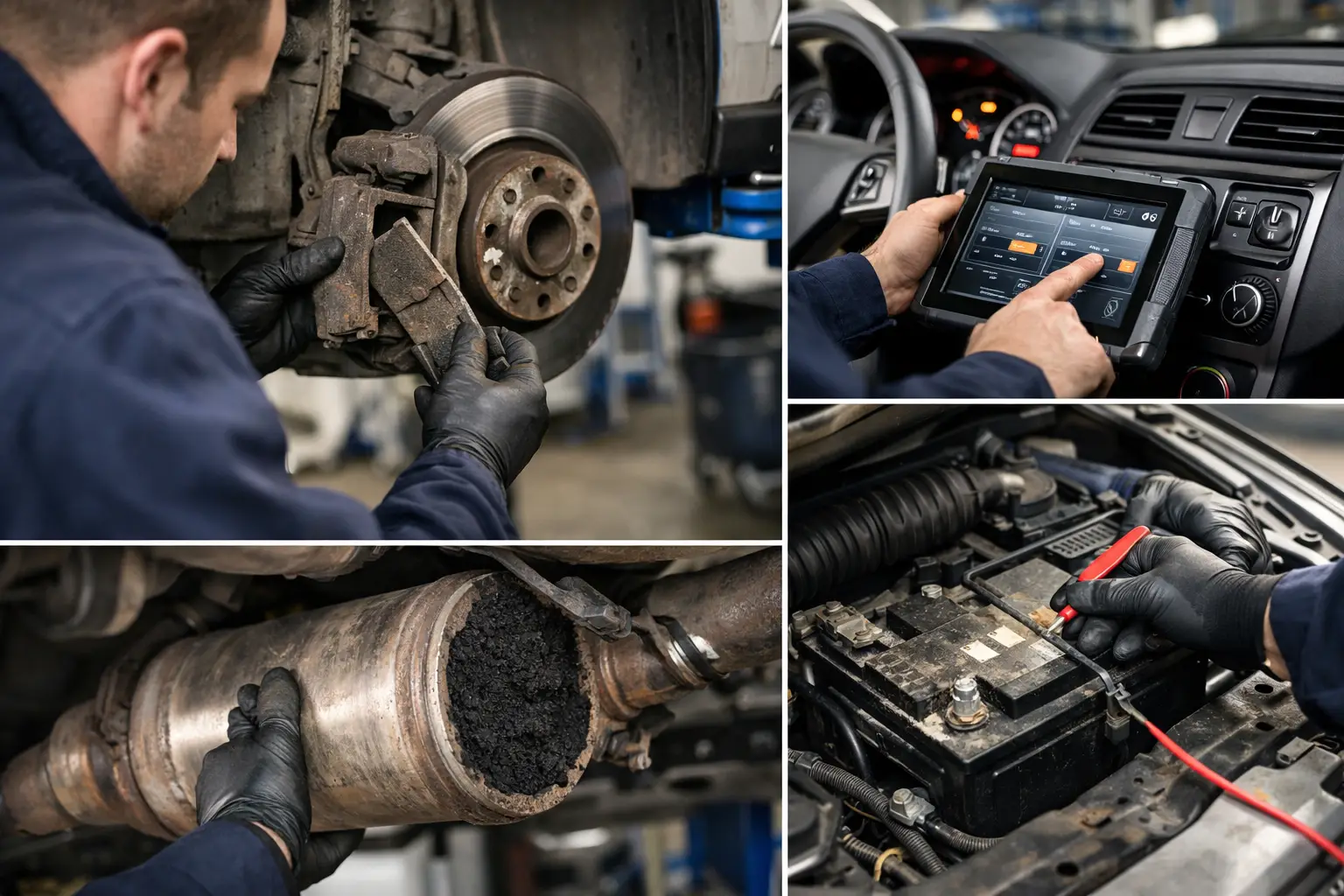
Brakes are next on the list. If the tester has flagged worn brake pads, damaged discs, an imbalance across the axle or poor braking performance, do not leave it. We often see this issue when pads have worn down gradually and the driver has not noticed until the car starts squeaking or the stopping distance changes. Sometimes the fault is mechanical wear. Sometimes a sticking caliper or seized slider is the real cause. That matters because fitting pads alone will not solve the problem for long. A proper brake inspection should confirm what is worn, what is sticking, and whether the repair needs pads, discs, calipers or brake pipes.
Suspension failures are also common, especially on cars used daily on rough local roads. Broken coil springs, worn shock absorbers, damaged bushes and worn ball joints can all lead to an MOT fail. The driver may notice knocking, clunking, uneven tyre wear or the car pulling slightly, but not always. In some cases, the issue only becomes obvious once the vehicle is checked properly on a ramp. The fix depends on the part that has failed, but the important thing is to replace worn components with quality parts and then check the alignment if needed.
Lighting and visibility faults
A surprising number of MOT failures come from simple visibility issues. These are often cheaper and quicker to put right, but they still matter because they affect what you can see and how well other road users can see you.
Blown bulbs are the obvious one. Headlights, brake lights, sidelights, indicators, number plate lights and rear fog lights can all cause a fail. In many cases, this is just normal bulb failure. On newer vehicles, though, it can point to a wiring fault, water getting into the light unit or an issue with the bulb holder. If a bulb keeps failing, that needs investigating rather than just replacing again.
Windscreen wipers and washers are another regular problem. If the blades smear, split or do not clear the screen properly, the car can fail. The same applies if the washer bottle is empty, the pump is not working or the jets are blocked. This is usually a straightforward fix, but if the screen is not clearing properly there is no point putting it off.
Windscreen damage also catches people out. A chip or crack can be acceptable in one area of the glass and a fail in another, depending on size and position. If the damage is in the driver’s view of the road, it is more likely to be a problem. The best approach is to have it checked early rather than turning up for the MOT and hoping for the best.
Emissions failures and warning lights
This is where a lot of drivers get frustrated because the failure sheet may say emissions too high, engine warning light on, or diesel smoke issue without making the root cause obvious. This is also where guessing gets expensive.
Petrol cars can fail on emissions because of faulty sensors, ignition problems, exhaust leaks, catalytic converter issues or poor servicing. Diesel vehicles often fail because of DPF problems, EGR faults, injector issues or a car that has only been used for short journeys and has not completed a proper regeneration. We often see this issue when the engine warning light has been ignored for a while or the car has been driven with reduced power.
The right fix starts with diagnostics, not parts darts. Reading the fault codes is only part of it. The garage should confirm why the warning light is on and whether the emissions problem is caused by a blocked DPF, a failed sensor, an air leak, or another engine fault. In some cases, a forced regeneration may help. In others, the DPF needs cleaning or a separate engine issue has to be fixed first. The same goes for petrol cars with lambda sensor or misfire faults. Replace the wrong part and the car may still fail the retest.
Best MOT failure fixes checklist for common workshop jobs
If you want a practical order to work through, focus on the faults that most often stop a car passing and getting safely back into daily use.
Start with tyres, brakes and suspension because they affect safety most directly. Then sort lights, wipers and washer faults, as these are usually quick wins. After that, deal with warning lights, emissions and any engine-related issues that need diagnostics. Finally, pick up smaller items like number plates, horn faults, mirrors, seatbelts or exhaust mountings.
That order matters because it keeps the repair plan sensible. There is little point spending money on minor items if the car still has a major brake fault or an unresolved engine warning light that could trigger another fail.
What to check before booking MOT failure repairs
Before any repair work starts, ask for the failure points to be explained in plain English. A good garage should be able to tell you which faults are urgent, which are straightforward, and whether any of them may be linked.
For example, uneven tyre wear and a suspension advisory often go together. A brake imbalance may be tied to a sticking caliper. An emissions fail and loss of power may point to a DPF or sensor fault. When the cause is identified properly, you avoid paying twice.
It also helps to ask whether the repair is likely to need parts ordering or whether it can be done the same day. That matters if you rely on one car for work, school runs or caring responsibilities. In most cases, common MOT failure items like tyres, bulbs, pads, discs and wiper blades can be turned around quickly. More involved faults like DPF issues, electrical faults or suspension repairs may need extra time depending on what is found.
When an MOT fail is not a quick fix
Some failures look simple on paper but turn into a larger repair once the car is inspected. Corroded brake pipes are a good example. The MOT may only mention one section, but once the vehicle is on the ramp, more corrosion may be found nearby. The same applies to suspension components. One worn bush can be part of a wider wear pattern.
That does not mean the garage is adding work for the sake of it. It means the first visible fault has led to the real cause. This is why clear communication matters. You should know what has failed, what else has been found, and what needs doing now versus what can wait.
If your car has failed its MOT and you are not sure where to start, the sensible next step is a proper inspection and repair plan. AutoFix4u helps drivers in Lowestoft and nearby areas get from failure sheet to clear fix without the runaround – honest advice, transparent repairs, and same-day slots where possible. Call now or get a quote if you need the fault checked and sorted quickly.
A failed MOT does not always mean a huge bill or the end of the car. In most cases, it means dealing with the problem in the right order, fixing the actual cause, and getting back on the road with confidence.


4 thoughts on “Best MOT Failure Fixes Checklist”