Top Reasons Car Fails MOT and What to Do
An MOT failure usually comes at the worst time – when you need the car for work, school runs or getting around without hassle. The top reasons car fails MOT are often simple faults that build up over time, not major breakdowns. In most cases, the problem was there for a while. It just was not spotted until test day.
That is why a bit of preparation matters. We often see drivers assume the car is fine because it still starts and drives. But an MOT is about roadworthiness and safety, not just whether the engine runs. A worn tyre, a blown bulb or weak brakes can be enough to fail.
Top reasons car fails MOT
Some MOT failures are more common than others. They tend to come down to parts that wear out naturally, small faults that are easy to miss, or warning signs that drivers put off dealing with.
Lights and electrical faults
This is one of the most common reasons a car fails. A bulb can go without you noticing, especially if it is a brake light, number plate light or one side light. Sometimes the bulb itself is fine, but there is a wiring fault, moisture in the unit or a poor connection.
The problem is straightforward. If a required light does not work properly, the car may fail. The fix depends on the cause. In some cases it is a quick bulb replacement. In others, proper diagnostics are needed to find an electrical issue.
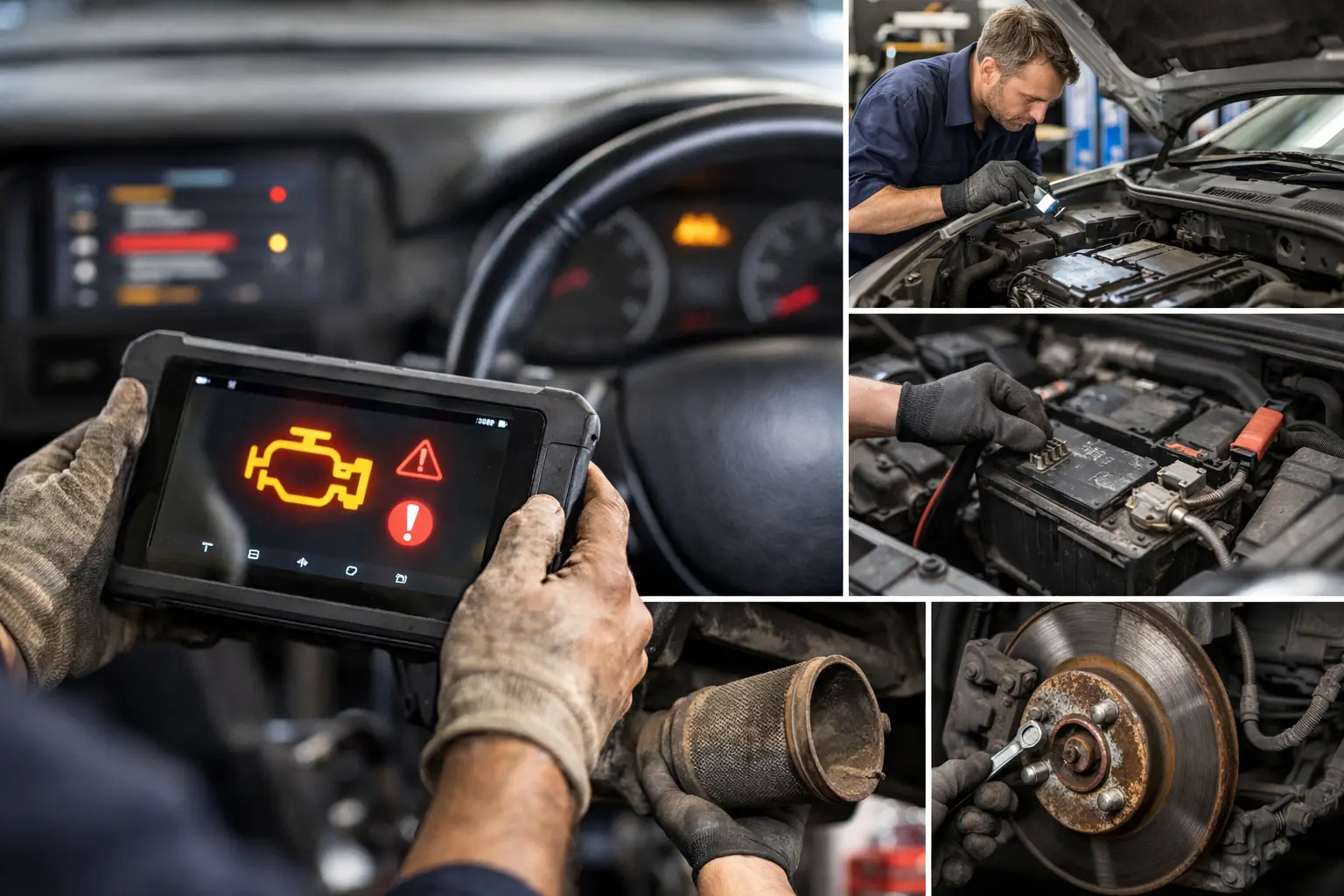
If your dashboard has warning lights on, that can also cause trouble at MOT time. An engine warning light, ABS light or airbag light should never be ignored. This usually happens because the car has logged a fault that needs to be diagnosed properly, not just cleared.
Tyres below the legal limit
Tyres are another regular fail point. The legal minimum tread depth is 1.6mm across the central three-quarters of the tyre, but tyres can still be unsafe before they get that low if the wear is uneven or there is damage to the sidewall.
We often see this issue when tracking is out, suspension parts are worn, or tyre pressures have been neglected for too long. The tyre may look acceptable at a glance, but the inner edge can be badly worn.
The solution is not just fitting another tyre and hoping for the best. If the wear pattern is uneven, it is worth checking the alignment and suspension too. Otherwise the replacement tyre may wear out just as quickly.
Brake problems
Brakes are a big one, and rightly so. Worn brake pads, damaged discs, sticking callipers and weak handbrakes are all common MOT failure points. Sometimes the driver has noticed a grinding noise, pulling under braking or a soft pedal. Other times, there are no obvious signs until the test picks it up.
This usually happens because brake parts wear gradually. The car still stops, so it feels like it can wait. But reduced braking performance is a safety issue, and MOT testers will check braking efficiency as well as the condition of the components.
If your brakes are making noise or do not feel right, get them checked before the MOT rather than after a fail. In many cases, catching brake wear early keeps the repair simpler and avoids further damage.
Suspension and steering wear
Knocking over bumps, vague steering and uneven tyre wear often point to suspension or steering faults. Worn bushes, drop links, ball joints and shock absorbers are all common problems, especially on cars that do a lot of daily miles on mixed road surfaces.
This kind of wear can creep in slowly. The car still feels usable, but not quite as solid as it used to. During an MOT, any excessive play or damage can lead to a failure.
The fix depends on what is worn. Sometimes it is one part. Sometimes a few related components need attention together. A proper inspection matters here because replacing the obvious part does not always cure the root cause.
Windscreen, wipers and washers
A damaged windscreen can fail an MOT if the crack or chip is in the driver’s view or large enough to breach the rules. Wipers that smear, split or fail to clear the screen properly are another common issue. So are washers that do not spray.
These faults often get ignored because they seem minor. But visibility is a basic safety requirement. If the tester cannot pass the car as safe to drive with a clear view of the road, it will not pass.
The good news is that these are often easy checks before the test. Make sure the washer bottle is topped up, the blades are in good condition and any windscreen damage is assessed early.
Exhaust emissions
Emissions failures are common on petrol and diesel cars, especially older ones or vehicles that do lots of short trips. If the engine is not running cleanly, the emissions reading may be too high. On diesel cars, DPF issues are a regular cause.
We often see this issue when there is an engine management fault, a sensor problem, a blocked DPF or a car has not had a proper run for some time. A warning light may already be on, but not always.
This is where guessing gets expensive. Fuel additives and a long drive might help in some cases, but if there is an underlying fault, the problem will stay there. A diagnostic-first approach usually saves time because it identifies why the emissions are out rather than treating the symptom.
Why MOT failures catch drivers out
A lot of MOT failures happen because the signs were easy to dismiss. A light on the dash that comes and goes. A tyre that looked all right from one angle. Brakes that squeak a bit in the morning. None of it feels urgent until the car fails.
There is also the problem of modern cars hiding faults well. A car can feel normal to drive and still have issues with emissions, sensors, ABS or suspension wear. That is why relying on how the car feels is not always enough.
What to check before your MOT
If your test is coming up, it is worth doing a few basic checks. Look at all exterior lights, check tyre tread and condition, test the wipers and washers, and make sure there are no warning lights showing on the dash. Listen for brake noises and pay attention to any pulling, vibrations or knocks.
That said, some faults need a proper inspection to spot them. You cannot always see brake wear through the wheel, and you will not diagnose an emissions issue by eye. If the car has any warning signs at all, it makes sense to get it looked at before the test.
When a pre-MOT check makes sense
Not every car needs a full pre-MOT inspection, but it is a smart move if your vehicle has had a warning light, has been making noises, or has not been serviced in a while. It is especially useful if you rely on one car and cannot afford downtime.
In most cases, a pre-MOT check gives you a clearer picture. You find out what is likely to fail, what may need attention soon, and what can wait. That means fewer surprises and a better chance of getting the car sorted quickly.
For drivers around Lowestoft, that usually matters more than anything else. You want the problem explained clearly, a sensible repair plan, and no messing about.
Failed your MOT already?
If the car has already failed, the next step is to focus on the actual reasons listed on the failure sheet. Some are minor and straightforward. Others point to a bigger issue behind the scenes. A failed emissions test, for example, may be tied to a sensor fault or DPF problem. Uneven tyre wear may mean suspension or alignment issues.
That is why the best approach is problem, cause, solution. Find the fault properly, understand why it happened, then repair it properly so it does not come straight back. We often see people spend money on the obvious part only to find the real cause was never dealt with.
If you need fast help with an MOT failure, warning light, brake problem or diagnostic issue, getting the car checked by a local garage is usually the quickest route back on the road. Same-day slots are often the difference between a minor disruption and losing the car for days.
If your MOT is due soon and something does not feel right, trust that instinct. A quick check now is usually easier than dealing with a fail when you are already under pressure.


One thought on “Top Reasons Car Fails MOT and What to Do”