
MOT Preparation Checks That Prevent a Fail
A failed MOT is often caused by something that gave a warning beforehand: a brake that started squealing, a tyre worn further on one edge, a warning light that stayed on, or a bulb that was easy to miss. Proper MOT preparation gives you time to deal with these issues before test day, rather than being left without the car when you need it for work, school runs or appointments.
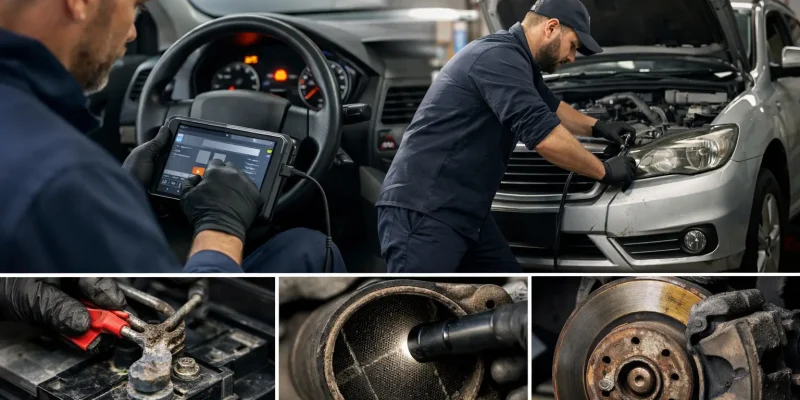
At AutoFix4u, we see plenty of vehicles where a small fault has become a larger repair simply because it was left until the MOT. A pre-MOT inspection is not about finding work that does not need doing. It is about checking the areas most likely to cause a fail, explaining what we find in plain English, and giving you a clear repair plan.
What MOT preparation should actually cover
An MOT checks whether your vehicle meets the minimum legal safety and environmental standards on the day of the test. It is not the same as a service. A car can have fresh oil and still fail on tyres, brakes, lights or emissions. Equally, a car can feel as though it drives normally but have a fault that is visible underneath or picked up by the tester.
In most cases, MOT preparation starts with the obvious items, then moves on to areas a driver cannot easily inspect at home. We check what is likely to fail, what could be recorded as an advisory, and what needs attention soon for safe, reliable motoring.
A sensible check includes the lights and warning lamps, tyres and wheels, brakes, steering and suspension, exhaust condition, wipers and washers, seat belts, registration plates, mirrors, horn and visible fluid leaks. For newer cars, the engine warning light and emissions equipment can be just as important as the mechanical checks.
Start with the faults you can spot yourself
There are a few quick checks worth making before bringing your car in. They will not replace a proper inspection, but they can highlight a problem early.
Walk around the vehicle with the lights switched on. Check headlights, sidelights, brake lights, indicators, rear fog lights and number plate lights. Ask someone to press the brake pedal if possible. A failed bulb is usually a straightforward fix, but moisture inside a lamp or a damaged lens may point to a bigger issue.
Look at the tyres on both sides of the car, including the inner edges where wear can be missed. The legal minimum tread depth is 1.6mm across the central three-quarters of the tyre, around its full circumference. We recommend changing tyres before they get close to that limit, particularly if the weather is wet. Cuts, cracks, bulges and cords showing through are all reasons to act quickly.
Then try the washers and wipers. If the washers do not work, the bottle may be empty, a jet could be blocked, or there may be a pump or electrical fault. Wiper blades that smear, split or leave a large area uncleared can also cause trouble during an MOT, especially if they affect the driver’s view.
Check that the number plates are clean, secure and readable. Make sure the horn works. Inside the car, test each seat belt for damage, secure mounting and positive locking. These are simple items, but they are easily overlooked.
Dashboard warning lights are not something to ignore
A warning light that remains on once the engine has started can cause an MOT failure, depending on the system involved. The engine warning light, ABS light, airbag light and electronic stability control warning are common examples.
We often see this issue when a customer has been told that the car is still driving fine. That may be true for the moment, but the light means the vehicle has stored a fault. It could be something minor, such as a sensor reading outside its expected range, or it could affect safety systems, emissions or engine performance.
Do not clear a warning light just to get through the test. If the underlying fault remains, it will usually return. More importantly, clearing codes can remove useful evidence that helps pinpoint the cause. A proper diagnostic check reads the stored faults, looks at live data where needed, and confirms whether the repair has solved the problem.
This matters particularly with diesel vehicles. A DPF warning, engine management light or loss of power can be linked to a blocked diesel particulate filter, pressure sensor fault, temperature sensor issue or another engine fault stopping regeneration. A forced regeneration is not always the answer. The cause needs checking first, otherwise the problem can come straight back.
Brakes, steering and suspension need more than a quick look
Brakes are one of the most common reasons drivers book MOT failure repairs. You may notice squealing, grinding, a pulling sensation, vibration through the pedal, a soft pedal or the handbrake needing more effort than usual. Sometimes there are no clear symptoms at all.
Brake pads and discs wear gradually, so the change can be hard to notice when you drive the same car every day. During an inspection, we look at pad thickness, disc condition, brake pipes, hoses, calipers and the operation of the parking brake. If a caliper is sticking, replacing pads alone may not fix the root cause.
Knocking over bumps, vague steering, a car that pulls to one side or uneven tyre wear can point to worn suspension or steering components. This usually happens because ball joints, bushes, shock absorbers or suspension links wear over time, especially on cars regularly driven over rough roads and potholes.
Not every knock means an immediate MOT fail, but it should not be guessed at. A hands-on check can show whether there is actual play in a component, whether it is safe for now, and what should be planned. Clear advice is better than changing parts until the noise disappears.
Exhaust and emissions faults can catch drivers out
A noisy exhaust does not always mean the whole system needs replacing. It may be a loose heat shield, failed clamp, cracked section or corroded mounting. However, a leak can affect emissions results, create excessive noise and, if it is serious enough, lead to an MOT failure.
Petrol and diesel vehicles are tested differently, but both need to meet the applicable emissions limits. A vehicle that has been used mainly for short local runs may struggle if the engine and exhaust system have not warmed up fully. Taking the car for a normal, decent run before the test can help it reach operating temperature, but it will not cure a mechanical or sensor fault.
If there is an engine warning light, smoke from the exhaust, poor fuel economy, rough running or loss of power, book diagnostics before the MOT. Guessing at an emissions fault can become expensive. Finding the actual cause first usually saves time and prevents repeat visits.
Do not forget visibility and vehicle condition
A chipped windscreen can fail an MOT if the damage is in the driver’s direct view and is large enough to affect vision. Damage elsewhere may be recorded as an advisory depending on its size and position. Mirrors must be secure and provide a proper view behind the vehicle.
Doors, bonnet and boot need to open and close securely. The fuel cap should fit correctly, and there should not be dangerous sharp edges or loose bodywork. These checks may sound basic, but they matter because the MOT is concerned with the safe condition of the vehicle, not just what happens when the engine is running.
Also make sure the vehicle identification number can be read where required and that the registration plates match the vehicle. If you have fitted accessories or carried out modifications, make sure nothing has affected lights, tyre clearance, seat belts or the driver’s view.
When to book MOT preparation
The best time is around two to four weeks before the MOT is due. That leaves enough room to inspect the car, order parts if needed and carry out repairs without a last-minute rush. If your MOT is due tomorrow, it is still worth calling. Same-day checks may be possible, depending on workshop availability and the fault involved.
Book sooner if you have a warning light, brake noise, a tyre concern, steering knock, exhaust rattle or a car that has recently failed. Bring any previous MOT failure sheet or advisory list with you. It gives a useful starting point, but we will still inspect the vehicle ourselves rather than assume last year’s note tells the whole story.
A preparation check does not guarantee that an MOT tester will find nothing on the day. Conditions can change, and the official test is carried out independently. What it does do is reduce avoidable surprises and give you a fair picture of your car’s condition before it becomes urgent.
If your MOT is approaching and something does not feel right, do not wait for a fail to tell you there is a problem. Contact AutoFix4u for straightforward MOT preparation in Lowestoft, clear pricing and honest recommendations. We will check the fault properly and help you get back on the road with confidence.