Modern Diesel Emissions: What Drivers Need to Know
Your diesel car suddenly loses power during a journey around Lowestoft. Perhaps a DPF warning light appears, or the engine struggles to accelerate.
These symptoms can point to a problem with modern diesel emissions systems. However, they do not automatically mean an expensive component has failed.
Modern diesel engines use several systems to reduce harmful exhaust emissions. These include the diesel particulate filter (DPF), exhaust gas recirculation (EGR) and, on many vehicles, AdBlue technology.
At AutoFix4u Garage Lowestoft, we help drivers investigate warning lights and diesel performance problems before recommending repairs.
This guide explains how these systems work, what can go wrong and when to seek professional diagnostics.
What are modern diesel emissions systems?
Modern diesel emissions systems help reduce pollution from vehicle exhaust gases.
Older diesel engines often produced more visible smoke and soot. Today, manufacturers use several technologies to control different pollutants.
The main systems include:
- DPF: Traps soot particles from the exhaust.
- EGR: Helps reduce nitrogen oxide formation.
- AdBlue and SCR: Reduce nitrogen oxides on vehicles equipped with this technology.
- Sensors: Monitor exhaust temperatures, pressures and emissions-related readings.
However, not every diesel vehicle uses the same equipment.
The system depends on the vehicle’s age, engine design and emissions standard.
Why do diesel emissions systems develop faults?
These systems work in demanding conditions.
For example, exhaust components experience high temperatures and soot deposits.
Meanwhile, sensors and electrical controls must operate accurately.
Over time, components can wear or become restricted.
As a result, the vehicle may display warning lights or reduce engine power.
However, a warning does not always identify the failed component.
That is why proper diagnosis matters.
What does a diesel particulate filter do?
A diesel particulate filter, or DPF, captures soot from exhaust gases.
Without the filter, more harmful particles could leave the exhaust system.
However, soot gradually builds up inside the DPF.
Therefore, the vehicle must remove suitable amounts of soot through a process called regeneration.
How does DPF regeneration work?
During regeneration, the exhaust system reaches conditions that allow trapped soot to burn away.
The vehicle’s engine management system controls this process.
However, regeneration requires suitable operating conditions.
For example, frequent short journeys may prevent the process from completing.
Over time, soot can accumulate and restrict the filter.
Why can short journeys cause DPF trouble?
Many drivers regularly use their diesel cars for short trips.
These might include school runs, shopping or short journeys around Lowestoft.
However, the engine and exhaust may not reach the conditions needed for successful regeneration.
Consequently, the filter may collect soot faster than the system can remove it.
The vehicle may then display a DPF warning.
A longer journey can sometimes help when the manufacturer recommends it and the vehicle is operating normally.
However, driving faster or harder is not a safe cure for every blocked DPF.
If the vehicle loses power or displays serious warnings, arrange professional advice.
What are the signs of a blocked DPF?
A DPF problem can affect vehicle performance.
Common symptoms include:
- A DPF warning light.
- An engine management warning.
- Reduced acceleration.
- Increased fuel consumption.
- Frequent regeneration attempts.
- Cooling fans running after a journey.
- Limp mode.
- Unusual exhaust smells.
However, these signs can also indicate another engine fault.
For example, a faulty pressure sensor may create misleading readings.
Therefore, a mechanic should check the relevant systems before recommending repairs.
Read our Blocked DPF Symptoms Guide for more information.
Can a blocked DPF damage the engine?
A heavily restricted DPF can affect engine operation.
In addition, repeated failed regeneration attempts may cause other problems.
For example, some diesel engines can suffer fuel dilution of the engine oil.
If the oil level rises above the maximum mark, seek professional advice before driving further.
Ignoring DPF warnings may also lead to limp mode or more involved repairs.
Therefore, early investigation is important.
What is an EGR valve?
EGR stands for exhaust gas recirculation.
The system returns a controlled amount of exhaust gas to the engine intake under suitable conditions.
This helps reduce the formation of nitrogen oxides.
However, soot and oil deposits can build up around EGR components.
As a result, the valve may begin sticking or operating incorrectly.
What are the symptoms of EGR problems?
Common signs include:
- Rough idling.
- Poor acceleration.
- Hesitation.
- Engine warning lights.
- Increased fuel consumption.
- Excessive smoke.
- Limp mode.
However, these symptoms do not automatically confirm EGR failure.
For example, air intake faults, boost leaks and fuel problems can produce similar effects.
Therefore, testing should come before replacement.
Does an EGR valve always need replacing?
No. The correct repair depends on the fault.
Sometimes, carbon deposits affect valve movement.
In other cases, the component has an electrical or mechanical failure.
A mechanic may inspect relevant readings, wiring and associated parts.
Cleaning can be suitable for some faults. However, it will not repair every failed EGR component.
The technician should explain the findings before recommending work.
What is AdBlue and how does it work?
Many newer diesel vehicles use AdBlue as part of a selective catalytic reduction system.
This technology helps reduce nitrogen oxide emissions.
AdBlue is a separate fluid. It is not a diesel fuel additive.
The vehicle stores it in a dedicated tank and uses it within the exhaust treatment system.
However, AdBlue is not fitted to every diesel vehicle.
What happens when AdBlue runs low?
The dashboard may display a low AdBlue warning.
Some vehicles also show a remaining driving range before a restart restriction.
If the level becomes too low, the vehicle may prevent a future engine restart.
Therefore, you should follow the manufacturer’s refill instructions promptly.
Why does an AdBlue warning stay on?
Sometimes, topping up the fluid does not clear the warning.
This may indicate another problem.
Possible causes include:
- A faulty level sensor.
- AdBlue pump problems.
- A blocked or faulty injector.
- Crystallised deposits.
- Electrical faults.
- NOx sensor problems.
- A fault within the SCR system.
However, the exact cause requires investigation.
Do not assume that the entire AdBlue system needs replacing.
Can you ignore an AdBlue countdown?
No. Some vehicles can prevent an engine restart once the countdown reaches its limit.
Therefore, investigate an unexplained warning before the vehicle becomes unusable.
Also, use only the correct AdBlue product.
Never pour AdBlue into the diesel fuel tank.
What are NOx sensors?
NOx sensors help monitor nitrogen oxide levels in the exhaust system.
On compatible vehicles, the engine management system uses their readings to assess emissions control.
However, these sensors can develop faults.
You may notice an engine warning light or an AdBlue-related message.
A sensor-related fault code does not always prove that the sensor itself has failed.
For example, wiring problems or another emissions fault may affect the readings.
Therefore, a mechanic should assess the fault before replacing the sensor.
Why does a diesel car enter limp mode?
Limp mode reduces vehicle performance when the engine control system detects certain problems.
This can help limit further damage.
However, it can make the vehicle difficult to accelerate.
Common possible causes include:
- DPF restrictions.
- EGR faults.
- Turbo boost problems.
- Fuel delivery faults.
- Sensor problems.
- Electrical issues.
Therefore, limp mode does not automatically mean the DPF is blocked.
A mechanic needs to investigate the stored information and the physical symptoms.
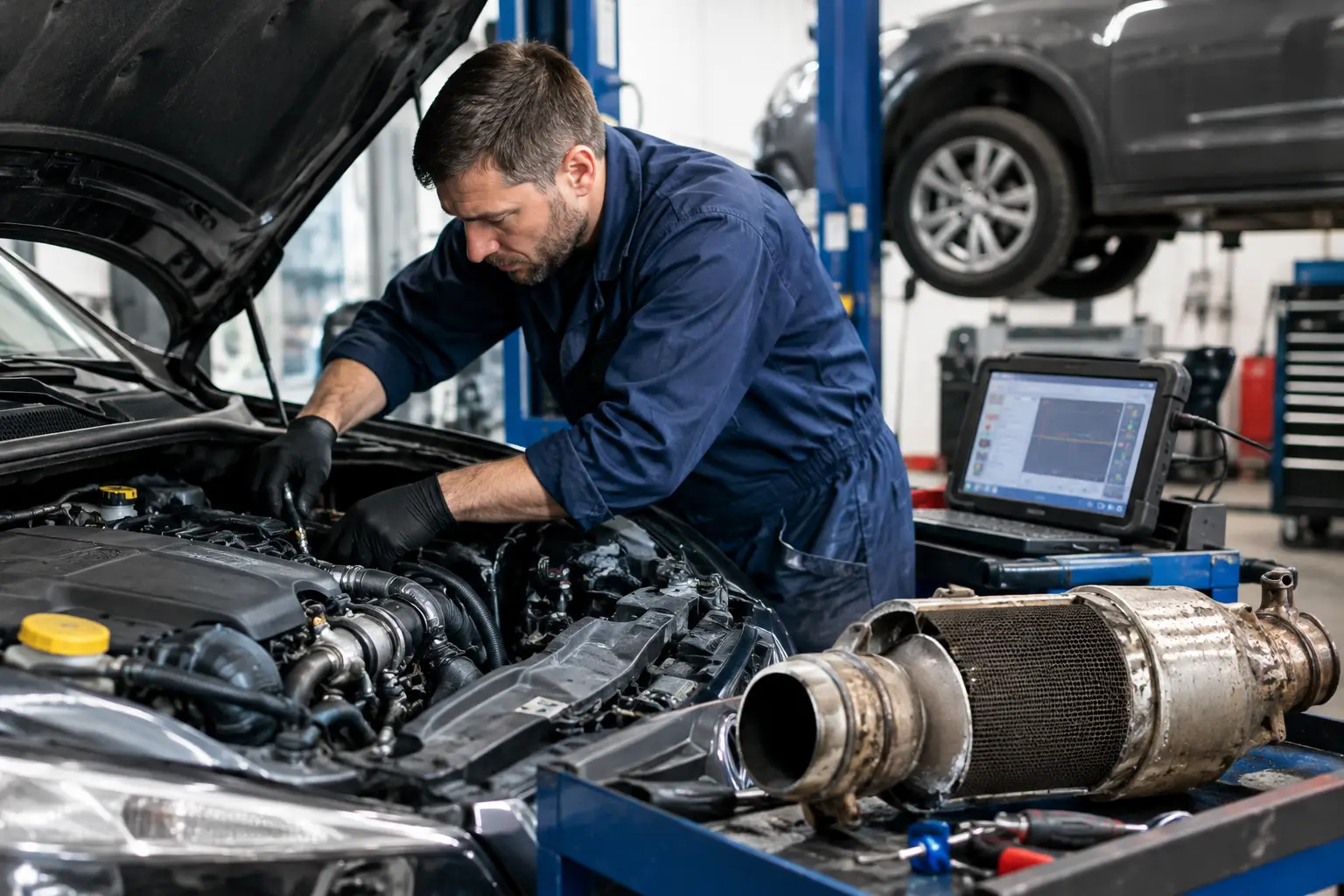
Our Engine Diagnostics Lowestoft service helps identify relevant faults before repair work begins.
How does a garage diagnose diesel emissions faults?
Professional diagnostics involves more than clearing a dashboard warning.
First, the mechanic asks about the symptoms.
Next, they review electronic information and carry out suitable checks.
Step 1: Review the warning lights
The technician identifies the warning symbols and any dashboard messages.
For example, a DPF warning may require different checks from an AdBlue countdown.
Step 2: Read stored fault codes
Diagnostic equipment can retrieve fault codes from compatible vehicle systems.
However, these codes are starting points.
They do not always identify the failed component.
Step 3: Check live data
The technician may examine readings such as:
- DPF differential pressure.
- Exhaust temperatures.
- Relevant sensor values.
- Engine operating conditions.
- Regeneration status, where supported.
- Boost pressure or air intake readings.
These measurements can help narrow down the fault.
However, the mechanic must interpret them alongside the symptoms.
Step 4: Inspect relevant components
Further checks may involve hoses, wiring, connectors or mechanical components.
For example, a damaged hose may affect pressure readings.
Meanwhile, a faulty sensor connection can create an electronic warning.
Step 5: Explain the repair options
Finally, the mechanic explains what the checks found.
Some vehicles may need a component repair.
Others may require a suitable regeneration procedure or further investigation.
At AutoFix4u Garage Lowestoft, we focus on finding the cause before recommending repairs.
When is DPF regeneration suitable?
DPF regeneration can help remove soot when the vehicle and filter meet the necessary conditions.
However, it is not suitable for every fault.
For example, a severely restricted filter or a failed sensor may prevent successful regeneration.
In addition, regeneration does not remove all accumulated ash from an ageing DPF.
Therefore, the mechanic should assess the filter and related systems first.
Our DPF Regeneration Lowestoft service covers DPF assessment and regeneration where appropriate.
If the filter cannot regenerate safely, the technician can explain the next options.
Is removing the DPF or EGR a good solution?
Some drivers consider removing or disabling emissions equipment after repeated faults.
However, this can create legal, environmental and mechanical problems.
In the UK, removing a DPF fitted by the manufacturer will result in an MOT failure.
Using a vehicle that no longer meets its required emissions standards can also break road-use rules.
Other emissions-control modifications may create similar compliance problems.
Therefore, proper diagnosis and repair offer the safer approach.
For official information, see the UK government’s DPF guidance.
Can you drive with a diesel emissions warning?
The answer depends on the warning and how the vehicle behaves.
A steady amber warning may allow a short, careful journey to a garage.
However, the handbook may require a different response.
When should you stop driving?
Stop safely and seek professional advice if:
- The engine loses significant power.
- The vehicle produces excessive smoke.
- A serious engine warning appears.
- The engine runs roughly or misfires badly.
- The temperature gauge rises dangerously.
- You notice severe mechanical noises.
- The vehicle becomes unsafe to control.
Do not attempt a forced regeneration yourself.
Also, do not keep driving a severely restricted vehicle to clear a warning.
Further damage may occur.
How can you reduce diesel emissions problems?
Regular maintenance and suitable driving habits can help.
However, no routine can prevent every component failure.
Follow the service schedule
Use the correct oil specification and replace service items when due.
Some diesel engines require low-ash oil to protect emissions equipment.
Therefore, always follow the manufacturer’s requirements.
Our Car Servicing Lowestoft service covers scheduled maintenance for cars and vans.
Pay attention to DPF warnings
Do not ignore a warning simply because the car still drives normally.
Instead, follow the vehicle handbook and arrange checks when necessary.
Avoid repeated interrupted regenerations
Frequent short journeys may contribute to incomplete regeneration.
Where the manufacturer recommends it and the car is healthy, a suitable longer journey may help.
However, do not use this approach when the vehicle has serious symptoms.
Investigate performance changes
Reduced power, poor fuel economy and rough running can indicate developing problems.
Therefore, arrange diagnosis before the fault affects other components.
Use the correct AdBlue
Always choose the correct specification for the vehicle.
Also, keep dirt and other liquids out of the AdBlue tank.
Book diesel emissions diagnostics in Lowestoft
Modern diesel emissions systems help reduce pollution. However, DPF, EGR and AdBlue faults can affect vehicle reliability.
The correct repair starts with identifying the cause.
At AutoFix4u Garage Lowestoft, we help drivers investigate engine warnings, DPF issues, limp mode and related diesel performance problems.
We use professional diagnostic equipment where appropriate and explain the findings before recommending work.
For more information, visit our Engine Diagnostics Lowestoft page.
Call: 07778 979802
WhatsApp: Message AutoFix4u Garage Lowestoft
Request an estimate: Get a Free Estimate
Address: Unit 4, 10 Battery Green Road, Lowestoft, NR32 1DE.
Early diagnosis can help prevent a minor diesel emissions fault from developing into a more expensive repair.


