
Your car was fine yesterday. This morning, the dashboard barely lights up, the starter clicks once or not at all, and you are already late for work, the school run or an appointment. This flat battery recovery example shows what a proper recovery should involve: getting you moving safely, then checking why the battery went flat in the first place.
A jump-start can be the right immediate fix. It is not always the full repair. In most cases, the important part is finding out whether the battery has simply discharged or whether the car has a fault that will leave you stranded again tomorrow.
Flat battery recovery example: from no-start to diagnosis
A customer’s car is parked outside their home overnight. In the morning, it will not start. The central locking is slow, the interior lights are dim and the engine only makes a rapid clicking sound when the key is turned. These are common signs of a battery with too little charge to operate the starter motor.
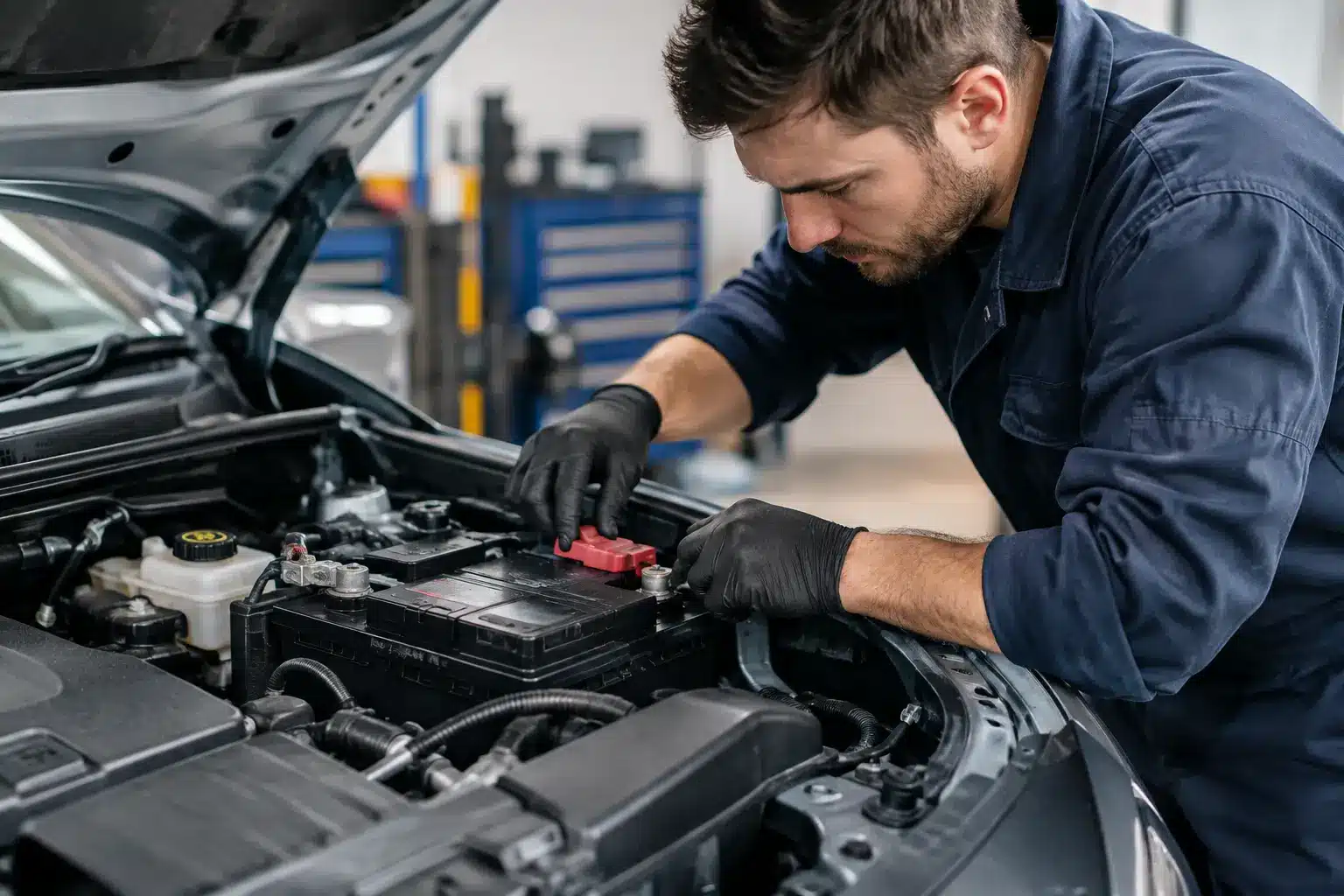
The first step is to make the situation safe. The vehicle should be in a safe place, with the handbrake on and the ignition switched off. A technician will check for obvious issues before connecting jump equipment. That includes loose battery terminals, visible damage to the battery case, signs of leaking fluid, and damaged cables.
If the battery is suitable for jump-starting, we can use a proper booster pack or safe jump leads to get the engine running. Once the engine starts, though, the job is not treated as finished. A car that starts after a boost but has a charging fault may get only a few miles before stopping again.
What happens once the engine starts
With the engine running, the charging system needs checking. The alternator should replenish the battery as the engine runs. If it is not producing enough charge, the battery warning light may be on, lights may dim while driving, or the car may cut out once the remaining battery power is used.
We also check the battery itself. A battery can show enough voltage to wake up the dashboard but still fail under the heavy load of starting the engine. This is common with older batteries, especially after cold weather or short local journeys. If the battery fails a proper test, replacement is usually more sensible than repeatedly jump-starting it.
The customer then gets a plain-English explanation. It may be as simple as a worn-out battery that needs replacing. Or the tests may point to an alternator, wiring or electrical drain that needs further diagnostic work. The repair plan should match the fault, with clear pricing before work goes ahead.
Why a jump-start does not always solve a flat battery
A flat battery is a symptom, not a diagnosis. Sometimes the reason is obvious. A door may not have shut properly, an interior light could have been left on, or the car may have sat unused for several weeks. In that case, a battery recharge and test may be all that is needed, provided the battery remains healthy.
We often see this issue when a vehicle only does short runs. Starting an engine takes a lot of power. If the car is then driven for five or ten minutes at a time, particularly with lights, heater fan, heated screens and mobile phone chargers in use, it may not replace what it used. Over time, the battery becomes weaker.
Other causes need attention quickly. A failing alternator cannot keep the battery charged while you drive. Corroded or loose connections can interrupt charging. An electrical drain can continue using power while the vehicle is parked, caused by a faulty module, light, accessory or wiring issue. Simply fitting a new battery without checking the cause can mean the same problem returns.
Checks that find the root cause
At AutoFix4u, recovery support is followed by sensible checks where needed. We do not want to sell a battery if the real problem is elsewhere. Testing normally starts with battery condition and charging voltage, then moves on if the results do not add up.
A technician may check whether the battery holds its charge after the engine is switched off and whether the alternator is charging correctly under load. Electrical items such as headlights, heated rear window and blower motor can show up a weak charging system. Battery terminals and earth connections are also checked, as poor contact can imitate a failing battery.
If the battery keeps going flat after it has been charged or replaced, further diagnostics may be needed to find a parasitic drain. Put simply, this means something is drawing power when the car should be asleep. This type of fault can take more time to trace, so it is better to test properly than guess and replace parts unnecessarily.
What you can do while waiting for help
If you suspect a flat battery, avoid repeatedly trying to start the engine. Each attempt takes more power from an already weak battery. Switch off lights, radio, heater and any accessories, then make sure the vehicle is parked safely.
Do not use jump leads if the battery is cracked, leaking, badly swollen or smells strongly of rotten eggs. Keep flames and cigarettes away from the battery area. If you are unsure, call for recovery assistance rather than taking a risk.
Modern vehicles also need a little care. Some cars have designated jump-start points rather than easy access to the battery. Hybrid and electric vehicles have different systems and should only be dealt with using the correct procedure. Your vehicle handbook will confirm the right approach. A standard 12-volt battery may still be used for the car’s electrical systems, but the high-voltage system is not something to interfere with.
Once the car starts, do not assume a long drive will always recharge it fully. If the battery is old or damaged, driving may not restore it. If a charging fault is present, you could lose power on the road. A quick battery and charging check gives a far clearer answer.
When recovery is the better option
There are times when a jump-start is not the sensible choice. If the car stops while driving, the battery warning light is on, the steering feels heavy, or several warning lights appear together, arrange recovery. These can be signs that the alternator has failed, and the engine may stop again without warning.
Recovery is also the right call if the vehicle is in an unsafe location, the battery is visibly damaged, or it will not start after a proper boost. A no-start fault is not always a battery issue. It could be a starter motor, immobiliser, wiring fault or another electrical problem. Proper diagnostics prevent wasted time and avoid changing parts on a guess.
For drivers in Lowestoft and nearby areas, a local garage can help with the immediate no-start problem and the checks that follow. Same-day slots may be available depending on the fault and parts required. You will get honest recommendations, clear pricing and no surprise extras.
If your car has needed more than one jump-start, do not wait for the next early-morning failure. Arrange a battery and charging-system check, get the cause confirmed, and leave knowing your car is far less likely to let you down when you need it most.