
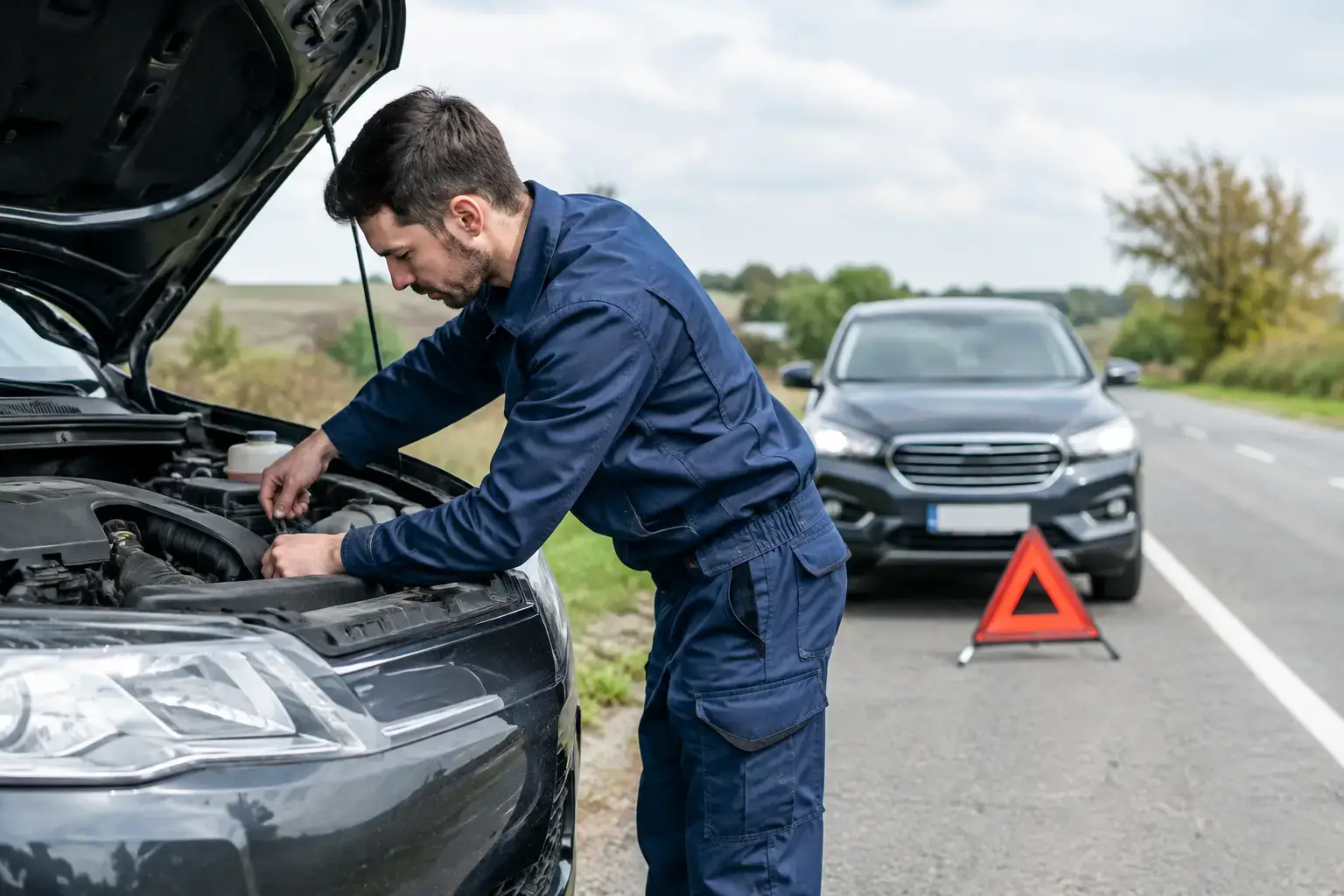
A warning light on the way to work, a sudden loss of power near Oulton Broad, or a car that simply will not restart after the school run can leave you flustered. Roadside breakdown safety starts with one simple priority: get yourself and your passengers out of danger before worrying about the fault, the repair or getting home.
The right action depends on where the vehicle stops. A flat battery in a quiet car park is very different from a smoking engine on a fast A-road. Do not assume you can always nurse the car to a safer place. If it is losing power, overheating, has a brake problem or is making a severe noise, continuing can put people at risk and may turn a repairable fault into a much bigger job.
Roadside breakdown safety: your first few minutes
If the vehicle is still moving, stay calm and avoid sharp braking or sudden steering. Switch on the hazard warning lights, ease off the accelerator and look for the safest available place to stop. A lay-by, side road, petrol station or car park is usually better than a narrow verge or a busy junction.
Once stopped, apply the handbrake, select neutral or park, and switch off the engine if it is safe to do so. Put on your hazard lights and, if visibility is poor, use sidelights where appropriate. At night, in rain or fog, other drivers may not see a stationary vehicle until late, so make yourself as visible as possible without standing in the road.
Before anyone gets out, take a moment to assess the traffic. Passengers should leave from the side away from moving vehicles where that is possible. Keep children close and well away from the carriageway. Do not stand between your car and oncoming traffic, and do not try to inspect a tyre, look under the bonnet or unpack the boot if it means putting yourself in a dangerous position.
On an ordinary road, move behind a barrier or well away from the vehicle if there is somewhere safe to wait. On a narrow country road without a safe verge, it may be safer to stay belted inside with the doors locked while arranging help. There is no one rule for every roadside situation – your position, the traffic speed and visibility all matter.
If you break down on a motorway or fast road
A motorway, dual carriageway or fast-moving A-road needs extra caution. If the vehicle can still move, leave at the next exit or pull into a service area rather than stopping on the hard shoulder. If you have no choice, use the hard shoulder where one is available, stopping as far left as possible with the wheels turned left.
Get everyone out using the left-hand doors and move behind the barrier, well away from the vehicle and traffic. Do not walk along the carriageway. Do not attempt a roadside repair, even if the problem appears minor.
Some roads have emergency refuge areas rather than a continuous hard shoulder. If you can reach one safely, use it and follow the instructions shown there. If you stop in a live lane and cannot move the vehicle, keep seatbelts on, hazard lights operating and call 999 if you are in immediate danger. Tell the operator the road, direction of travel, nearest marker post, junction or landmark if you can see one.
A breakdown provider will need the same details. Knowing your precise location saves time, especially on unfamiliar routes after dark. Your mobile phone map can help, but do not walk around looking for a signal or a sign if that puts you near traffic.
Warning signs that mean stop and call for help
Some faults give you a little time to find a safe stopping place. Others need immediate action. Pull over as soon as it is safe and arrange recovery if you notice smoke from the engine bay, a strong burning smell, a red oil-pressure warning light, a high engine-temperature warning, or a serious brake warning.
Steam from under the bonnet can mean the engine is overheating. Do not remove the coolant cap while the engine is hot. The cooling system is pressurised, and hot coolant can cause serious burns. Switch off, keep clear of the front of the car and allow it to cool. A coolant leak, failed fan, thermostat fault or water pump problem may be involved, but it needs checking properly.
Loss of power is another situation where the details matter. A car in limp mode may still move slowly, but that does not automatically make it safe to drive. A flashing engine management light, severe misfire, loud knocking, heavy vibration or clouds of smoke all point to stopping and seeking advice. Continuing with an engine misfire can damage the catalytic converter, while a DPF warning combined with poor performance can have several possible causes.
Brake symptoms deserve particular care. A squeal may be wear-related and may not require an emergency stop, but grinding, a soft brake pedal, pulling to one side, strong vibration or a warning light can mean the vehicle is unsafe. Do not rely on the handbrake as a substitute for properly working foot brakes.
If a tyre has failed, slow down gradually, hold the steering wheel firmly and avoid hard braking. Stop somewhere safe before looking at it. Driving on a flat tyre can damage the tyre sidewall and wheel, and changing a wheel beside live traffic is not worth the risk.
Do not let a simple fault become a roadside risk
A flat battery is one of the most common reasons a car will not start. It can be caused by an ageing battery, loose connections, a charging fault, short journeys or something draining power while parked. Jump-starting may get the vehicle going, but it does not identify why the battery went flat.
If you are using jump leads, only do so in a safe place away from traffic and only if you are confident in the correct procedure for both vehicles. Modern vehicles can have sensitive electrical systems, and incorrect connections can cause damage. If the battery has repeatedly gone flat, ask for a battery and charging-system check rather than replacing parts on a guess.
The same applies to warning lights. Clearing a fault code may turn the light off temporarily, but it does not repair the cause. A proper diagnostic check looks at stored fault codes alongside live readings, wiring, sensors and the way the vehicle is behaving. That is how a mechanic separates a one-off issue from a fault that is likely to return.
Keep a few useful items in the car: a charged mobile phone, warm layer, waterproof coat, torch, drinking water and any medication you may need. A high-visibility jacket can be useful, but it does not make it safe to stand near fast traffic. If you carry a warning triangle, do not place it on a motorway or where doing so means walking into danger.
What to tell recovery or a garage
When you call for recovery, give the vehicle registration, exact location, direction of travel and a clear description of what happened. Mention any warning lights, noises, smells, smoke, fluid leaks or loss of braking. Explain whether the car starts, whether it can move, and whether there are vulnerable passengers with you.
This information helps the recovery operator decide what equipment is needed and helps a garage plan the next checks. For example, a vehicle that cranks but will not start needs a different investigation from one that starts but has no charging warning light, or one that cuts out after warming up.
Once the vehicle is somewhere safe, avoid assuming the fault is fixed because it restarts. Intermittent electrical faults, alternator problems, starter motor faults and engine management issues can disappear briefly and return at the worst time. At AutoFix4U in Lowestoft, the sensible next step is to describe the symptoms exactly and arrange suitable diagnostics or repairs based on the evidence, not a guess.
When not to drive on
Do not drive on if steering feels loose or heavy, brakes are not responding normally, the engine is overheating, oil pressure is low, a tyre is badly damaged, there is fuel leaking, or smoke is coming from the vehicle. These are recovery situations. The inconvenience of waiting is usually far less than the risk of a collision, engine damage or being stranded somewhere worse.
For less urgent faults, such as an amber engine light with no change in how the car drives, you may be able to get to a safe location and seek advice promptly. It depends on the warning, the symptoms and the journey ahead. If you are unsure, stop safely and call for guidance rather than gambling on the car making it.
A breakdown is rarely convenient, but a calm decision in the first few minutes protects the people in the car and gives the fault the best chance of being repaired properly later.


