Same Day Car Diagnostics: What to Expect
A warning light on the dash at 7am can turn into a full day of stress by 8am. If you rely on your car for work, school runs or getting around Lowestoft and the nearby area, same-day car diagnostics can make the difference between a quick fix and days of guessing.
The main thing to know is this: diagnostics are not just about plugging in a machine and reading a code. In most cases, the code is only the starting point. A proper same-day diagnostic check is about finding the actual cause, explaining it clearly, and working out whether the problem can be fixed there and then.
What same-day car diagnostics actually means
When people hear diagnostics, they often think of a scanner being plugged into the car for two minutes. That does happen, but it is only one part of the job.
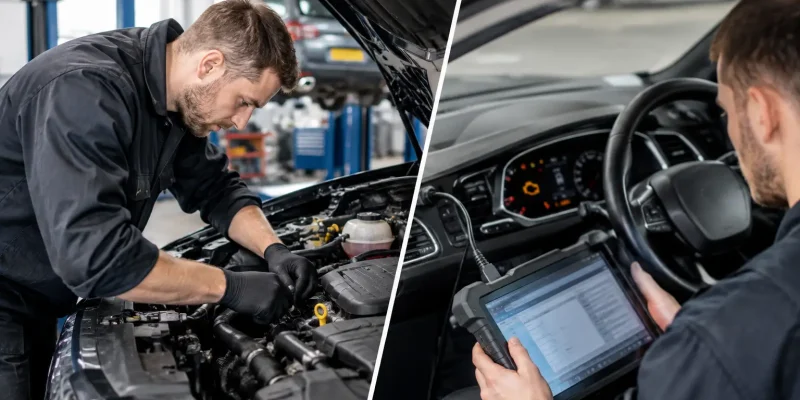
A proper diagnostic process usually starts with the fault you have noticed. That might be the engine warning light, loss of power, trouble starting, a DPF warning, poor running, electrical faults, or an MOT failure where the cause is not obvious. From there, the technician checks fault codes, looks at live data, tests likely problem areas and rules things out.
This usually happens because modern vehicles can store a fault code that points to a system, not always to the failed part itself. For example, an engine warning light might suggest a sensor issue, but the real cause could be wiring, air leaks, fuel pressure, carbon build-up or a deeper engine management fault.
So same-day car diagnostics does not mean rushed work. It means the fault-finding starts quickly, the checks are carried out properly, and you get answers without waiting days just to know where you stand.
When you might need same-day car diagnostics
We often see this service requested when a driver has an urgent problem and cannot afford to leave the car off the road for long.
Warning lights that appear suddenly
The most common reason is a dashboard warning light. That might be the engine warning light, DPF light, ABS light, airbag light or battery warning light. Some lights mean the car is still safe to drive short distances. Others need checking straight away.
If the light is flashing, the car is in limp mode, or the vehicle feels rough, sluggish or unstable, it is best not to ignore it. Leaving it too long can turn a manageable repair into a bigger one.
Loss of power or limp mode
This is a big one for diesel and turbo petrol vehicles. The car starts, but it will not pull properly, struggles to accelerate, or feels as though it is holding back.
In most cases, this points to a fault the engine management system has detected. That could be linked to boost pressure, fuel delivery, EGR problems, DPF blockage, sensor faults or something electrical. Diagnostics help narrow that down quickly.
Car not starting or intermittent starting faults
If the car clicks, cranks slowly, starts one minute and not the next, or cuts out unexpectedly, guessing rarely saves time. Batteries, alternators, starter motors, immobiliser issues and wiring faults can all feel similar from the driver’s seat.
A proper same-day check can often show whether the problem is power supply, charging, communication or something else entirely.
MOT failures with no clear explanation
Sometimes a car fails on emissions, warning lights or a fault linked to safety systems, and the reason is not obvious. This is where diagnostics can save time and money. Instead of changing parts in hope, the issue can be traced properly and a repair plan put in place.
What can usually be found on the same day
A lot depends on the fault, the vehicle and how the problem presents itself. Some issues are straightforward. Others take more testing, especially if the fault is intermittent.
Simple sensor faults, battery and charging issues, some warning light causes, air-conditioning faults, and many electrical problems can often be identified the same day. DPF-related issues can also be diagnosed fairly quickly in many cases, especially if there are clear warning signs and fault codes to work with.
Brake wear sensors, clutch switch faults, misfires, injector imbalance, coil pack issues and some ECU communication faults can often be narrowed down quickly as well.
Where it gets more involved is when the car only plays up under certain conditions, when previous repairs have been carried out badly, or when multiple faults are linked together. Water ingress, damaged wiring looms and intermittent electrical issues can take longer because the technician has to reproduce the fault and test methodically.
That is why honest garages do not promise that every issue will be fully repaired within hours. What they should promise is fast action, clear findings and no guessing.
What happens after the diagnostic check
The useful part of same-day car diagnostics is not just finding the fault. It is knowing what happens next.
You get a plain English explanation
A good garage should tell you what has been found without burying you in technical terms. If the fault code says low boost pressure, for example, you should be told what that means in practice. Is it likely to be a split hose, a turbo control issue, a sticking actuator or something else?
You should also be told what has been ruled out. That matters because it shows the diagnosis has been done properly, not guessed.
You get a clear repair plan
Once the cause is identified, the next step is deciding whether the repair can be done the same day. In many cases it can, especially if the part is available and the repair is straightforward.
If it cannot, you should still know exactly what needs doing, how urgent it is, and whether the car is safe to drive in the meantime. That kind of clarity helps you make a sensible decision.
Same-day repair is possible in many cases
This depends on workshop space, parts availability and the type of fault. A failed battery, sensor, brake issue, air con fault or many common electrical problems may be sorted on the same day. More involved work, such as gearbox faults, deeper engine issues or complex wiring repairs, may need more time.
There is no point pretending otherwise. Fast service is helpful, but only if the work is done properly.
Why proper diagnostics save money
A lot of drivers put off diagnostics because they assume it adds cost. In reality, it often prevents wasted spending.
We often see this issue when someone has already replaced a part based on a guess, but the problem is still there. The warning light comes back, the car still lacks power, or the starting fault returns a few days later.
This usually happens because fault codes do not always mean that the named part has failed. A sensor code might be caused by wiring. A DPF fault might begin with a temperature sensor or pressure issue. A misfire might not be the ignition coil at all.
Proper testing helps avoid throwing parts at the car and hoping for the best. It also reduces the chance of the same breakdown happening again because the root cause is dealt with.
Choosing a local garage for same-day car diagnostics
If you need help quickly, local matters. A garage serving Lowestoft, Oulton Broad, Carlton Colville, Kessingland, Beccles and the surrounding area is usually better placed to offer a faster response than somewhere further away.
More importantly, you want a workshop that explains things clearly and does not use diagnostics as a way to push unnecessary work. The right approach is simple: identify the fault properly, explain it in plain English, give a clear repair plan, then fix what actually needs fixing.
That is the difference between a service-led local garage and a place that treats diagnostics as a quick code read and a sales opportunity.
When not to wait
Some faults can safely be booked in for inspection over the next day or two. Others need acting on straight away.
If the car is in limp mode, losing power badly, showing multiple warning lights, struggling to start, overheating, or making braking feel unsafe, do not keep driving and hope it clears itself. The longer the fault is left, the more chance there is of extra damage or a full breakdown.
If you are not sure whether it is safe to drive, ask. A quick phone call can save a recovery job later.
For drivers around Lowestoft, same-day car diagnostics are often the quickest route to an answer when a vehicle starts playing up without warning. You do not need guesswork, and you do not need a lecture. You need to know what is wrong, what it will take to sort it, and whether you can get back on the road today. If your car is showing warning lights, losing power or not starting properly, get it checked before a small fault turns into a bigger one.


One thought on “Same Day Car Diagnostics: What to Expect”