Car Warning Lights Guide for Everyday Drivers
You are halfway to work, a light comes on, and the car feels normal. That is usually when people start guessing. This car warning lights guide is here to make that simpler. Some lights mean you can drive carefully for now. Others mean stop as soon as it is safe, because carrying on can turn a manageable repair into engine damage, brake failure or a breakdown.
At the garage, we see this every week. A driver ignores an amber engine warning light because the car still starts and runs. A few days later, it has gone into limp mode or failed its MOT. In most cases, the warning light was the early sign. The best approach is simple – know which lights are urgent, know which ones still need checking, and do not rely on guesswork.
How to use this car warning lights guide
The first thing to look at is the colour. That gives you a quick idea of how serious the problem might be.
Red warning lights usually mean stop driving when it is safe to do so and switch the engine off. These are the ones linked to safety or major mechanical risk, such as low oil pressure, brake system faults or engine overheating.
Amber warning lights usually mean the car needs attention soon, but it may still be safe to drive carefully for a short distance. That includes the engine warning light, DPF warning light, ABS light and battery charging faults in the early stages.
Green, blue or white lights are normally information lights. They usually tell you that a system is on, such as headlights or indicators, rather than warning of a fault.
Colour helps, but it is not the whole story. If a light appears and the car is losing power, making unusual noises, overheating, struggling to start or smelling hot, treat it more seriously.
Red warning lights that need quick action
Oil pressure warning light
If the oil pressure light comes on while driving, stop as soon as it is safe. This usually happens because the engine is not getting the oil pressure it needs. That could be low oil level, a failing oil pump, a blocked pickup, or an internal engine issue.
Driving with low oil pressure can ruin an engine very quickly. Topping the oil up may help if the level is low, but if the light stays on, do not keep driving. It needs proper diagnosis.
Engine temperature warning light
If the temperature warning light comes on, or the gauge climbs too high, the engine may be overheating. We often see this issue when there is a coolant leak, thermostat fault, failed water pump or radiator fan problem.
If the engine is overheating, stop and let it cool down. Do not remove the coolant cap while it is hot. If you keep driving, you risk head gasket damage and much bigger repair costs.
Brake system warning light
A red brake warning light can mean low brake fluid, worn brake components, or a hydraulic fault. If the pedal feels soft, the braking feels weaker than normal, or the handbrake is definitely off, do not ignore it.
Brakes are not something to take chances with. In some cases it is a simple fluid level issue caused by brake wear. In others, it points to a leak or a more serious brake fault.
Amber warning lights that should not be ignored
Engine warning light
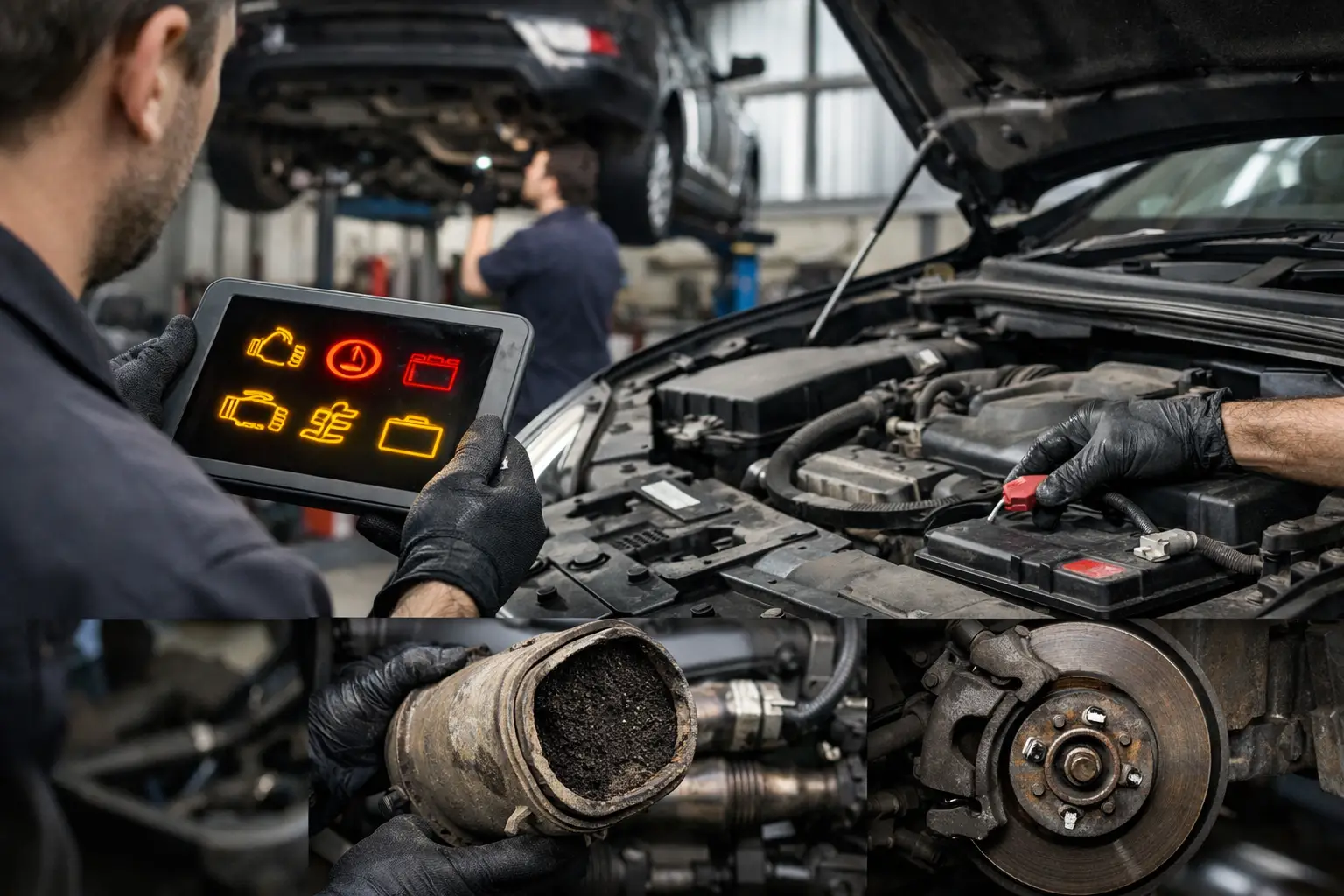
This is one of the most common lights we deal with. The engine warning light can come on for a long list of reasons. It could be a sensor fault, ignition issue, emissions problem, air intake leak, fuel system fault or something linked to the DPF or EGR system.
This usually happens because the engine management system has detected something outside normal range. Sometimes the car still drives fine. Sometimes you get rough running, poor fuel economy or loss of power.
The problem is that the light itself does not tell you the exact fault. A proper diagnostic scan does. Reading the code is the starting point, not the repair. You still need someone to test the cause properly rather than just clearing the light and hoping it stays off.
DPF warning light
If you drive mostly short trips, the DPF light is one to watch. We often see this when a car has not had the chance to complete a proper regeneration. Soot builds up, the filter starts blocking, and eventually the car may go into limp mode.
Sometimes a forced regeneration or cleaning can solve it. Sometimes there is an underlying fault stopping regeneration, such as a sensor issue, thermostat problem or injector fault. That is why guessing can waste time and money.
ABS warning light
The ABS light usually means the anti-lock braking system has a fault. Your normal brakes may still work, but the ABS function might not. That matters more in wet weather or emergency braking.
In most cases, this comes down to a wheel speed sensor, damaged reluctor ring or wiring fault. It still needs checking quickly, especially if other lights appear with it.
Battery warning light
A battery light does not always mean the battery itself is bad. It often points to a charging fault. That could be the alternator, drive belt, wiring or battery condition.
If this light comes on while driving, the car may continue running for a short time using battery power alone. Once that is used up, it can stop and fail to restart. If you have this light and dim lights, electrical faults or difficulty starting, get it checked sooner rather than later.
Common warning light situations we see in the workshop
A warning light on its own is one thing. A warning light plus symptoms usually tells a clearer story.
If the engine warning light is on and the car feels sluggish, that often points to a fault affecting performance, such as boost pressure issues, airflow faults or a blocked DPF. If the battery light comes on and the steering feels heavier, the charging system may be failing. If the ABS light and traction control light appear together, there is often a shared sensor or module fault.
This is why proper diagnostics matter. The dashboard tells you there is a problem. It does not tell you the full reason.
What to do when a warning light comes on
Start with the basics. Check whether the car is driving normally, whether there are any noises, and whether the temperature gauge is rising. If it is a red light, stop when safe. If it is an amber light and the car feels normal, avoid long journeys and book diagnostics.
Do not keep restarting the car to see if the light disappears. Do not clear the code without finding the cause. And do not assume a recent service means the fault is unrelated. We often see warning lights caused by wear, wiring faults, sensor failure, carbon build-up or electrical issues that are separate from routine servicing.
If you are unsure, the safest option is to ask. A quick phone call can save a breakdown or a larger repair.
Why warning lights come back after being reset
This catches a lot of people out. Someone scans the car, clears the light, and it stays off for a day or two. Then it returns. That does not mean the car is being difficult. It usually means the fault was never fixed.
For example, if an engine warning light is triggered by a boost leak, clearing the code will not repair the split hose. If the DPF light is caused by failed regeneration due to a thermostat fault, forcing a regen may only be a temporary fix. The same applies to ABS faults, battery charging issues and electrical faults.
A proper repair means identifying the root cause, not just removing the warning from the dashboard.
When to book diagnostics
If a warning light stays on, comes back, or appears with poor running, reduced power, starting trouble or unusual noises, book diagnostics. That is especially true if you rely on the car every day and cannot afford a breakdown.
For local drivers around Lowestoft, this is often the difference between a same-day fix and a more expensive repair later. In many cases, catching the problem early means a quicker turnaround and less disruption.
At AutoFix4u, we take a diagnostic-first approach. We identify the fault properly, explain it in plain English, and give you a clear repair plan with no surprise extras. If your car has a warning light on and you are not sure whether it is safe to keep driving, call now and get it checked.
A dashboard light is your car asking for attention. The sooner you deal with it, the more options you usually have.