

Why Has My Air Con Stopped in My Car?
You usually notice it on the worst possible day. You turn the air con on, hear the fan, maybe even see the light on the button, but the air coming through is still warm. If you are asking, why has my air con stopped, the good news is that this is often a fixable fault. The main thing is not to guess, because car air conditioning can stop working for several different reasons.
In most cases, the problem comes down to low refrigerant, an electrical fault, a failed compressor, or a pressure issue somewhere in the system. Sometimes it is simple. Sometimes it is not. What matters is finding the actual cause before any parts are replaced.
Why has my air con stopped working?
When a customer comes in and says the air con has stopped, we start with the basics. Is it blowing no air at all, or is it blowing air that just is not cold? Those are two different faults.
If there is no airflow, the issue may be with the blower motor, resistor, fuse, or control panel. If there is airflow but no cold air, that usually points more towards the air conditioning system itself. That could mean the petrol level is too low, the compressor is not engaging, or a sensor is stopping the system from operating.
A lot of drivers assume it just needs a regas. Sometimes that is true. But not always. If the petrol has leaked out, the question is why. Air con systems are sealed. They do not just use up refrigerant like fuel.
The most common reasons car air con stops
Low refrigerant is one of the most common causes. Over time, a small loss can happen naturally, especially on older vehicles. Once the pressure drops too far, the system may shut down to protect itself. You will often get weak cooling at first, then no cooling at all.
Leaks are another regular issue. We often see this when seals dry out, a pipe corrodes, or the condenser gets damaged by road debris. The condenser sits at the front of the car, so it takes a lot of exposure to dirt, moisture and stone chips.
The compressor can also fail. This is the part that circulates refrigerant around the system. If it stops working properly, the air con cannot cool the air. Sometimes the compressor clutch fails. Sometimes the compressor itself wears out internally.
Electrical faults are more common than people think. A blown fuse, faulty relay, damaged wiring or failed pressure sensor can all stop the system from switching on. In these cases, the air con might appear dead even if the main components are still fine.
There are also cases where the cooling fan is not working as it should. If the fan does not help control pressure in the system, the air con may cut out or struggle to cool properly, especially when the car is stationary.
What you can check before booking in
There are a few sensible checks you can make yourself. First, make sure the system settings are right. It sounds obvious, but we do see cars set to warm, economy mode, or a ventilation setting that stops the air con compressor from coming on.
Next, check whether the fan inside the car is working properly. If there is no air coming through the vents on any setting, the fault may not be the air con unit at all.
It is also worth listening when you switch the air con on. On some vehicles, you may hear a slight click as the compressor engages. If there is no change at all, that can point towards an electrical issue, low pressure, or compressor trouble.
Have a look under the bonnet only if you are comfortable doing so. Obvious signs like a damaged auxiliary belt, loose connector, or heavily corroded condenser can be useful clues. But if nothing stands out, that is where proper testing matters.
Why has my air con stopped if the fan still works?
This is one of the most common versions of the problem. The blower fan pushes air through the vents, but the air is not cold. In simple terms, the ventilation system is working, but the cooling side is not.
This usually happens because the refrigerant pressure is wrong, the compressor is not kicking in, or there is a sensor fault stopping operation. On some cars, the system will shut itself off if pressure is too low or too high. That protects expensive components, but it also means you get warm air even though the fan seems normal.
If the fan works and the air is only slightly cool, it may be low petrol. If it is completely warm all the time, there may be a larger leak or a more serious mechanical or electrical fault.
Why a regas is not always the full answer
A regas is helpful when the refrigerant level has dropped and there is no major leak. But it is not a cure-all. If the petrol has escaped because of a damaged condenser or leaking pipe, simply refilling it means the problem will come back.
This is why a diagnostic-first approach matters. Pressure readings, leak checks, and system testing tell you whether the air con just needs servicing or whether something has actually failed. It saves time, money and repeat visits.
We often see people who have already tried the quick fix elsewhere, only for the air con to stop again a few weeks later. At that point, they have paid for petrol but still need the real fault repaired.
When to stop using the air con
If the system is not cooling, you can usually still drive the car safely. But there are times when it is best to get it checked sooner rather than later.
If there is a bad smell through the vents, unusual noise when the air con is switched on, or the engine note changes sharply, leave it off until it has been looked at. A noisy compressor or seized pulley can turn an air con fault into a bigger repair.
You should also act quickly if the windscreen is not clearing properly. Air conditioning helps remove moisture from the cabin, so when it stops working, demisting can become slower and less effective.
How a garage diagnoses an air con fault properly
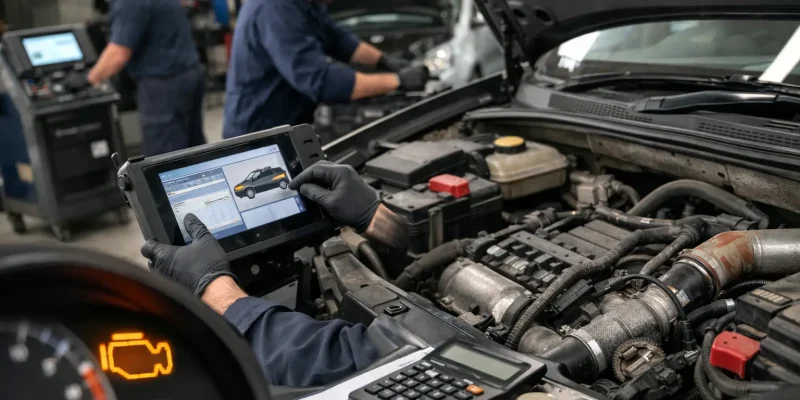
A proper diagnosis should start with system pressure checks and a visual inspection. That helps show whether the refrigerant level is low and whether there are obvious signs of leakage or damage.
After that, electrical testing may be needed. That can include checking fuses, relays, compressor operation, pressure switches and sensor signals. On newer cars, diagnostics may also show fault codes linked to the climate control system.
If a leak is suspected, the system may need a dye test or nitrogen pressure test to pinpoint where the refrigerant is escaping. That part matters, because replacing the wrong part is a waste of money.
The best garages will explain the fault in plain English. You should know what has failed, why it happened, and what needs doing next. That is especially important with air con, because symptoms can look the same even when the causes are completely different.
Repair or replace – what depends on the fault
Some air con problems are straightforward. A regas, a valve replacement, or a relay repair can get the system working again without much delay. Other faults are more involved.
A leaking condenser is common and usually worth repairing. A failed compressor can cost more, particularly if it has contaminated the system internally. In that case, extra parts and a full system clean may be needed.
This is where honest advice matters. On an older vehicle, the right repair depends on the overall condition of the car and how long you plan to keep it. There is no one-size-fits-all answer.
Preventing the same problem again
Air con tends to last longer when it is used regularly. Even in winter, running it for a short time every week helps keep seals lubricated and the system in use. Cars that sit with the air con off for months often develop leaks or performance problems sooner.
It also helps to deal with weaker cooling early. If the air is not as cold as it used to be, get it checked before it stops completely. Catching a small leak early is usually cheaper than waiting until the system is empty and other parts are under strain.
If your answer to why has my air con stopped is still not clear after the basic checks, the next step is a proper diagnostic. That is the quickest way to avoid guesswork and get the fault sorted properly. If you are in Lowestoft or nearby and need a clear answer without the usual runaround, AutoFix4u can inspect the system, explain the issue plainly, and advise on the right repair. Call now or get a quote – same-day slots may be available.


One thought on “Why Has My Air Con Stopped in My Car?”