Why Is My Clutch Slipping? Common Causes
You notice it first when pulling away at a roundabout. The engine revs rise, but the car does not pick up speed the way it should. Or you press the accelerator in a higher gear and it feels like the power is going nowhere. If you are asking, why is my clutch slipping, the short answer is this – the clutch is no longer gripping properly between the engine and gearbox, and it needs checking before it gets worse.
In most cases, a slipping clutch starts as a smaller issue and then becomes more obvious quite quickly. Some drivers put up with it for weeks, especially if the car still moves and the gears still go in. The problem is that once the clutch starts to lose grip, it creates more heat and wear every time you drive. That can leave you with a car that struggles to move, or one that eventually will not drive at all.
Why is my clutch slipping?
A clutch slips when the friction material can no longer hold the engine’s power properly. Think of it like this – the clutch should lock the engine and gearbox together when you lift your foot off the pedal. If it cannot do that fully, the engine revs increase without the same matching drive through the wheels.
This usually happens because the clutch plate is worn out. That is the most common cause by far. Like brake pads, clutch components wear down over time. The more stop-start driving, hill starts and heavy use the car sees, the faster that wear happens.
We often see this issue when drivers have ignored early signs such as a biting point that feels higher than normal, a slight burning smell, or poor acceleration in higher gears. It may still drive for a while, but the fault does not fix itself.
The most common causes of clutch slip
Worn clutch plate
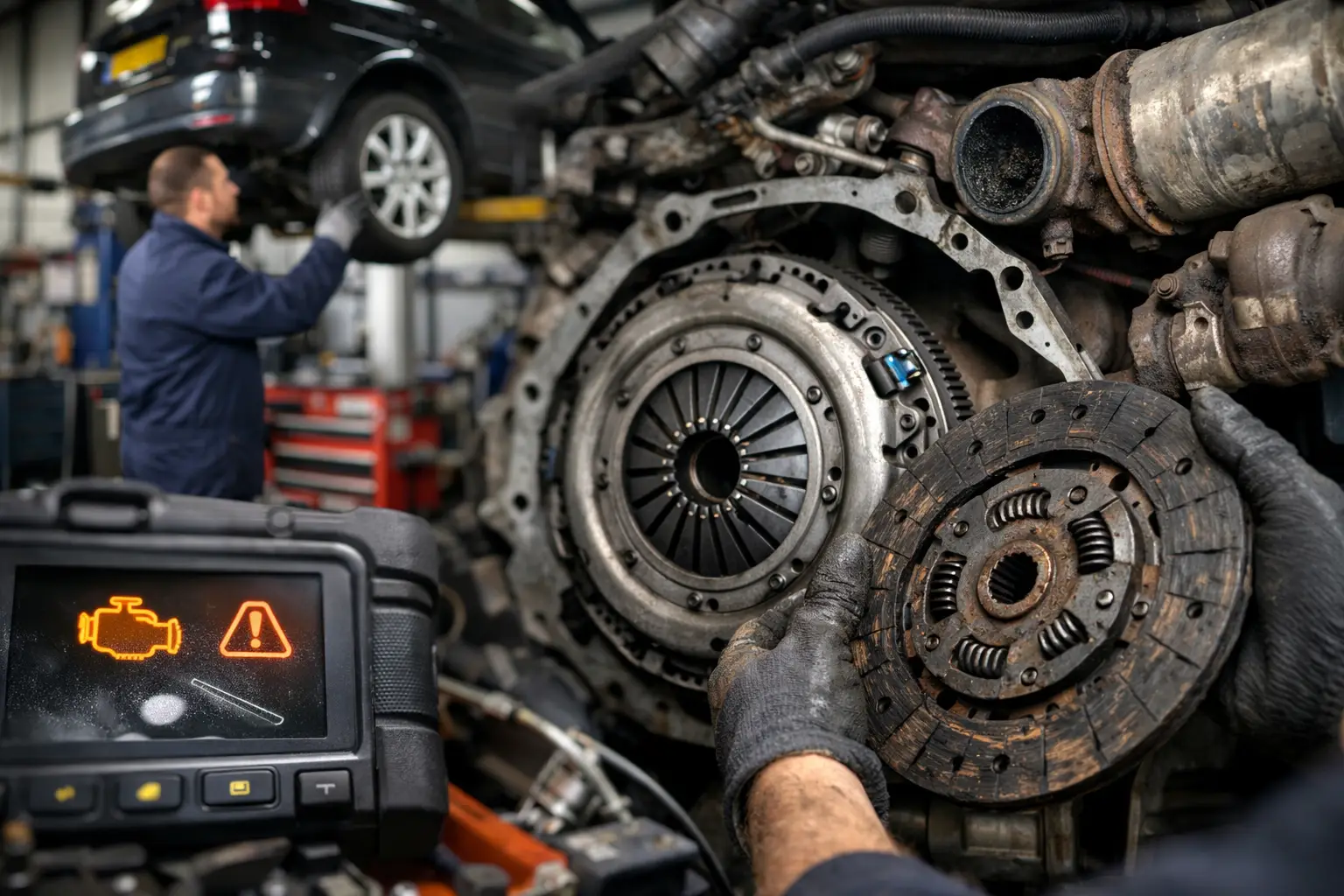
This is the main one. The clutch plate is lined with friction material, and over time it wears thin. Once that happens, it cannot grip the flywheel firmly enough under load.
You may notice the slipping more in fourth, fifth or sixth gear, or when accelerating uphill. That is because the clutch is under more strain in those situations. At first it may only happen now and then. Later, it can happen almost every time you press the accelerator.
Heat damage and glazing
A clutch that has been slipping for a while can overheat. That heat can harden or glaze the friction surface, which reduces grip even further. It becomes a bit of a cycle – the more it slips, the hotter it gets, and the worse it performs.
This is also why some drivers notice a sharp burning smell, especially in traffic or after reversing uphill. That smell should not be ignored.
Oil contamination
Sometimes the clutch itself is not just worn. It may be contaminated by oil leaking from the engine rear crankshaft seal or gearbox input shaft seal. If oil gets onto the clutch surfaces, grip drops off quickly.
In that case, simply replacing the clutch without fixing the leak can mean the same problem comes back. This is why proper diagnosis matters. You want the root cause sorted, not just the visible symptom.
Pressure plate problems
The pressure plate helps clamp the clutch plate tightly in place. If it weakens or becomes damaged, the clutch may start slipping even if the friction plate is not fully worn out.
This is less common than normal wear, but it does happen. It is one reason why clutch repairs are usually done as a full kit rather than changing one part in isolation.
Hydraulic faults or clutch adjustment issues
On some vehicles, the clutch is operated by a hydraulic system. If there is a fault with the master cylinder, slave cylinder, or clutch mechanism, the clutch may not fully engage.
It depends on the vehicle. Some older systems can also suffer from adjustment problems. If the clutch is being held slightly open all the time, that can cause slip and wear the components faster.
Signs your clutch is slipping
The clearest sign is rising revs without matching acceleration. You press the accelerator, the engine sounds busy, but the car does not pull as it should.
There are usually a few other clues as well. The biting point may feel very high. The car may struggle more when carrying passengers or going uphill. You might notice a burning smell after manoeuvring. In some cases, gear changes start to feel less smooth because the clutch is not engaging properly.
A lot of drivers describe it as the car feeling weak, even though the engine still sounds normal. That is an easy way to mistake a clutch fault for an engine performance issue. The difference is that with clutch slip, the revs often flare up without real progress.
Can you keep driving with a slipping clutch?
Sometimes, yes – for a short time. But it is a risk.
If the slipping is mild, you may still be able to get around locally for a few days. The trouble is there is no good way to predict how quickly it will worsen. We have seen cars come in where the clutch was just starting to slip, and others where it failed almost completely within a very short time.
Driving on a slipping clutch can also create extra heat and damage nearby parts, including the flywheel. That can increase the repair cost. So while the car may still move, it is better to get it checked before you end up stranded or facing a bigger bill.
What a garage will check first
A proper inspection usually starts with the symptoms you have noticed. When does it slip? Only under heavy acceleration? In higher gears? When the car is hot? Those details help narrow it down.
From there, a road test can confirm whether the clutch is slipping or whether the issue is actually elsewhere, such as a gearbox fault or engine problem. If clutch slip is confirmed, the next step is working out whether it is normal wear, contamination, or a release system issue.
This is where a diagnostic-first approach saves time. There is no point fitting parts blindly if an oil leak or hydraulic fault is the reason the clutch is not holding properly.
Will it need a full clutch replacement?
In most cases, yes.
If the clutch plate is worn or heat-damaged, the standard repair is a full clutch kit. That usually includes the clutch plate, pressure plate and release bearing. Replacing the complete set makes sense because these parts wear together.
Depending on the vehicle, the flywheel may also need checking closely. Some cars use a dual mass flywheel, and if that has excessive wear or heat damage, it may need replacing too. Not every slipping clutch means a flywheel replacement, but it should be inspected while the gearbox is off.
If oil contamination is found, the leaking seal should be repaired at the same time. Otherwise the new clutch can be damaged by the same problem.
Why clutch problems get missed early
The reason is simple – the car often still drives.
A worn clutch does not always fail all at once. It can start with small signs that are easy to brush off, especially if you do a lot of short local trips and are used to how the car feels. Drivers often think the engine is just getting tired, or that the car is slower because it is loaded up.
We often see this issue after an MOT, before a holiday, or when a driver suddenly has to do more dual carriageway miles than usual. That extra load makes the slipping more obvious. By then, the clutch has usually been wearing for some time.
What to do next if your clutch is slipping
If you suspect clutch slip, the best step is to stop guessing and get it diagnosed properly. The earlier it is checked, the better chance you have of avoiding extra wear to the flywheel or getting caught out when the car finally stops driving properly.
For drivers around Lowestoft, Oulton Broad, Carlton Colville, Beccles and nearby areas, this is the sort of fault that is worth dealing with quickly, especially if you rely on your car every day. A clear inspection, honest advice and a proper repair plan will tell you exactly where you stand.
If the engine is revving but the car is not pulling as it should, book it in. Same-day slots may be available, with clear pricing and no surprise extras. A slipping clutch rarely gets better with time, but it is usually straightforward to put right once the real cause is confirmed.
Left too long, it turns into a breakdown problem. Caught early, it is just a repair.


