How to Prepare Car for MOT Properly
That failed MOT often starts with something small – a bulb out, a worn tyre, a washer bottle left empty, or a warning light that was ignored for a few weeks. If you want to prepare car for MOT properly, the aim is not to second-guess the test. It is to spot obvious problems early, sort what you can, and get anything unsafe checked before test day.
We see this a lot with busy drivers who use one car for work, school runs and everything else. The MOT date creeps up, the car seems mostly fine, and then it fails on a handful of basic items. In most cases, a little prep saves time, avoids the retest hassle, and gives you a clearer idea of whether the car needs repairs first.
What the MOT is really checking
An MOT is a legal roadworthiness test for safety and certain emissions standards. It is not the same as a service, and it does not mean every part of the car is in perfect condition. A car can pass an MOT and still need maintenance. It can also fail on a simple issue that has nothing to do with how well the engine runs.
That matters because many drivers prepare in the wrong way. They might top up oil and coolant, give the car a clean, and assume that is enough. Those things help, but MOT failures usually come down to safety items, visibility, tyres, brakes, suspension, emissions, and dashboard warning lights.
Prepare car for MOT with a simple home check
You do not need specialist tools to spot a lot of common MOT problems. A basic walk-round takes ten minutes and can pick up issues before they become a failed test.
Start with the lights. Check dipped beam, main beam, side lights, brake lights, indicators, number plate lights and fog lights. If possible, ask someone to help or park near a reflective surface so you can see what is working. We often see cars fail because a bulb has gone and the driver simply did not know.
Next, look at the tyres. Tread depth must be above the legal limit, but tread is only part of it. Check for cuts, bulges, cracking and uneven wear. If one tyre is wearing more on one edge, that can point to suspension or alignment issues. Replacing a tyre might solve part of the problem, but not the cause.
Then check the windscreen and wipers. Chips and cracks can fail an MOT if they are in the driver’s view. Wipers should clear the screen properly, not smear it. Make sure the washer bottle is topped up too. That sounds minor, but it matters.
You should also test the horn, check both number plates are secure and readable, and make sure the mirrors are present and not damaged. Inside the car, check seatbelts pull and click in properly. If the driver’s seat is loose or does not adjust as it should, that can also be an issue.
Warning lights are where many MOT problems start
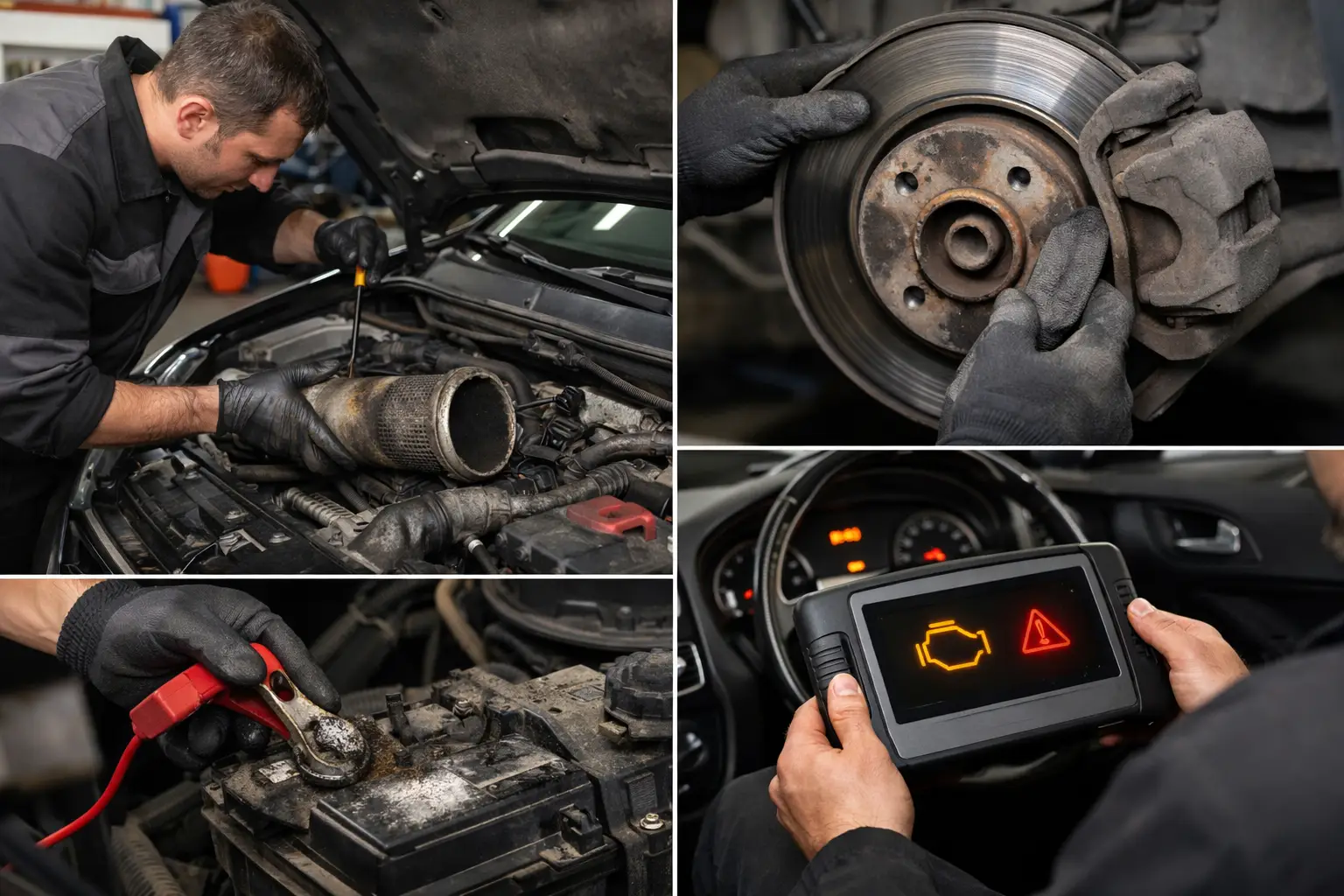
One of the biggest reasons cars fail now is dashboard warning lights. If the engine warning light, ABS light, airbag light or other safety-related light is on, the car may fail. This usually happens because the fault has been left too close to the MOT date.
The mistake is assuming a warning light can be cleared and forgotten. In most cases, if a light is on, the car is telling you there is a fault stored in the system. Sometimes it is minor. Sometimes it points to an emissions issue, sensor fault, braking problem or airbag system defect. Either way, it needs diagnosing properly.
We often see this issue when customers have been told a light is “probably nothing” or when the car still drives normally. That is exactly why a diagnostic-first approach matters. The car may feel fine, but the fault can still trigger a fail.
Brakes, suspension and steering need honest attention
If the car pulls to one side, knocks over bumps, vibrates through the steering wheel, or feels unstable when braking, do not leave it until the MOT. Those symptoms often point to worn brakes, suspension joints, bushes, springs or steering parts.
This is where DIY checks have limits. You may notice a noise or a change in how the car drives, but you cannot always see the full problem from your driveway. A brake disc might be badly worn on the inner face. A spring may have cracked low down where it is hard to spot. A suspension bush can look acceptable until the vehicle is lifted and tested.
If your car has any of those signs, getting it looked at before the MOT usually saves time. It also reduces the chance of failing, then waiting for repairs, then booking back in.
Emissions problems are easy to miss until the test
A car can run well enough day to day and still fail on emissions. This usually happens because of a fault with the emissions system, a sensor issue, a blocked DPF, or an engine warning light linked to combustion or exhaust performance.
Diesel cars are especially prone to this if they mostly do short trips. We often see DPF trouble when the car does school runs, local commuting and not much else. The driver may notice a warning light, reduced power, poor fuel economy or the cooling fan running when it should not. Sometimes there are no obvious symptoms at all until the MOT emissions test.
If your car has had a recent loss of power, gone into limp mode, smoked more than usual, or shown an engine warning light, do not assume it will scrape through. That is worth checking before the test.
Clean and tidy helps, but it will not hide faults
It is worth turning up with a clean car, mainly because it helps the tester inspect it properly. Clear out clutter from the boot if access is needed, remove anything blocking seatbelts, and make sure the registration plates are readable.
That said, a clean car does not make up for worn components or warning lights. Some drivers spend time polishing the bodywork and forget to check if the rear brake lights work. Focus on condition first, appearance second.
When to book repairs before the test
If you already know something is wrong, book the repair before the MOT rather than hoping for the best. That includes obvious tyre wear, noisy brakes, a cracked windscreen, broken lights, warning lights or handling issues.
There is a simple reason for this. An MOT is a test, not fault-finding in depth. If it fails, you still need the repair work done afterwards. If the fault is already known, sorting it first usually means less downtime and less frustration.
It also helps to avoid repeat visits if the car is essential for work or family use. For most drivers, being without a car for a day or two is the bigger problem than the test itself.
Prepare car for MOT if it has been off the road
Cars that have been standing for a while often need more attention. Flat batteries, seized brakes, perished tyres and stale fuel are common. Wipers may have deteriorated, brake discs may be heavily corroded, and warning lights can appear once the vehicle is driven again.
In that situation, a basic check is not enough. It is better to have the car inspected first, especially if it has missed a service or has not covered many miles recently. Low mileage does not always mean low wear. Time causes problems too.
A service can help, but it is not the same thing
A lot of people ask whether they should service the car before the MOT. The honest answer is that it depends. If the car is due a service anyway, it makes sense to combine the two where possible. A service may pick up issues like worn brakes, poor tyre condition or fluid leaks.
But a service does not replace the MOT, and an MOT does not replace a service. They do different jobs. If your main goal is to avoid an MOT failure, you need preparation focused on test items, fault diagnosis and visible safety issues.
The best approach if you are unsure
If you are not confident checking the car yourself, or you already have a warning light, odd noise or driving issue, get it looked at before the test. That is usually the quickest route to a pass because the cause is identified properly and you know what needs doing.
For drivers around Lowestoft, Oulton Broad, Carlton Colville and nearby areas, this is often the difference between a straightforward MOT and a failed one followed by more time off the road. AutoFix4u can check the vehicle, explain any problems in plain English, and carry out MOT preparation or repair work with clear pricing and no surprise extras. Call now or get a quote if you want it checked before your test date.
A little preparation goes a long way, but if the car is already showing signs of trouble, the sensible next step is to deal with the fault now rather than meet it again on the MOT ramp.


One thought on “How to Prepare Car for MOT Properly”