
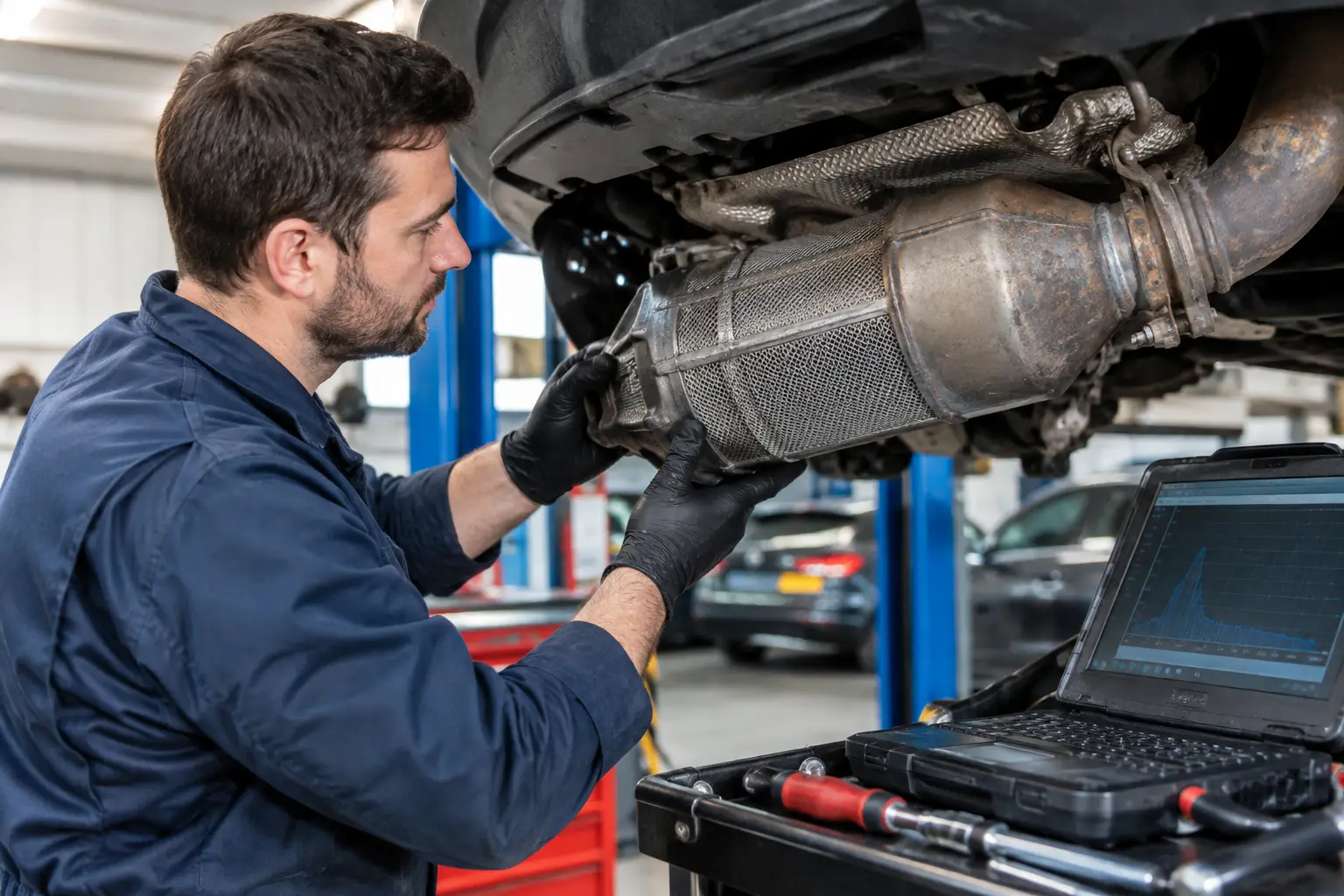
How to Clear DPF Warning Without Making It Worse
Your DPF warning light can appear without much notice. Perhaps you see it during the school run or while driving to work. At first, the car may still drive normally. However, ignoring the warning can lead to more serious problems.
If you want to know how to clear DPF warning lights safely, start by understanding the cause. Simply deleting the fault code rarely solves the problem.
A blocked diesel particulate filter can cause poor performance, increased fuel consumption and limp mode. Therefore, identifying the reason for the warning is essential.
At AutoFix4u Garage Lowestoft, we help drivers investigate DPF faults and understand the available repair options.
What Does a DPF Warning Light Mean?
A diesel particulate filter, or DPF, traps soot from engine exhaust gases.
Over time, soot collects inside the filter. The vehicle normally removes this soot through a process called regeneration.
During regeneration, the exhaust temperature rises and burns away accumulated soot.
However, regeneration needs suitable operating conditions. Frequent short journeys can interrupt the process.
Consequently, soot may build up faster than the system can remove it.
When the soot level reaches a certain point, the vehicle may display a DPF warning.
This does not automatically mean the filter needs replacing.
Instead, the vehicle may need a successful regeneration or further diagnostic checks.
For more information, read our Blocked DPF Regeneration Explained guide.
How to Clear DPF Warning Lights Safely
The correct approach depends on the vehicle and the warning symptoms.
If the DPF warning has just appeared, check the owner’s handbook first.
Some manufacturers recommend a suitable drive to help the vehicle complete regeneration.
However, only follow this advice when the car operates normally and the handbook permits it.
1. Check the Dashboard Warning
Start by identifying the warning message.
Some vehicles display a dedicated DPF symbol. Others show an engine warning light or a message about exhaust filter cleaning.
If the vehicle has several warnings, reduced power or limp mode, avoid attempting a regeneration drive.
Instead, arrange professional diagnostics.
2. Check Whether the Vehicle Drives Normally
Pay attention to engine performance.
Does the car accelerate normally? Does it produce unusual smoke? Are there any strange noises?
If the engine runs smoothly, the handbook may allow a regeneration drive.
However, significant power loss or abnormal operation can indicate a deeper fault.
3. Follow the Manufacturer’s Regeneration Instructions
Some vehicles can complete regeneration during a suitable uninterrupted journey.
The engine normally needs to reach operating temperature first.
After that, follow the driving conditions specified in the handbook.
A steady journey on an appropriate road may help.
However, the required speed, engine speed and journey duration vary between vehicles.
Never exceed speed limits or drive unsafely to complete regeneration.
4. Check Whether the Warning Returns
If the warning disappears, monitor the vehicle over the next few journeys.
A completed regeneration may solve a temporary soot-loading problem.
However, repeated warnings can indicate another fault.
For example, a faulty sensor may prevent successful regeneration.
Therefore, a warning that returns needs further investigation.
Why You Should Not Simply Delete the DPF Fault Code
A diagnostic scanner may allow you to clear certain stored fault codes.
However, deleting a code does not remove soot from the filter.
It also does not repair damaged wiring, faulty sensors or engine problems.
As a result, the warning may return shortly afterwards.
Sometimes the vehicle enters limp mode because the underlying fault remains.
Therefore, mechanics should use fault codes to support diagnosis rather than simply hide the warning.
A proper diagnostic process helps identify the cause before repairs begin.
Common Reasons a DPF Warning Keeps Coming Back
Several problems can prevent successful regeneration.
Frequent Short Journeys
Short journeys are a common cause of DPF problems.
For example, repeated school runs may not allow the engine to reach suitable operating conditions.
As a result, the vehicle may interrupt regeneration before it finishes.
Over time, soot can accumulate inside the filter.
However, short journeys are not always the only cause.
Faulty DPF Pressure Sensors
Many diesel vehicles use pressure sensors to monitor exhaust restriction.
These sensors help the engine management system assess DPF conditions.
If a sensor fails or gives incorrect readings, the vehicle may display a warning.
Damaged pressure hoses can cause similar problems.
Therefore, technicians should check the sensor readings and related components.
Exhaust Temperature Sensor Problems
Regeneration requires controlled exhaust temperatures.
The engine management system relies on temperature information during the process.
A faulty temperature sensor may prevent regeneration or trigger a warning.
Consequently, the filter can continue collecting soot.
EGR Valve Problems
The exhaust gas recirculation system helps manage engine emissions.
However, EGR faults can affect combustion and exhaust conditions.
In some cases, this contributes to increased soot production.
A proper inspection can identify whether an EGR fault is involved.
Turbocharger and Air Intake Problems
Boost leaks and other air intake faults can affect engine performance.
They may also increase soot production under certain conditions.
For example, a split boost hose can cause poor acceleration and unusual exhaust smoke.
Therefore, a DPF warning may be a symptom of another engine fault.
Fuel System Problems
Poor combustion can contribute to soot accumulation.
Possible causes include injector faults and fuel delivery problems.
However, these faults require testing before recommending repairs.
Replacing components without diagnosis can create unnecessary costs.
Signs Your DPF May Be Becoming Blocked
A DPF problem can produce several symptoms.
Common warning signs include:
- DPF warning light on the dashboard
- Engine management warning light
- Reduced engine power
- Limp mode
- Increased fuel consumption
- Unusual exhaust smoke
- Frequent regeneration attempts
- Cooling fans running after the engine stops
However, these symptoms can also have other causes.
For that reason, a professional diagnostic check is important.
Read our Blocked DPF Symptoms Guide for more information.
Can You Drive With the DPF Warning Light On?
The answer depends on the warning and vehicle condition.
Some manufacturers allow a suitable regeneration drive when the DPF warning first appears.
However, this advice does not apply to every situation.
You should avoid continuing to drive if the vehicle develops serious symptoms.
These include:
- Severe loss of power
- Heavy exhaust smoke
- Engine overheating
- Unusual engine noises
- Multiple warning lights
- Repeated engine stalling
If the car becomes unsafe, stop somewhere safe and arrange assistance.
Continuing to drive with a serious fault can increase repair costs.
Does Driving on a Motorway Clear a DPF Warning?
Sometimes a suitable longer journey helps the vehicle complete regeneration.
However, motorway driving does not guarantee that the warning will disappear.
The engine management system must allow regeneration to take place.
If a sensor fault or another engine problem prevents regeneration, driving longer may not help.
Likewise, a heavily restricted filter may need professional attention.
Therefore, always follow the manufacturer’s instructions.
Avoid repeatedly taking the vehicle on long journeys when the warning remains active.
Can a Forced Regeneration Clear the DPF Warning?
A professional workshop may use diagnostic equipment to request a regeneration.
This process is often called forced regeneration or service regeneration.
However, it is not suitable for every vehicle.
Before starting, the technician should check the relevant fault codes and operating conditions.
The procedure can create extremely high exhaust temperatures.
For that reason, it requires the correct equipment, surroundings and safety precautions.
If the filter has excessive soot loading or other faults, regeneration may be unsafe.
A mechanic should identify these problems before attempting the procedure.
Our DPF Regeneration Lowestoft service explains how we approach DPF-related faults.
DPF Cleaning Versus DPF Replacement
Not every DPF warning requires a new filter.
In some cases, regeneration restores normal operation.
Other vehicles may need specialist cleaning after a proper assessment.
However, cleaning cannot repair every type of damage.
For example, a cracked or internally damaged filter may require replacement.
Also, regeneration removes soot but does not remove accumulated ash.
Over time, ash can reduce the filter’s available capacity.
Therefore, a high-mileage vehicle may need further assessment.
The correct repair depends on the filter’s condition and the underlying fault.
How AutoFix4u Garage Lowestoft Diagnoses DPF Problems
A proper DPF diagnosis starts with understanding the symptoms.
We consider when the warning appeared and how the vehicle behaves.
Next, we use appropriate diagnostic checks to investigate the problem.
Depending on the vehicle and fault, these checks may include:
- Reading stored fault codes.
- Reviewing relevant live data.
- Checking DPF pressure readings.
- Assessing exhaust temperature information.
- Inspecting accessible sensor hoses and connections.
- Checking for related engine performance faults.
- Reviewing regeneration information where available.
- Identifying whether further testing is necessary.
These checks help determine whether the vehicle needs regeneration, repair or additional investigation.
Once the cause becomes clear, we can explain the available options.
Our aim is to avoid unnecessary replacement parts and repeat problems.
How to Prevent DPF Warning Lights From Returning
Regular maintenance can help reduce DPF problems.
However, prevention depends on the vehicle and driving conditions.
Follow the Correct Service Schedule
Use the engine oil specification recommended by the manufacturer.
Many vehicles with DPF systems require particular low-ash oil specifications.
Incorrect oil can contribute to problems over time.
Pay Attention to Warning Lights
Address engine faults before they affect other systems.
For example, unresolved sensor or air intake problems may interfere with regeneration.
Avoid Repeatedly Interrupting Regeneration
Some vehicles display signs when regeneration is taking place.
These can include changes in idle speed or cooling fan operation.
However, the signs vary between models.
Follow the manufacturer’s guidance where possible.
Include Suitable Longer Journeys
Vehicles used mainly for short trips may benefit from occasional suitable longer drives.
However, no fixed driving routine guarantees successful regeneration.
The correct approach depends on the vehicle’s operating conditions.
Investigate Repeated Warnings
If the DPF light returns regularly, arrange diagnostics.
Repeatedly clearing the warning can delay the necessary repair.
Frequently Asked Questions About DPF Warnings
Will a DPF warning light clear itself?
Sometimes the warning disappears after a successful regeneration.
However, the vehicle must meet the required operating conditions.
If the underlying problem remains, the warning may return.
Can I clear a DPF warning with a diagnostic scanner?
A scanner may delete certain codes.
However, this does not clean the filter or repair the cause.
The warning may return until the actual problem receives attention.
Does a DPF warning mean I need a new filter?
Not necessarily.
The vehicle may need regeneration, sensor repairs or further diagnosis.
A mechanic should assess the system before recommending replacement.
Can a blocked DPF cause limp mode?
Yes. Some vehicles limit engine performance when DPF restriction becomes excessive.
However, other faults can also cause limp mode.
Diagnostic testing helps identify the reason.
How much does a DPF repair cost?
The cost depends on the fault and required work.
A sensor repair, regeneration procedure and filter replacement involve different costs.
Therefore, an inspection is the best starting point for an accurate quotation.
Book a DPF Diagnostic Check in Lowestoft
Is your diesel vehicle showing a DPF warning light?
Perhaps it has lost power, entered limp mode or repeatedly failed to complete regeneration.
At AutoFix4u Garage Lowestoft, we can investigate DPF-related faults and explain the next steps.
We help drivers from Lowestoft, Oulton Broad, Carlton Colville, Pakefield, Kessingland, Beccles and surrounding areas.
Garage address:
Unit 4, 10 Battery Green Road, Lowestoft, NR32 1DE
Call: 07778 979802
WhatsApp: Message AutoFix4u Garage
DPF service: DPF Regeneration Lowestoft
Contact: Request an Estimate
A DPF warning is an opportunity to investigate a problem early. The right diagnosis can help prevent further damage and unnecessary repairs.


