Manual Clutch Versus Gearbox Fault: How to Tell
Your car pulls away from a junction, but the revs rise faster than the speed. Or perhaps selecting first gear on the school run suddenly takes a firm shove, while reverse crunches no matter how carefully you try. These are the situations where a manual clutch versus gearbox fault can be difficult to judge from the driver’s seat.
The symptoms can overlap, but the repair is not the same. A clutch is a wearing part between the engine and gearbox. The gearbox contains the gears and components that transfer drive to the wheels. Before replacing either, the real cause needs checking properly.
What a clutch fault usually feels like
The clutch allows the engine and gearbox to separate briefly when you press the pedal. This lets you stop without stalling and change gear smoothly. Over time, the friction material on the clutch plate wears, much like brake pads do.
A slipping clutch is one of the clearest signs. You may notice the engine revs climb when accelerating in a higher gear, particularly uphill or when carrying passengers, but the car does not pick up speed as it should. It can feel as though the engine is working hard without putting its power down.
A high biting point can also suggest clutch wear. This is where the car begins moving only when your foot is nearly off the pedal. It is not proof on its own, as pedal feel varies between vehicles, but it is useful information alongside slipping.
Other signs can include a burning smell after manoeuvring, difficulty pulling away with a load, or judder as the clutch takes up. Judder may come from a worn clutch, but it can also be caused by oil contamination, worn engine or gearbox mounts, or issues with the dual-mass flywheel fitted to many diesel and modern petrol cars.
A clutch pedal that feels unusually soft, stays on the floor, or has little resistance may point to the hydraulic system instead. Many cars use brake fluid and hydraulic cylinders to operate the clutch. A leak, worn master cylinder or slave cylinder can prevent the clutch from fully disengaging, making gear changes difficult even if the clutch plate itself is still serviceable.
Signs the gearbox may be at fault
Gearbox faults often affect a particular gear or make noise that changes with road speed. For example, second gear may be hard to select, or it may jump out of gear when you lift off the accelerator. A whine, rumble or grinding sound that appears in certain gears can indicate internal wear.
If the gearbox oil level is low, old or contaminated, internal components may not be properly protected. Some manual gearboxes have no routine oil-change interval listed in a basic service schedule, but that does not mean the oil and seals should never be checked when symptoms appear.
Worn synchronisers are another possible cause. These are internal parts that help match gear speeds during a change. When they wear, one gear may crunch or resist selection more than the others, often while the clutch pedal is fully pressed. That does not automatically mean the entire gearbox needs replacing, but it does need an accurate assessment.
A gearbox issue can also be outside the gearbox itself. Loose or worn gear linkage bushes, damaged cables and selector faults can make the gear lever feel vague, stiff or inaccurate. On some cars, a simple adjustment or replacement linkage component is a far more sensible repair than assuming the gearbox has failed.
Manual clutch versus gearbox fault: useful clues
There is no single road test that confirms the answer, but the pattern of symptoms gives a mechanic a sensible starting point.
If the engine revs rise without matching acceleration, especially in higher gears, clutch slip is more likely. If selecting gears is difficult with the engine running but easier with the engine switched off, the clutch may not be disengaging fully. This could be a worn clutch assembly or a hydraulic operating problem.
If one particular gear is noisy, crunches repeatedly, will not stay engaged or feels different from the rest, a gearbox or gear-selection problem becomes more likely. Noise that disappears when the clutch pedal is pressed can also help narrow things down, although it may relate to a release bearing or another rotating component rather than the gearbox itself.
The timing matters too. If the problem started after a clutch replacement, incorrect adjustment, a hydraulic issue or a disturbed linkage may need investigating. If it followed a fluid leak, impact underneath the vehicle, or a gradual increase in gearbox noise, different checks are needed.
Try not to force the gear lever. Repeatedly pushing a resisting gear can worsen damage, particularly if a synchroniser or selector component is already worn.
How a garage diagnoses the problem
A proper diagnosis starts with what you have noticed: when the fault happens, whether it is worse cold or warm, which gears are affected, and whether warning lights are showing. That information can save time and avoid changing parts based on guesswork.
The mechanic can then check the clutch pedal operation, hydraulic fluid level and any signs of leaks. They will inspect the clutch master and slave cylinder where accessible, as well as the gear linkage or cables. Engine and gearbox mounts may also be checked, because excess movement can affect how the car feels during changes.
A controlled road test may be needed to assess clutch slip, biting point, judder, gear selection and noises under acceleration and overrun. The gearbox oil level and condition may be checked if the vehicle design allows it. Any leaks around driveshaft seals or the gearbox casing should be investigated rather than simply topped up and ignored.
In some cases, the gearbox needs to be removed before the full condition of the clutch, release bearing, flywheel or internal gearbox parts can be confirmed. That is why an honest garage should explain what is known, what needs further inspection, and why. A routine service can identify general maintenance needs, but fault-finding for difficult shifting or slipping is additional diagnostic work.
Repair options depend on the cause
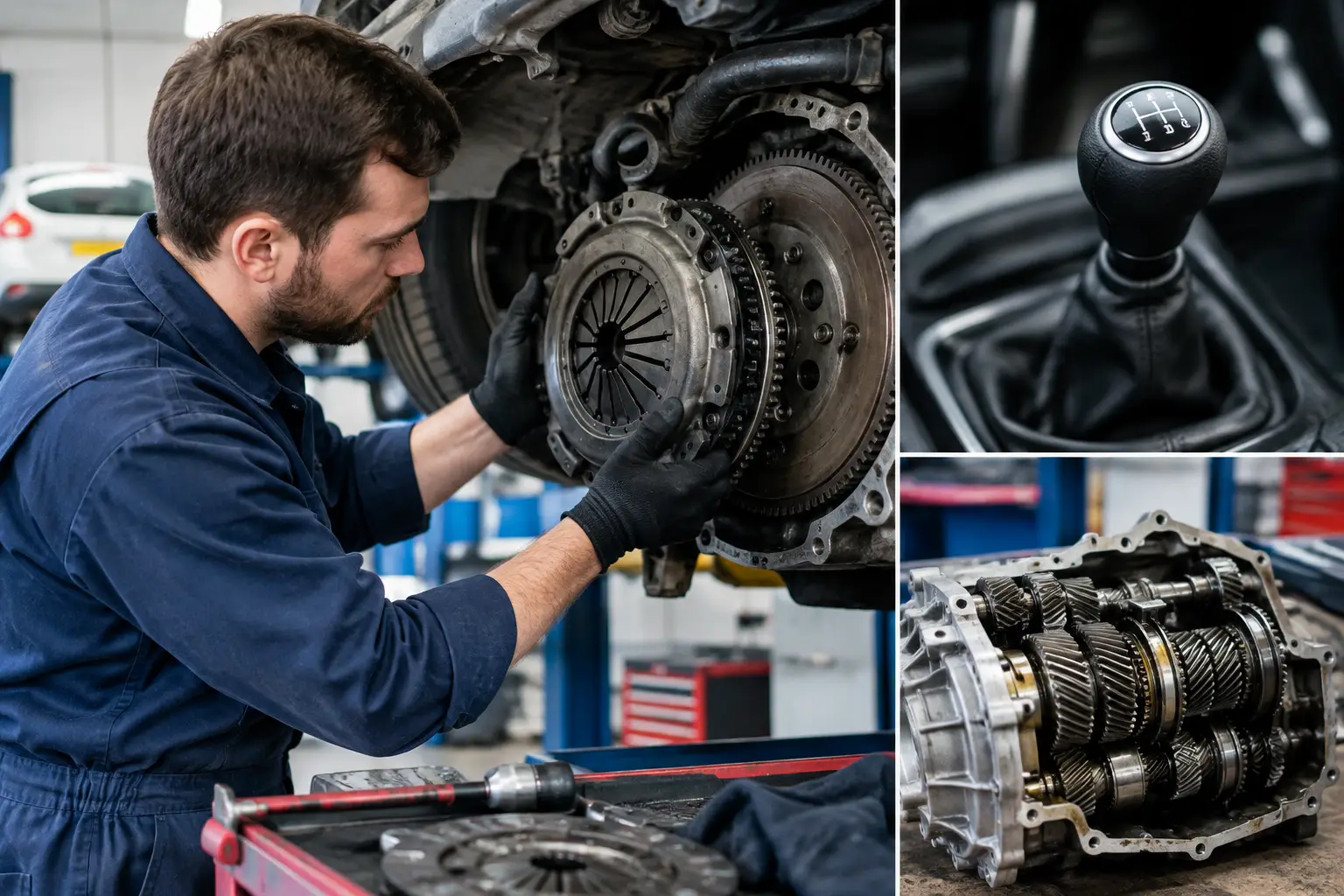
If the clutch friction plate is worn or damaged, the usual repair is to replace the clutch kit. This commonly includes the clutch plate, pressure plate and release bearing. Where applicable, the dual-mass flywheel should be inspected at the same time. It may be reusable, or it may be worn beyond limits and need replacement. It should not be changed automatically without a reason, but it should not be overlooked either.
A hydraulic fault may require a master cylinder, slave cylinder, pipework repair or a fluid change and bleed. The right repair depends on where the fault lies. Replacing a complete clutch when the problem is a leaking cylinder would not address the cause properly.
For gearbox-related faults, the options range from renewing external cables or linkage bushes to repairing, rebuilding or replacing the gearbox. The best route depends on the vehicle, the extent of internal damage, parts availability and the condition of the rest of the car. An older vehicle with a minor selection issue may need a very different decision from a van that is relied on for daily work.
Can you keep driving?
A slipping clutch can deteriorate quickly and may leave you unable to pull away safely. If the pedal stays down, gears will not select, the car jumps out of gear, or there is a loud grinding noise, avoid driving it if possible. Continuing can turn a manageable repair into a larger one and may leave you stranded at a junction.
If the car still drives but changes are becoming difficult, arrange an inspection soon. Avoid heavy loads, steep hill starts and towing until the fault is understood. Do not rely on rev-matching or careful driving to hide a problem that is getting worse.
For drivers in Lowestoft and nearby areas, AutoFix4U can assess clutch, gearbox and gear-selection symptoms in plain English, then recommend the repair that fits the actual fault. Call now to discuss the symptoms and get a clear next step before a difficult gear change becomes a breakdown.