How to Jump Start Safely Without Damaging Your Car
A flat battery always seems to happen at the worst time: before work, on the school run, or when you need to get home. Knowing how to jump start safely can get you moving, but it is not a fix for the reason the battery went flat. If the car needs a jump more than once, there is usually a battery, charging or electrical fault worth checking properly.
Before You Try to Jump Start Safely
First, make sure the problem is likely to be a flat battery. Common signs include slow cranking, repeated clicking when you turn the key, dim dashboard lights, or no response at all. If the engine turns over strongly but will not fire, a jump start is unlikely to help. That points more towards fuel, ignition, immobiliser or engine management issues.
Do not attempt a jump start if the battery is cracked, leaking, swollen, badly corroded, or smells strongly of sulphur, like rotten eggs. Batteries can release flammable gas and a damaged one needs replacing, not boosting. Also stop if you can see damaged cables or smoke around the battery area.
Put both vehicles in a safe position with the handbrakes fully on. They must not touch each other. Switch off the ignition, lights, heaters, radio and any other electrical equipment in both cars. Remove keys where possible and keep the jump leads clear of belts, fans and moving engine parts.
Most cars have a 12-volt system, but it is still worth checking the vehicle handbook before connecting anything. Some vehicles have designated jump-start points rather than easily accessible battery terminals. This is common on newer cars where the battery sits in the boot or under a cover.
Be Careful With Hybrids and Electric Vehicles
Hybrid and electric vehicles still have a small 12-volt battery that can go flat. However, their high-voltage systems must never be touched. Only use the clearly marked 12-volt jump points and follow the handbook instructions. If you are unsure, arrange recovery support rather than guessing.
Connect the Jump Leads in the Right Order
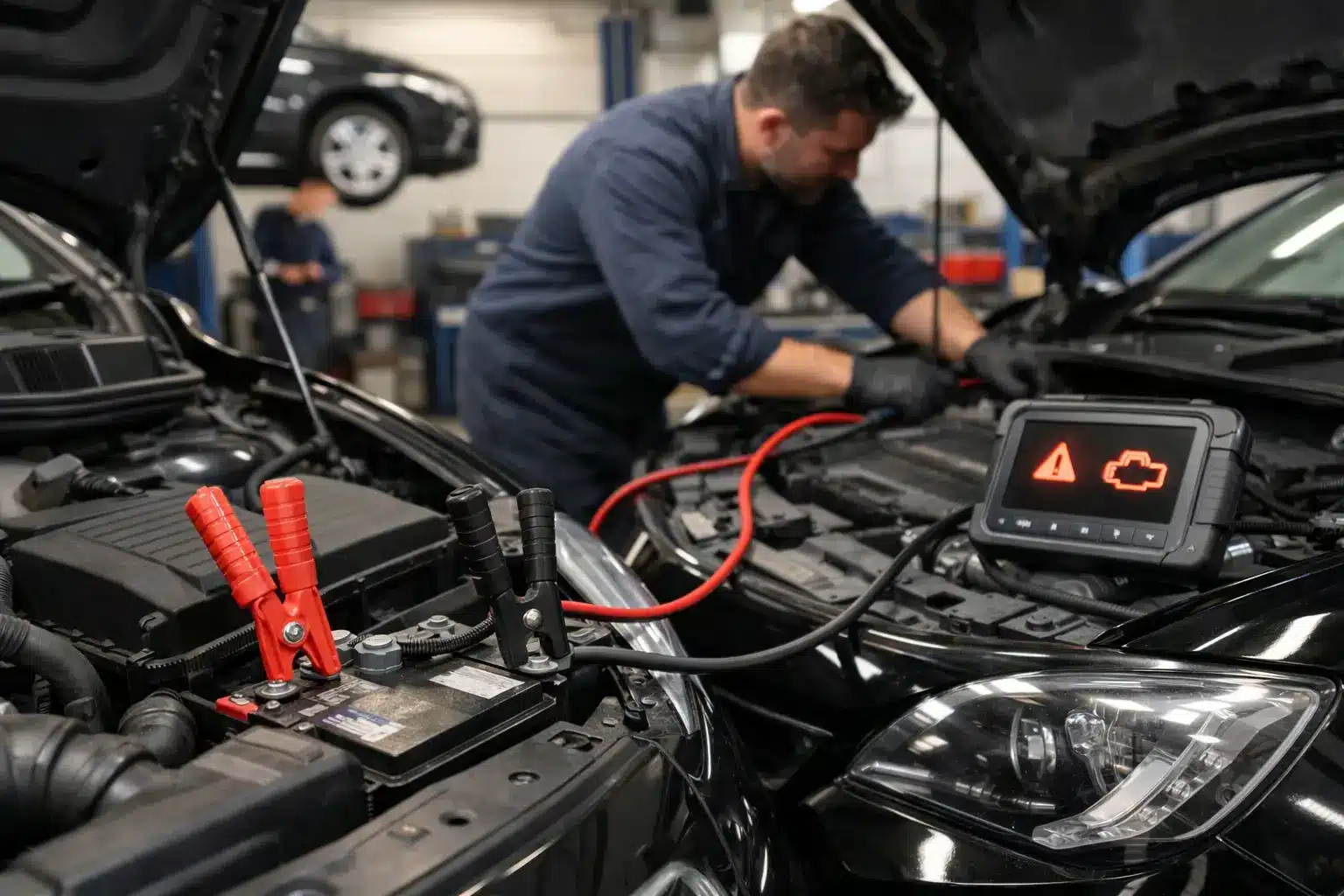
Poorly connected jump leads can cause sparks, blow fuses or damage sensitive electrical systems. Take your time here. The leads are normally red for positive and black for negative.
Connect them in this order:
- Attach the red lead to the positive terminal on the flat battery.
- Attach the other red clamp to the positive terminal on the donor battery.
- Attach the black lead to the negative terminal on the donor battery.
- Attach the final black clamp to a solid, unpainted metal earth point on the broken-down car, away from the battery and fuel system.
The final connection should not normally go directly onto the flat battery’s negative terminal unless the vehicle handbook specifically says to do so. Using a suitable earth point reduces the chance of a spark near the battery.
Check the clamps are secure and that the red and black leads cannot touch each other. Keep everyone clear of the engine bay while starting the cars.
Starting the Car Without Creating Another Problem
Start the donor vehicle first, if its handbook allows it, and let it idle for a few minutes. There is no need to rev the engine hard. Excessive revving does not charge a flat battery quickly and can create unnecessary risk on modern electrical systems.
Then try starting the vehicle with the flat battery. Do not crank it continuously. Try for around five seconds, then wait a short while before trying again. If it does not start after two or three sensible attempts, stop. Repeated cranking can overheat the starter motor and will not solve a fault that is not battery-related.
Once the car starts, leave it running for a few minutes before disconnecting the leads. Switch on as few electrical items as possible at first. Heated screens, blowers, lights and charging devices all add demand when the alternator is trying to recover the battery.
Disconnect the leads in the reverse order: black clamp from the previously flat car, black clamp from the donor vehicle, red clamp from the donor vehicle, then red clamp from the vehicle that was flat. Keep the clamps apart throughout.
A Drive May Help, but It Does Not Prove the Battery Is Fine
After a successful jump start, take the car for a proper drive if it is safe to do so. A short trip around the block often will not put enough charge back into the battery, especially in cold weather or with lots of electrical equipment running. Around 20 to 30 minutes of normal driving can help, but the real answer depends on the battery condition and whether the alternator is charging correctly.
We often see this issue when a car is used only for short journeys. Starting the engine takes a large amount of power, then a five-minute trip may not give the alternator enough time to replace it. The same can happen after the car has been parked for several days, particularly in winter.
If the battery was only run down by an interior light being left on, it may recover once properly charged. If it goes flat again the next morning, do not keep relying on jump leads. That usually means the battery is weak, the alternator is not charging as it should, or something is draining power while the car is parked.
Why Your Battery Keeps Going Flat
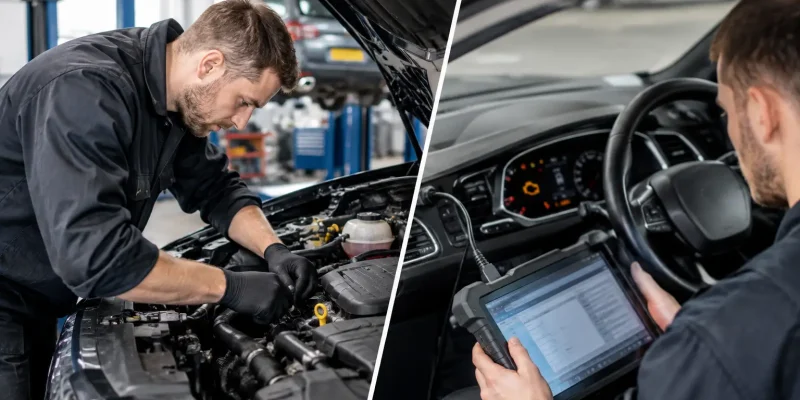
A battery is often blamed because it is the part you can see, but it is not always the root cause. At AutoFix4u, we check the battery and charging system rather than simply fitting a new battery and hoping for the best.
In most cases, repeat flat-battery problems come down to one of four causes: an ageing battery that no longer holds charge, an alternator or charging fault, poor battery connections, or a parasitic drain. A parasitic drain means an electrical component is using power after the car has been switched off. This could be something simple, such as a boot light staying on, or a fault in an electrical module.
Warning lights matter too. A battery warning light while driving usually points to a charging-system problem, not just a low battery. The car may continue running for a short distance using stored battery power, then cut out when that power is gone. If that light is on, avoid unnecessary driving and get the charging system checked.
Corroded or loose battery terminals can also cause a no-start. The battery may have plenty of charge, but the power cannot get through properly. This is why a proper test is more useful than assuming the battery itself has failed.
When Not to Keep Trying
There are a few situations where stopping is the sensible option. If the engine warning light was already on, the car cuts out soon after starting, there is a burning smell, or the battery warning light remains on, a jump start is only getting around the immediate symptom.
The same applies if the car starts with leads attached but dies as soon as they are removed. That strongly suggests it is not charging properly. Continuing to drive could leave you stranded again, and it may create further faults if the system voltage drops.
If you are outside Lowestoft, Oulton Broad, Carlton Colville, Kessingland, Beccles or nearby areas and cannot get the car started safely, recovery support is often the better call. It saves the risk of connecting leads incorrectly at the roadside and gets the vehicle to a point where the actual fault can be diagnosed.
Get the Cause Checked, Not Just the Car Running
A jump start is useful in an emergency. It should not become part of your morning routine. A battery and charging check can show whether the battery is holding charge, whether the alternator is doing its job, and whether there is an electrical drain that needs tracing.
If your car has needed a boost, is slow to start, or has a battery warning light, contact AutoFix4u for clear diagnostics and honest recommendations. We will explain what has failed, what needs doing now, and what can wait – with no surprise extras. Getting the fault sorted before the next cold morning is usually far easier than dealing with another no-start when you are already late.