Warning Lights Carlton Colville: What to Do Next
A warning light appearing on the way to work, school drop-off or the shops is never convenient. If you are searching for warning lights Carlton Colville, the key question is simple: can you keep driving, or should you stop? The answer depends on the light, how the car feels and whether any other symptoms have appeared.
At AutoFix4u, we see this every week from drivers in Carlton Colville and the Lowestoft area. Some lights point to a minor issue that can be booked in soon. Others mean the vehicle needs to be stopped safely and checked before damage gets expensive. The sensible next step is proper diagnostics, not guessing or replacing parts that may not be faulty.
Red warning lights: stop when it is safe
A red dashboard warning is normally the car telling you that there is a safety or mechanical issue requiring immediate attention. Do not ignore it because the car still appears to be running normally.
The oil pressure warning light is one of the most serious. This does not always mean the engine simply needs more oil. It can indicate low oil pressure, a leak, a faulty sensor or a problem with oil circulation. Continuing to drive with genuinely low oil pressure can cause major engine damage quickly. Pull over safely, turn the engine off and arrange advice or recovery.
A coolant temperature warning light means the engine may be overheating. You may also notice steam, a sweet smell, a loss of power or the temperature gauge climbing. Stop safely and allow the engine to cool. Do not remove the coolant cap while the engine is hot. This usually happens because of a coolant leak, failed thermostat, faulty water pump or radiator problem, and it needs investigating properly.
The brake system warning light also needs prompt attention, especially if it comes on with a soft brake pedal, poor braking, pulling to one side or a low brake fluid level. It could be something as straightforward as a low fluid level caused by worn pads, but it can also point to a leak or fault in the braking system. Do not take chances with it.
Amber warning lights: book a diagnostic check
Amber or yellow lights often mean the car can be driven carefully for a short time, but they should not be treated as a permanent dashboard feature. Leaving them can turn a manageable repair into a breakdown, an MOT failure or a vehicle that drops into limp mode.
Engine warning light
The engine warning light can come on for many reasons. We often see it caused by an emissions fault, ignition issue, sensor reading, air leak, fuel-system problem or DPF-related fault. The vehicle may feel completely normal, or it may misfire, use more fuel, struggle to accelerate or run unevenly.
A steady engine warning light usually allows you to drive gently to a garage if there are no serious symptoms. A flashing engine warning light is different. It can indicate a misfire severe enough to damage the catalytic converter. Avoid driving it further unless you need to move to a safe place.
The warning light does not identify the failed part on its own. It stores a fault code, but the code is only the starting point. A proper diagnostic checks the live readings and the likely cause behind the code, so you are not paying to fit parts on a hunch.
DPF warning light
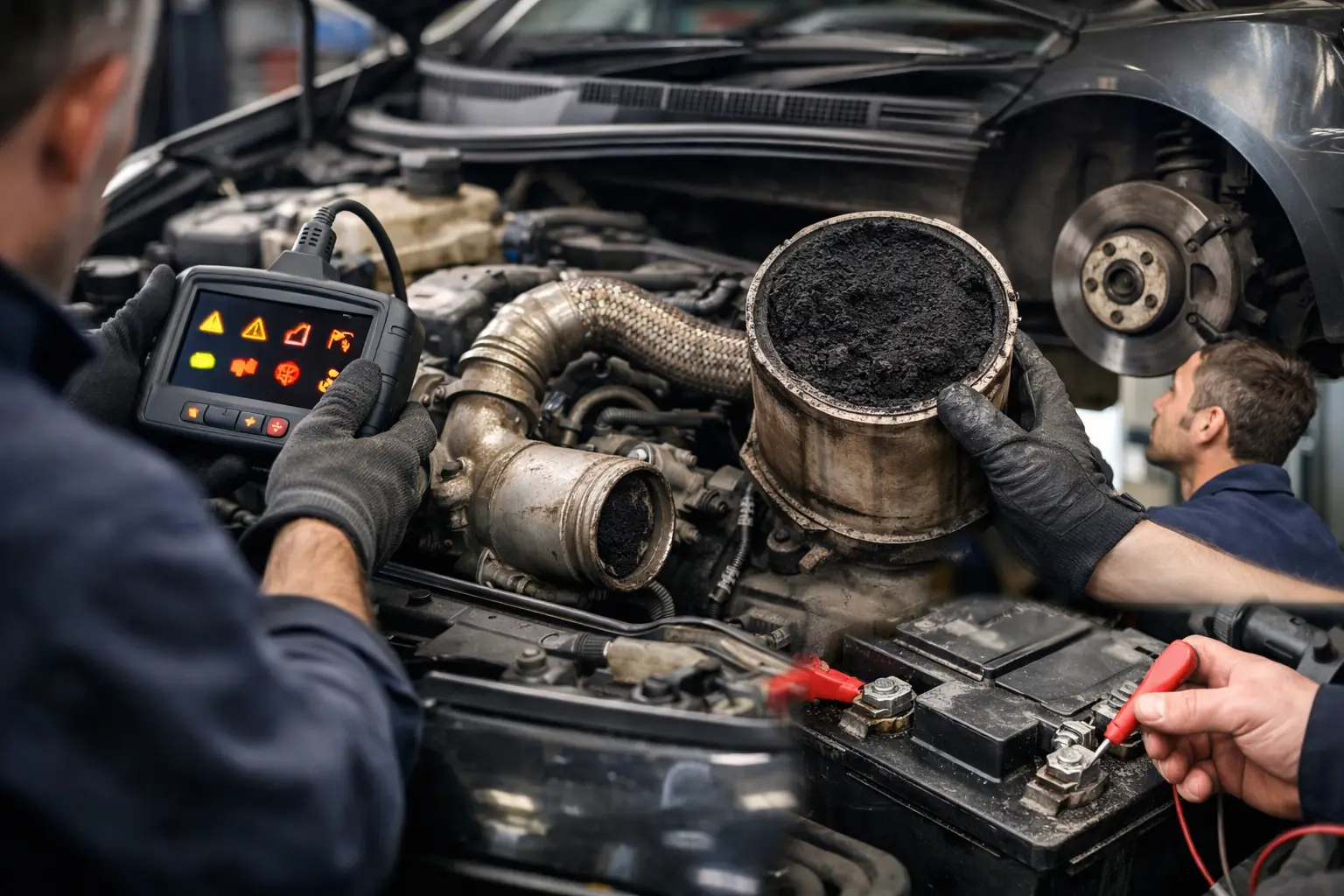
A DPF warning light is common on diesel vehicles used for short local journeys. The diesel particulate filter collects soot from the exhaust, then burns it off during regeneration. If the car does not get the right driving conditions, or another fault prevents regeneration, soot builds up.
In some cases, a suitable longer run may help if the warning has only just appeared and the car has no other fault. But if the light stays on, the vehicle loses power, goes into limp mode or has several dashboard warnings at once, do not keep trying to force it through. The root cause may be a sensor fault, boost issue, EGR problem or a filter that needs professional cleaning. We can assess the condition and advise on the right repair plan.
ABS, traction control and tyre pressure lights
An ABS light means the anti-lock braking system may not work correctly in an emergency stop. Your normal brakes may still operate, but the safety system needs checking. The cause is often a wheel-speed sensor, damaged wiring or an issue with the ABS system.
A traction control light can appear alongside the ABS light because the systems share information. If it flashes briefly on a wet road, it may simply be showing that the system is helping. If it stays on continuously, book a check.
The tyre pressure monitoring warning should be taken seriously too. Check all four tyres for obvious damage, then check pressures against the vehicle’s recommended settings. A slow puncture, damaged tyre, leaking valve or sensor issue can all trigger it. Never rely on a visual check alone, as a tyre can be significantly underinflated without looking flat.
When a battery light means more than a battery
The battery warning light confuses many drivers. It does not always mean the battery itself has failed. Usually, it means the charging system is not charging the battery while the engine is running.
This can be caused by an alternator fault, wiring problem, damaged drive belt or poor connection. The car may continue for a short distance using stored battery power, then lose electrical functions and stop. If the battery light comes on while driving, reduce unnecessary electrical use, head to a safe place if nearby and arrange a check. Do not assume a new battery will solve it.
What to do when a warning light appears
Start by looking for changes in the way the vehicle drives. Is there a loss of power, smoke, overheating, strange noise, burning smell, vibration or difficulty braking? These details help narrow down the fault and can tell you whether the car should stay parked.
If the light is red, flashing, or appears with serious symptoms, stop safely and switch off the engine where appropriate. If it is an amber light and the car is driving normally, avoid heavy acceleration, towing or long unnecessary trips until it has been checked.
Do not clear the light with a basic code reader and assume the problem has gone away. Clearing a code only removes the warning temporarily if the fault is still present. The light will usually return, often at the worst possible time. It can also make a proper diagnosis harder if useful fault information is erased.
Warning light diagnostics that find the cause
A diagnostic appointment should give you more than a code and a vague recommendation. We connect professional diagnostic equipment, read the stored information, check live data and inspect the related components where needed. That might include wiring, sensors, hoses, battery charging voltage, brakes or the DPF system.
In most cases, we can explain the fault in plain English before any repair work begins. You will know what has been found, what needs doing now and what can wait. If a same-day repair is possible, we will tell you. If parts or further testing are needed, you will receive a clear repair plan with no surprise extras.
Get a clear answer before the fault gets worse
Dashboard warnings are designed to get your attention early. Acting quickly can protect your engine, brakes, emissions system and wallet. It also gives you a better chance of avoiding a breakdown or an unexpected MOT failure.
If a warning light has appeared on your car in Carlton Colville, contact AutoFix4u for a diagnostic check. Tell us which light is on, whether it is red, amber or flashing, and how the car is behaving. We will give you practical advice on the safest next step and work to get you back on the road with a repair that addresses the real cause.