How to Spot DPF Issues Before They Get Worse
One of the most common calls we get is from drivers who say the car feels flat, a warning light has come on, and now it will barely pull properly. Quite often, that points to the same thing – a DPF problem. If you are wondering how to spot DPF issues before they turn into a breakdown or a bigger repair bill, there are a few clear signs to watch for.
The diesel particulate filter, or DPF, is there to catch soot from the exhaust. Over time, that soot needs to burn off through a process called regeneration. When that does not happen properly, the filter starts to block. In most cases, the early signs are there before the car becomes undriveable.
How to spot DPF issues from the way the car drives
A blocked or struggling DPF often shows up in day-to-day driving before anything more serious happens. The car may feel sluggish, especially when you try to accelerate. You might notice it hesitating, holding back, or refusing to rev as freely as usual.
We often see this issue when drivers mainly do short local trips. The engine and exhaust do not get hot enough for long enough to complete a proper regeneration. Soot builds up bit by bit, and eventually performance starts to suffer.
Another common sign is higher fuel use. If the car seems to be using more diesel than normal, that can be linked to failed or repeated regeneration attempts. The engine is effectively working harder to deal with the problem.
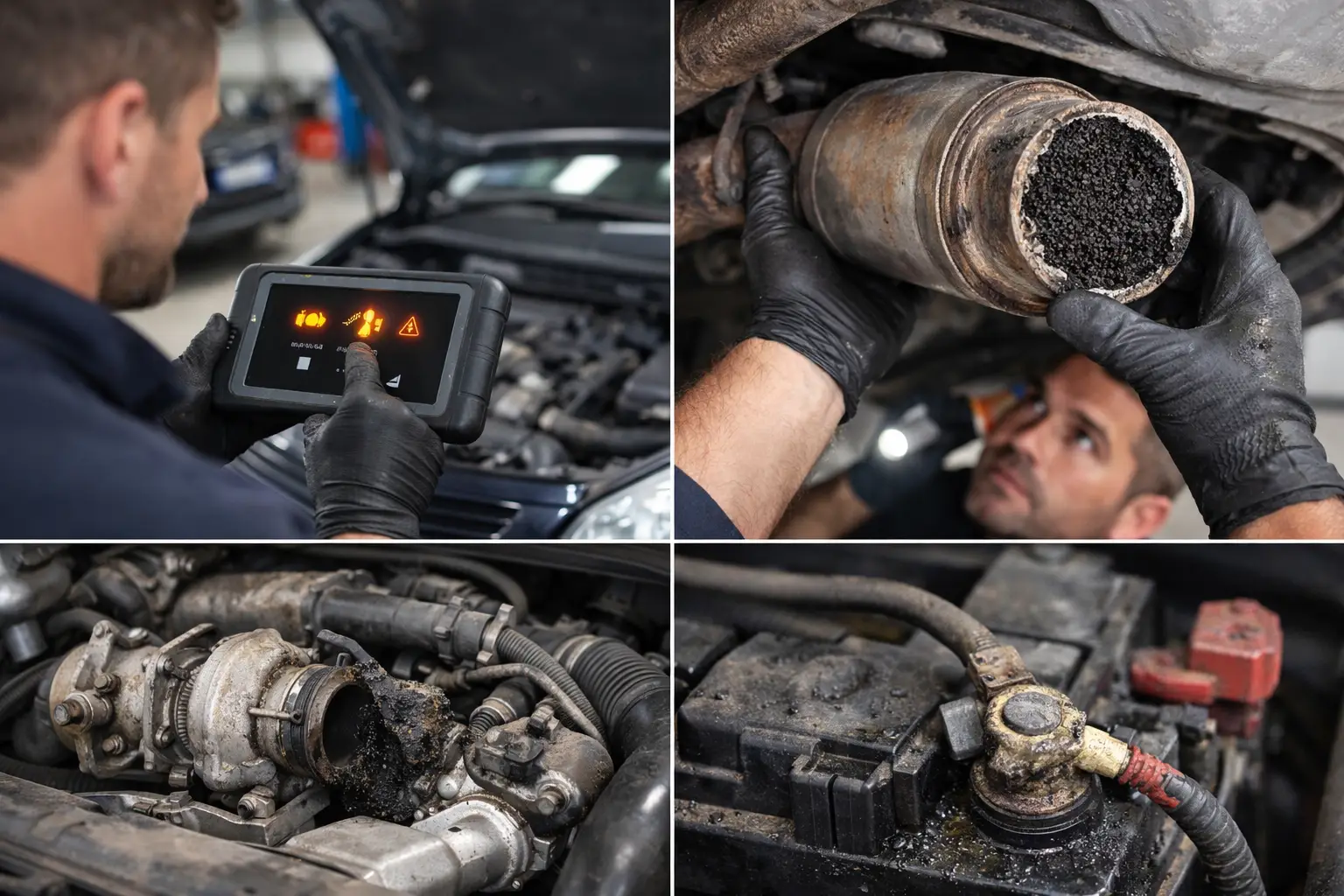
Then there is limp mode. If your car suddenly loses power and will not go past a certain speed or rev range, that is a strong sign something needs checking straight away. Limp mode is the car trying to protect itself. Sometimes the DPF is the issue on its own. Sometimes there is an underlying fault causing the DPF to block, such as a sensor problem, injector issue, turbo fault, or EGR valve trouble.
Warning lights that point to DPF trouble
Dashboard lights matter with DPF faults because they give you the best chance of catching the issue early. The obvious one is the DPF warning light itself, but not every car labels it clearly. Some drivers only notice the engine warning light, or a message saying the exhaust filter is full or regeneration is needed.
If you get a warning light and the car still seems to drive normally, do not ignore it. That is usually the stage where the problem is still manageable. In many cases, a proper diagnostic check and the right repair plan can stop it becoming a blocked filter, limp mode situation, or forced recovery.
If the warning light is joined by poor performance, rough running, cooling fan activity after short trips, or a strong hot smell, the car may be trying and failing to regenerate. That needs looking at properly. Clearing the warning light without fixing the cause will not solve anything for long.
When a DPF warning light is not just a DPF problem
This catches a lot of people out. The filter itself is not always the root cause. We often find DPF faults linked to pressure sensors, temperature sensors, split hoses, glow plug issues, thermostat faults, or driving patterns that never allow a proper regen.
That is why a diagnostic-first approach matters. If you only treat the symptom, the same warning light usually comes back.
Signs of a blocked DPF you should not ignore
Some symptoms are more urgent than others. Excess smoke is one. So is a car that starts but feels heavily restricted, particularly under load. In more advanced cases, the engine may become harder to start, idle poorly, or cut power with very little warning.
You may also notice the radiator fan running when it should not, or staying on after the engine is switched off. That can happen when the car has been trying to regenerate unsuccessfully. A burning smell can also point to an interrupted regen process.
If you keep driving like that for too long, the problem can spread beyond the DPF itself. Back pressure in the exhaust system is not something to leave. It can affect turbo performance and overall engine efficiency, and it usually makes the repair more involved.
Short journeys and repeated stop-start driving
This usually happens because the car never gets the sustained run it needs. Diesel engines fitted with DPF systems do not always suit repeated short trips, school runs, or low-speed local driving. That does not mean the car is faulty by design, but it does mean the system needs the right conditions to keep itself clear.
If your usage has changed recently and DPF problems have started appearing, that is worth mentioning when you book the car in. It can help explain why the issue has started now.
What causes DPF faults in the first place?
Soot build-up is the basic problem, but the cause is not always simple. In some cases, it is mainly driving style. In others, there is another fault in the background that is stopping regeneration from happening properly.
We often see blocked DPFs linked to faulty sensors that are sending the wrong readings to the engine control unit. If the car cannot measure pressure or temperature correctly, it may not trigger a regen when needed. A thermostat stuck open can also stop the engine getting up to proper operating temperature, which interferes with regeneration.
There are also cases where injector faults, turbo issues, oil contamination, or EGR valve problems create excess soot in the first place. If that is happening, cleaning the DPF without sorting the cause is only a short-term fix.
What to do if you think you have DPF issues
If the car is still driving reasonably well and you have only just noticed a warning light, act early. Do not wait for the car to drop into limp mode. Booking a proper diagnostic check at that stage usually gives you more options.
If the car has already lost power, is smoking, or feels unsafe to drive, stop using it until it has been checked. Pushing on can make the fault worse. In some situations, a normal regeneration is no longer possible and more work is needed.
The right fix depends on what the car is telling us. It might need diagnostics, a forced regeneration, DPF cleaning, sensor replacement, or repair of the underlying cause. It depends how blocked the filter is and why it blocked in the first place.
Avoid guesswork and quick resets
A lot of drivers have already tried the obvious before calling a garage. They may have taken it for a faster run, added fuel treatment, or had someone clear the fault code. Sometimes that helps if the issue is mild and caught early. Often, it does not.
The problem with guesswork is that it wastes time and can delay the proper repair. A reset may turn the light off for now, but if a pressure sensor is faulty or the filter is badly loaded with soot, the warning will come back.
How a garage should check DPF faults properly
A proper DPF diagnosis is not just plugging in a code reader and reading out one fault. The car needs checking properly. That means looking at live data, checking pressure readings, checking sensor operation, seeing whether regeneration is possible, and looking for the reason the filter has become blocked.
That is the difference between a temporary fix and a reliable one. If the fault is found early, the repair is often more straightforward. If it has been left until the car is barely running, the options can narrow quickly.
For local drivers around Lowestoft, Oulton Broad, Carlton Colville and nearby areas, this is usually a problem that starts small and then becomes urgent at the worst possible time – on the school run, on the way to work, or just before an MOT. The good news is that early action normally makes things easier.
If you have a DPF light on, loss of power, or a diesel car that is not driving as it should, get it checked before it turns into a bigger repair. AutoFix4u can carry out fast diagnostics, explain the fault in plain English, and let you know the next step with clear pricing and no surprise extras. Call now or book in for a diagnostic check while the problem is still manageable.