Car Diagnostics Lowestoft – What to Do First
A warning light on the dash rarely appears at a good time. It usually happens when you need the car for work, the school run or a weekend trip. That is why car diagnostics Lowestoft drivers book most often are not about curiosity – they are about finding the fault quickly, understanding what it means, and getting back on the road without guesswork.
At our garage, we see the same pattern every week. A customer notices the engine warning light, a loss of power, rough starting, poor fuel economy or a car that suddenly drops into limp mode. In most cases, the biggest mistake is carrying on and hoping it sorts itself out. Sometimes the issue is minor. Sometimes it is the early sign of a bigger repair. The only sensible next step is to test it properly.
Why proper car diagnostics in Lowestoft matters
Modern cars rely on sensors, control units and wiring to manage everything from fuel delivery to emissions and braking systems. When one part stops working as it should, the vehicle stores a fault code. That code is a clue, not the full answer.
We often see this issue when a driver has already had a quick code read elsewhere and been told they need a new part straight away. The problem is that fault codes point you in a direction, but they do not always tell you the root cause. A warning for an oxygen sensor, for example, can be caused by the sensor itself, damaged wiring, an air leak or another engine issue affecting the readings.
That is why a proper diagnostic check matters. It helps separate the real fault from the symptom. It also helps avoid wasted money on parts that do not fix the problem.
Common problems that need diagnostics
Most people do not book diagnostics because they want technical information. They book because something feels wrong. The car is driving differently, sounding rough, or showing a warning that was not there yesterday.
Engine warning light
This is one of the most common reasons people come in. The engine warning light can come on for a wide range of faults, from ignition and fuel issues to sensor problems and emissions faults. Sometimes the car still feels normal. Sometimes it runs badly straight away.
If the light is flashing, stop driving and get it checked as soon as possible. A steady light is usually less urgent, but it still needs attention. Leaving it too long can turn a smaller job into a more expensive one.
Loss of power or limp mode
If your car suddenly feels flat, struggles to accelerate or limits itself to protect the engine, there is usually a fault that needs tracing. We often see this with turbo issues, boost leaks, DPF problems, sensor faults or fuel system issues.
This usually happens because the vehicle has detected something outside safe limits and is trying to prevent damage. The car may still move, but that does not mean it is fine to keep using.
DPF and emissions faults
Diesel cars in particular can suffer from blocked DPFs, failed regenerations and related warning lights. In some cases, the filter itself is the issue. In others, the DPF problem is being caused by something else, such as a faulty sensor, injector issue or repeated short journeys.
This is where diagnostics become essential. If you only deal with the filter and ignore the cause, the same fault often returns.
Starting and battery problems
A car that is slow to start, clicks, cuts out or fails to crank may not simply need a battery. We see faults caused by charging problems, starter motor issues, poor earth connections and electrical drains.
A proper test helps confirm whether the battery is the problem or whether something else is stopping it from doing its job.
MOT failure faults
Sometimes a car fails its MOT for emissions, ABS, airbag lights or another fault that is not obvious to the driver. Diagnostics can save time here by identifying the cause properly and giving you a clear repair plan instead of guessing your way through the fail sheet.
What happens during a diagnostic check
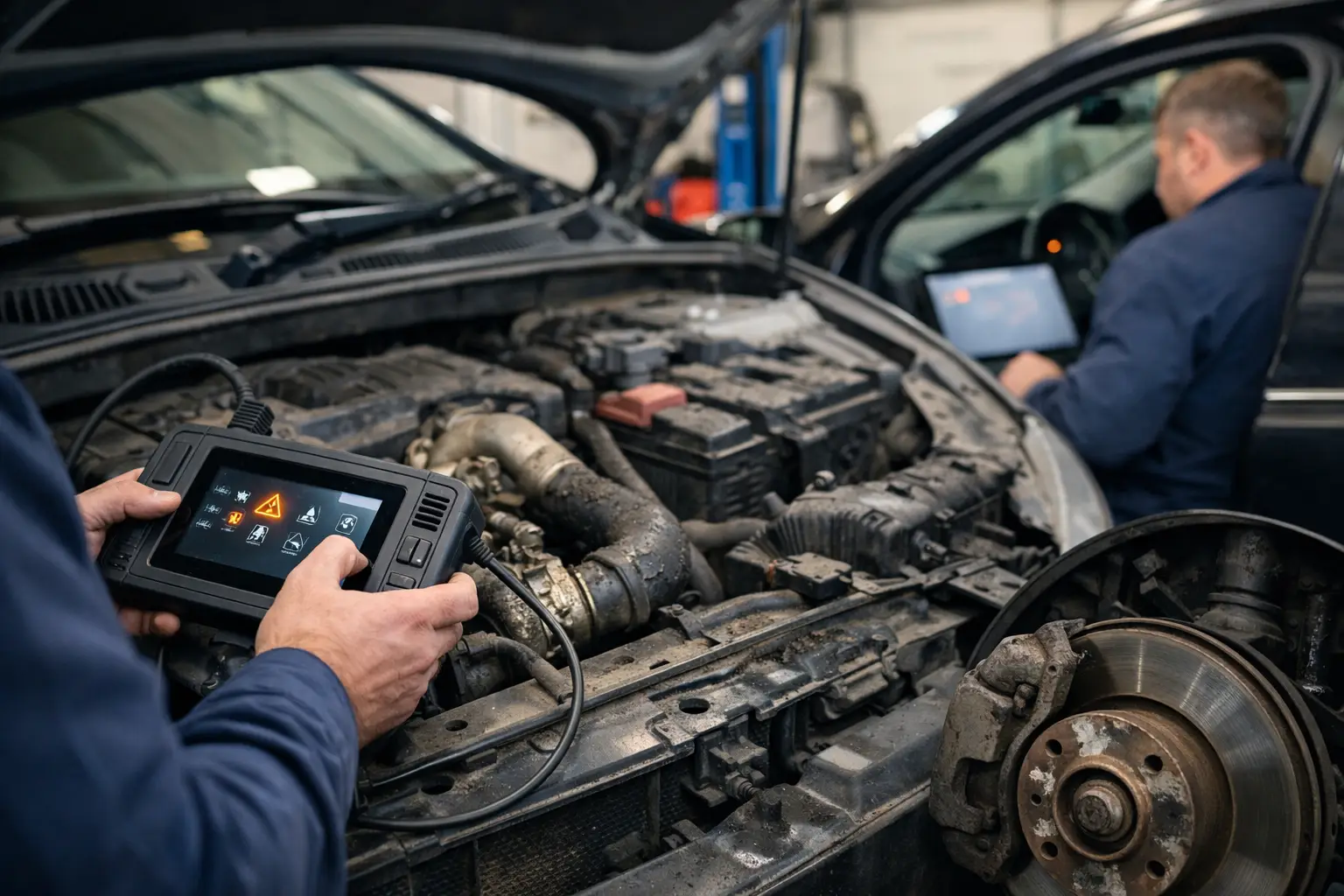
A good diagnostic process should be simple from the customer side. You tell the garage what the car is doing, when the fault started and whether anything has changed. From there, the technician checks the system, reads the stored codes, looks at live data and tests the likely causes.
This matters because two cars with the same warning light may need completely different repairs. The code is only one part of the picture. The way the car starts, idles, drives and responds under load all helps point to the actual fault.
At AutoFix4u, the aim is not to confuse you with technical terms. It is to identify the fault properly, explain it in plain English and tell you what needs doing next. If the issue can be repaired the same day, we will say so. If it needs more time or parts, you will know where you stand.
Car diagnostics Lowestoft drivers often need fast
A lot of faults do not give much warning. One day the car is fine. The next day it is down on power or showing a dashboard light on the way to work. For drivers around Lowestoft, Oulton Broad, Carlton Colville, Kessingland and nearby areas, speed matters almost as much as accuracy.
That is why a local garage is often the best option. You are not dealing with a call centre or waiting days for a basic answer. You are speaking to the people working on the vehicle. That makes it easier to explain the problem, get honest advice and decide what to do next.
In most cases, drivers want three things. They want to know if the car is safe, what is actually wrong, and how soon it can be fixed. Diagnostics should answer those questions clearly.
When not to ignore the signs
Some faults can wait a day or two. Others should be looked at straight away. If the engine warning light is flashing, the car is misfiring, there is a strong burning smell, the brakes feel wrong or the vehicle keeps cutting out, stop using it and get advice.
The same applies if the car goes into limp mode repeatedly or loses power in traffic. Even if it restarts and seems fine again, the fault is still there. Intermittent issues often become permanent if left long enough.
It also depends on how you use the car. If you only make short local trips, you may manage for a short time with a minor fault. If you rely on the vehicle daily for commuting or family travel, it is usually better to deal with it early before it leaves you stranded.
Why guessing usually costs more
It is understandable that some drivers search online, buy a part based on a fault code and hope for the best. Occasionally that works. Quite often, it does not.
We often see cars that have already had sensors, batteries or other parts fitted elsewhere without solving the issue. The original fault is still there, and the customer is now paying twice – once for the guess, and again for the proper diagnosis.
A diagnostic-first approach is usually the better route. It saves time, reduces wasted spend and gives you a clearer repair plan. That is especially important with electrical faults, DPF issues and engine management problems, where one symptom can have several possible causes.
What to do if your car has a warning light or fault
If the car still drives normally, book it in before the issue gets worse. If it feels unsafe, has severe loss of power or will not start, call for advice and avoid forcing it. The sooner the fault is checked, the easier it usually is to pinpoint.
Be ready to explain what the car is doing. Does the light come on all the time or only after start-up? Is the problem worse when cold? Has fuel economy dropped? Has any work been done recently? Small details help speed up the process.
If you are looking for car diagnostics in Lowestoft, choose a garage that will do more than plug in a scanner and read out a code. You need someone who will trace the issue properly, explain it clearly and fix the cause, not just clear the warning light.
Same-day slots are often available for urgent faults, and that can make all the difference when the car is your only way to get around. If something does not feel right, get it checked now rather than waiting for a breakdown at the worst possible moment.
A fault found early is usually easier to deal with, and a clear answer is always better than a guess.


5 thoughts on “Car Diagnostics Lowestoft – What to Do First”