
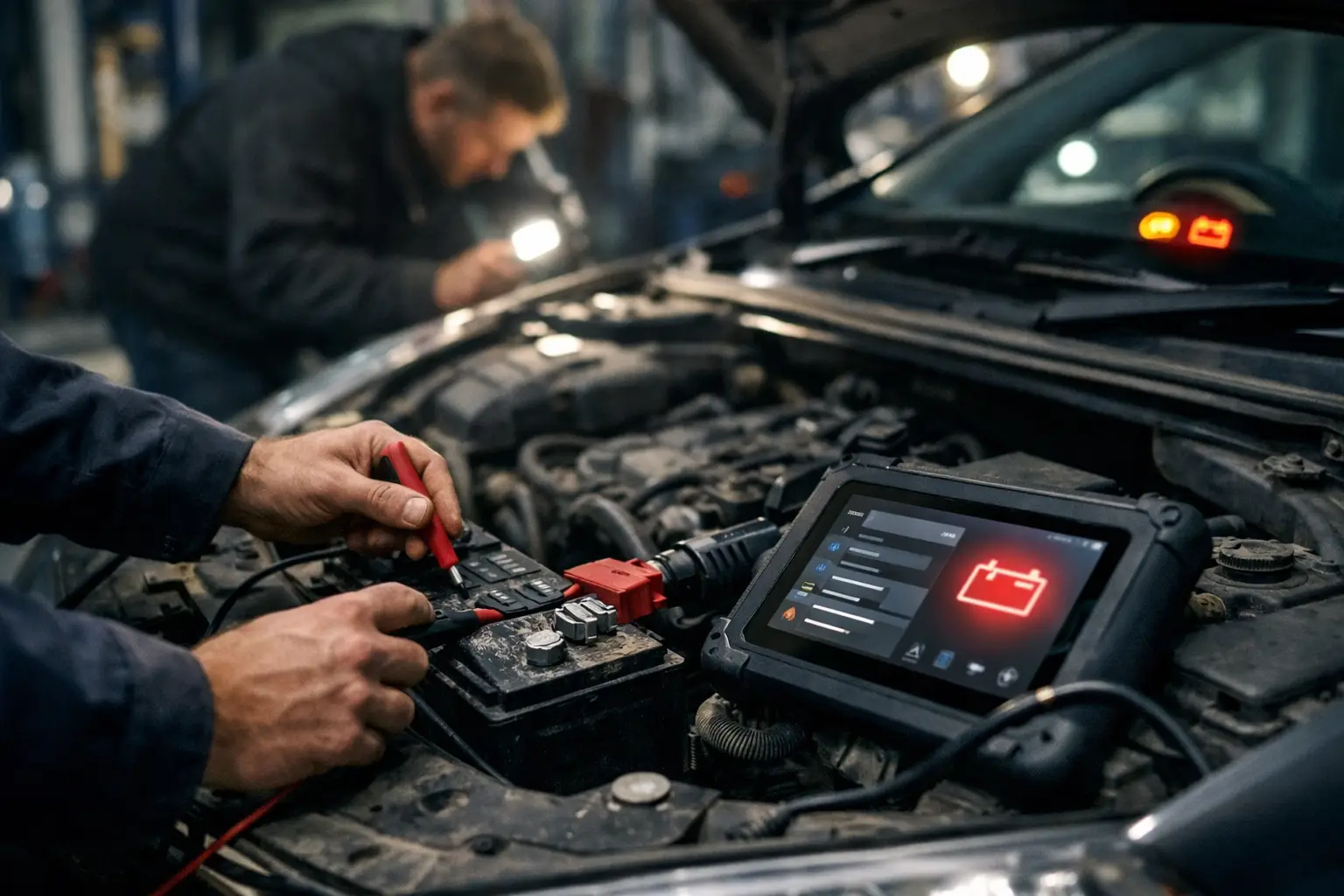
Battery Keeps Going Flat Overnight?
You go out in the morning, turn the key or press the start button, and nothing happens. If your battery keeps going flat overnight, the battery itself is only part of the story. In most cases, there is an underlying fault draining power while the car is parked, or the battery is no longer able to hold charge properly.
We see this quite often with cars that were fine the day before, then suddenly will not start before work, the school run or an appointment. It is frustrating, and it usually leaves people wondering whether they just need a new battery or whether something else is wrong. The answer depends on what is causing the drain.
Why a battery keeps going flat overnight
A healthy battery should hold enough charge overnight without any trouble. If it does not, there are usually three main possibilities. The battery is worn out, the charging system is not doing its job, or something in the car is staying on and pulling power after you have locked it.
Older batteries are an obvious starting point. Most do not last forever, and cold weather often exposes a weak one. A battery can seem usable for short trips and then fail suddenly once its capacity drops far enough. If it is several years old, that is worth checking first.
That said, replacing the battery without testing the rest of the system can be a waste of money. We often see this issue when the alternator is undercharging, or when there is a parasitic drain from an electrical fault. The new battery then goes flat as well, and the real problem is still there.
The most common causes
The battery has reached the end of its life
This usually happens because the internal plates wear out over time. The battery may still show some voltage, but it cannot deliver enough power to crank the engine properly. You might notice slower starting, dim lights, or dashboard warnings before it finally gives up.
Short journeys can make this worse. If the car is mainly used for quick local trips, the battery may never fully recover what it used to start the engine. Over time, that repeated partial charging shortens its life.
A parasitic drain is flattening it overnight
A parasitic drain means something is using battery power when the car should be asleep. Common examples include an interior light staying on, a faulty boot light switch, a dashcam wired in badly, an aftermarket stereo issue, or a control module that does not shut down properly.
Some drains are obvious. Others are not. Modern cars can have several electronic modules, and one fault can keep part of the system awake long after the car is locked. That is why proper diagnostics matter. Guesswork rarely solves electrical drains for long.
The alternator is not charging the battery properly
If the alternator is weak or failing, the battery may not be getting fully charged while you drive. The car starts and runs for a while, then the battery goes flat again once parked. In that situation, the overnight flat battery is really the result of poor charging during the day.
You may also notice a battery warning light, flickering lights, or electrical systems behaving oddly. But not always. Some charging faults are subtle at first.
Poor connections or damaged wiring
Loose battery terminals, corroded clamps, damaged earth straps or wiring faults can all cause trouble. Sometimes the battery is fine, but the connection is poor enough that the car struggles to start or fails to charge correctly.
This is one of those faults that can look like a dead battery one day and then seem normal the next. Intermittent electrical problems are common, especially on older vehicles.
What to check first if your battery keeps going flat overnight
Before assuming the worst, start with a few simple checks. Make sure no interior lights are staying on. Check the boot closes properly and the glovebox light is not stuck on. If you have any aftermarket electrical items fitted, such as a tracker, stereo, dashcam or mobile phone charger, keep them in mind.
Then think about the battery age. If it is old and the car has become slower to start over the last few weeks, the battery may simply be worn out. If the battery is fairly new but keeps dying, the fault is more likely elsewhere.
Also think about how the car is used. A vehicle doing short stop-start trips every day is under more strain than one getting regular longer runs. That does not always mean there is a fault, but it can push a weak battery over the edge.
If the car needs repeated jump starts, stop there and get it checked. Constantly jump starting a vehicle can lead to further issues, especially if the charging system or electrical system is already under stress.
Why guessing can cost more
A flat battery feels like a simple problem, but it often is not. We have had cars come in after the battery was replaced elsewhere, only to find the real issue was a drain from an electrical control unit or a charging fault. The customer ends up paying twice.
This is where a proper diagnostic-first approach saves time. Instead of fitting parts and hoping for the best, the system needs testing. Battery condition, charging rate, and current draw while the vehicle is switched off all need checking.
That is how you find the root cause. It is also how you avoid being left stranded again a few days later.
How the fault is diagnosed properly
Battery and charging tests
The first step is to test the battery itself and check how the charging system is performing. A weak battery will show up quickly under load. The alternator output can also be measured to see whether it is charging at the correct level.
If both are doing what they should, attention then turns to power draw with the ignition off.
Parasitic drain testing
This involves measuring how much current the car is drawing when parked and then narrowing down which circuit is responsible. In some cases, it is a straightforward fault such as a light or accessory. In others, it takes more time because a module may be waking up intermittently.
This is why the fix is not always instant. Electrical drains can be simple, but they can also be time-consuming to trace properly. Honest garages will tell you that upfront.
Inspecting connections and wiring
Battery terminals, earth points and visible wiring should also be checked. Corrosion, loose fittings and damaged cables can all mimic bigger faults. Sometimes the solution is simple. Sometimes it points to a deeper issue in the vehicle electrical system.
When the problem is urgent
If the car is your only vehicle, an overnight flat battery is more than an annoyance. It can stop you getting to work, school, appointments or picking someone up on time. That is why it makes sense to act early rather than waiting for a complete no-start situation.
Repeated flat batteries can also damage the battery further. Letting it discharge deeply again and again shortens its life, even if it was good to begin with. So if this has happened more than once, it is worth getting it tested now rather than later.
For drivers around Lowestoft and nearby areas, this is the sort of fault that needs a clear answer, not vague advice. A proper test will tell you whether you need a battery, an alternator repair, an electrical fix, or simply a bad connection sorting out.
The right next step
If your battery keeps going flat overnight, the safest move is to book diagnostics and get the cause confirmed before replacing parts. In some cases it is just an old battery. In others, the battery is only the victim of a fault somewhere else.
At AutoFix4u, this is exactly the sort of problem we deal with – finding out why the battery is going flat, explaining it in plain English, and putting together a repair plan with clear pricing and no surprise extras. Same-day slots may be available depending on workload.
Call now, get a quote, or book the car in for testing. A flat battery tomorrow morning usually starts with a fault that is already there today.


One thought on “Battery Keeps Going Flat Overnight?”