Suspension Knocking Noise: Causes and Fixes
That sharp knock you hear over speed bumps is your car telling you something is loose, worn, or moving when it should not. Ignore it and you often end up with more than an annoying noise – handling gets worse, tyre wear speeds up, and small wear turns into bigger breakage.
This guide covers the most common car suspension knocking noise causes, how to narrow them down by when the sound happens, and what to do next. No guesswork, no fluff – just practical fault-finding in plain English.
What a suspension knock usually means
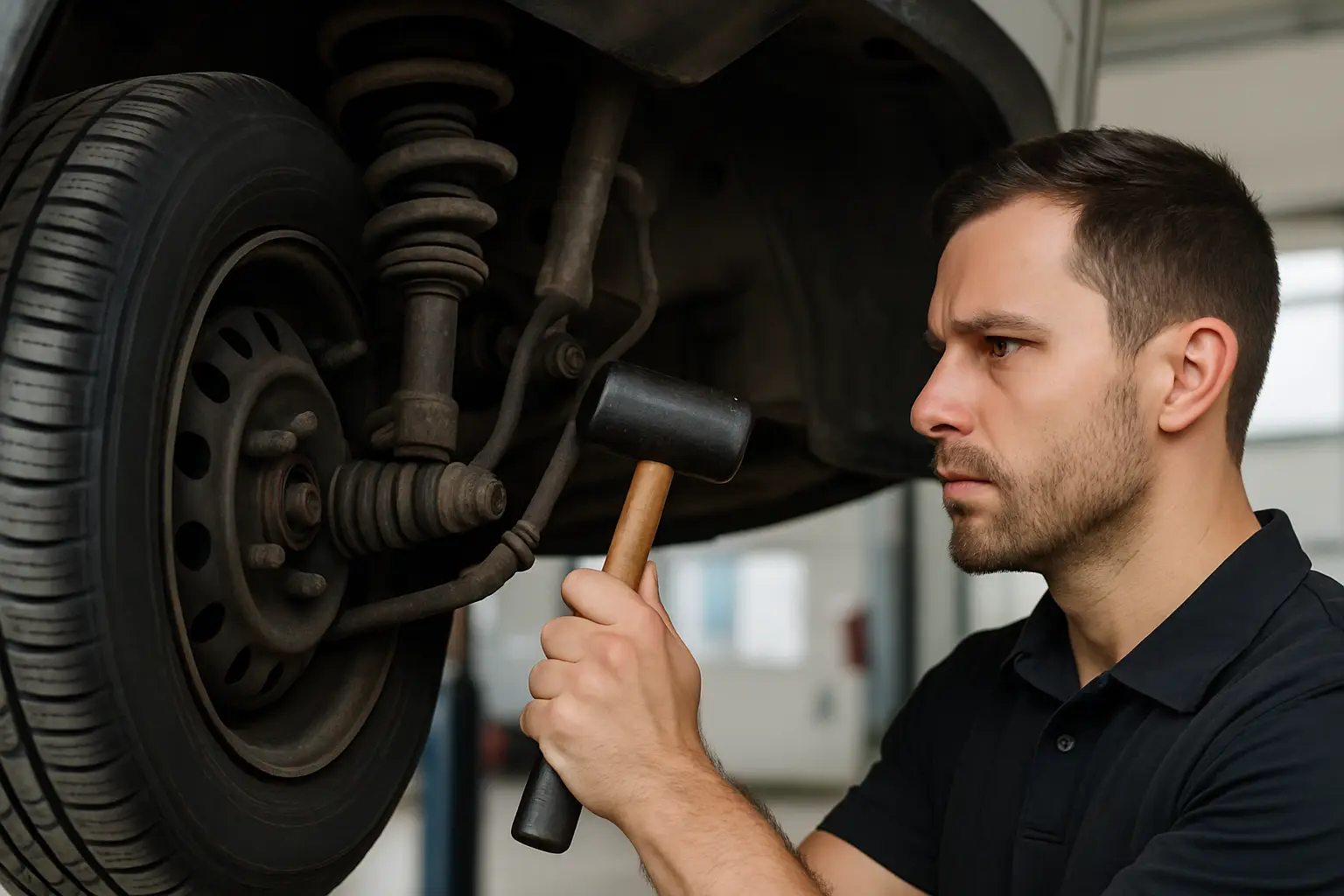
A true suspension knock is typically a metal-on-metal tap or thud that happens when the wheel hits a bump, the body rolls in a corner, or the suspension compresses and rebounds. Suspension components are meant to pivot through rubber bushes or ball joints. When that cushioning wears out or a joint develops play, parts start contacting each other under load. That is the knock.
There is a trade-off here. Some knocks are just a worn link that can be replaced quickly. Others point to structural wear that affects braking stability and steering control. The job is to work out which it is before it becomes unsafe.
Car suspension knocking noise causes (most common)
Worn drop links (anti-roll bar links)
Drop links are one of the biggest offenders. They connect the anti-roll bar to the suspension strut or arm. The little ball joints at each end wear, then you get a rattle or knocking, often at low speed over rough roads.
A classic sign is a knock that is worse on small repeated bumps (cobbles, patched roads) than on one big bump. It can sound like something is loose in the boot, but it is coming from the corner of the car.
Anti-roll bar bushes
If the drop links are fine, the anti-roll bar itself can knock where it mounts to the subframe. The rubber bushes harden, crack, or shrink, and the bar shifts side to side under body roll. This often shows up as a dull knock when turning into driveways, roundabouts, or quick lane changes.
These can be deceptively noisy for something that looks minor. Left too long, the movement can start stressing other components.
Worn lower arm bushes
Control arms (wishbones) have rubber bushes that take a lot of punishment. When they split, the wheel can move back and forth slightly during braking or over bumps. That movement can create a knock and it can also pull the car about.
If the knock comes with vague steering, pulling under braking, or uneven tyre wear, control arm bushes jump up the suspect list.
Ball joints with play
Ball joints allow the suspension to move while keeping the wheel located. When they wear, you can get a knock on bumps and a clunk when moving from reverse to drive (or when setting off and stopping). Ball joint wear is not something to sit on – if the play becomes excessive, it becomes a safety issue and an MOT concern.
Top mounts and strut bearings
Front suspension struts use a top mount (with a bearing on many cars) to allow the strut to rotate with steering. When the bearing gets rough or the rubber mount collapses, you can hear knocking or creaking, especially when turning the steering at low speed or going over a bump while steering.
Drivers often describe it as a knock from high up in the wing area rather than down by the wheel.
Worn shock absorbers
Shocks do not usually cause a sharp knock on their own, but failed internal valves, loose mounting bushes, or a broken shock mount can. More commonly, worn shocks allow the car to bounce, which then makes other worn parts knock harder.
If your car feels floaty, takes longer to settle after a bump, or dips heavily under braking, the shocks may be part of the story.
Broken coil spring
A coil spring can snap, often at the bottom coil where corrosion builds up. A broken spring can knock, especially when turning or when the suspension compresses and the broken end shifts. Sometimes you also hear a twang.
This is another one that needs prompt attention. It affects ride height and can damage the tyre if the broken end moves.
Steering rack, track rod ends, or inner joints
Not every “suspension” knock is suspension. Worn track rod ends or inner steering joints can knock when you hit a bump or change direction. The steering may feel less precise, and you might notice a clunk through the wheel.
If the noise happens more when steering than when simply going over bumps, the steering joints need checking.
Loose brake components or worn caliper sliders
A knock that seems to come from the front can be brakes. If caliper slider pins are worn or dry, or if anti-rattle clips are missing, the pads can move and knock. You might only hear it over bumps, then it disappears when you lightly press the brake pedal.
That “it goes away when I touch the brakes” detail is a useful clue.
Subframe or suspension bolts not tight
After previous work, it is possible (though not common) for bolts to be under-torqued or for a component to settle. That can cause a heavy knock and a feeling that something is shifting.
If the noise started right after a repair, do not assume “it will bed in”. Get it checked and tightened correctly.
Narrow it down by when the knock happens
A good description saves time in diagnostics. Pay attention to these patterns.
Knocking over small bumps at low speed
This often points to drop links, anti-roll bar bushes, or worn brake hardware. It can also be track rod ends on some cars, but drop links are the usual starting point.
A single clunk when braking or setting off
Think control arm bushes, ball joints, or engine/gearbox mounts rather than anti-roll bar links. Mounts are not strictly suspension, but a worn mount can feel like a suspension knock because the drivetrain shifts under load.
Knocking when turning the steering
Top mounts and strut bearings are common here, as are steering joints. If it is more of a click on full lock, that can be CV joints, which is a different system again but often reported as a “front suspension noise”.
Knocking from the rear
Rear knocks can be anti-roll bar links (if fitted), trailing arm bushes, shocks, or exhaust contact. Rear shocks with worn top mounts can make a surprisingly loud thud over speed bumps.
Simple checks you can do without tools
You do not need to get under the car to gather useful information.
Listen with the windows down on a quiet road. Try one speed bump straight on, then at a slight angle. If the knock changes when one wheel hits first, that often points to anti-roll bar links or bushes.
Try a gentle brake application over a rough surface. If the knocking reduces when the brakes are lightly applied, suspect pad/caliper movement.
Check your tyres for odd wear on the inside or outside edges. Suspension play and poor alignment often show up here.
If the steering feels vague, pulls, or the car wanders, treat that as a sign to book in sooner rather than later.
When it is safe to drive and when it is not
It depends on what is worn and how far it has gone. A light rattle from a worn drop link might not stop you getting to work today, but it still needs fixing because it affects stability.
If you have a heavy clunk, a steering wobble, a sudden change in ride height, or the car feels unstable under braking, stop treating it as “just a noise”. A broken spring, a ball joint with play, or a loose mounting can escalate quickly.
As a rule: if the noise is getting worse week to week, or you can feel it through the steering wheel or brake pedal, book a proper inspection.
What a proper diagnostic looks like
A correct diagnosis is not swapping parts until the noise stops. It is checking for play under load, inspecting bushes for splits and movement, and confirming the noise with a road test.
A workshop will typically check wheel play, lever-test bushes and joints, inspect springs and shock mounts, and look for witness marks where parts have been contacting. Once the actual worn component is identified, you get a clear quote and you fix the root cause.
If you are local and want it dealt with quickly, AutoFix4u in Lowestoft can carry out same-day diagnostics where possible, then talk you through what is worn and what is not before any work starts. More info is on https://autofix4u.co.uk/.
What repairs tend to involve (and what else to consider)
Some repairs are straightforward swaps, but suspension work often comes with sensible add-ons. If a component affects wheel alignment – like a control arm or track rod end – you may need the alignment checked afterwards to avoid chewing through tyres.
It is also worth thinking in pairs. Shocks and springs are commonly replaced in axle pairs to keep handling balanced. Links and bushes can be more “as needed”, but if one side is worn, the other is often not far behind.
FAQs
Can a suspension knock be caused by something in the boot?
Yes. Loose spare wheels, jack kits, child seats, or even a battery clamp can mimic a rear suspension knock. Always clear the obvious items first, then re-test.
Why does it knock more in wet or cold weather?
Rubber bushes harden in the cold and can squeak or knock more. Water can also wash away grease in joints that are already worn, making the noise louder.
Will an MOT always pick up the cause?
Not always. Some components only knock under specific loads or at certain angles, and a quick static check can miss it. If you can reproduce the noise on a road test, diagnosis becomes much more accurate.
A suspension knock is not your car being “fussy”. It is movement where there should not be any. Get it checked early, get a clear answer, and you will usually save yourself money, tyres, and hassle down the line.


4 thoughts on “Suspension Knocking Noise: Causes and Fixes”