Jump Start Service for Flat Battery Help
You turn the key, the dash flickers, and nothing happens. That is usually the moment you stop caring why the car will not start and just want it sorted. A jump start service for flat battery problems is often the fastest way to get moving again, but it is not always the full fix.
If your battery has gone flat once, there is a reason. Sometimes it is simple – a light left on, a car not used for several days, cold weather, or an ageing battery near the end of its life. Other times, the battery is only the symptom and the real issue sits elsewhere, such as a charging fault, poor connection, or electrical drain. That is why a proper response matters.
When a jump start service for flat battery issues makes sense
A jump start is the right call when the battery has enough life left to recover once the engine is running again. If the car was fine the day before and now struggles after a cold night, a short period parked up, or an interior light being left on, there is a fair chance a jump start will get you back on the road.
Typical signs of a flat battery include a slow crank, clicking when you turn the key, dim dashboard lights, or central locking that has stopped responding properly. In some cars, you may also see warning lights behaving oddly or hear relays clicking without the engine turning over.
That said, not every non-start is a battery issue. If the engine turns over strongly but will not fire, the fault may be fuel, ignition, sensor related, or something else entirely. If there is no power at all, you could be dealing with a failed battery, a main fuse problem, or a loose terminal. A decent jump start service should not just clamp on leads and hope for the best. It should start with a basic check so the next step is sensible.
Why flat batteries happen in the first place
Batteries do not usually fail without warning, even if it feels sudden on the day. Most are weakened over time. Short trips are a common cause. If you only drive a few miles at a time, the alternator may not put enough charge back in to replace what starting the engine used.
Cold weather makes the problem worse. Batteries lose performance when temperatures drop, while the engine needs more effort to turn over. That is why plenty of cars that seem fine in mild weather suddenly refuse to start on a frosty morning.
Age matters as well. A battery that is several years old may still work one week and give up the next. Internal wear builds gradually. You might notice slower starts, stop-start not working properly, or electrical gremlins before complete failure, but not always.
There are also cases where the battery keeps going flat because something is wrong with the vehicle. A weak alternator, poor earth, corroded terminals, or a parasitic drain from an electrical component can all leave you stranded again after a jump start. That is where proper fault finding saves time and money.
What a proper jump start should involve
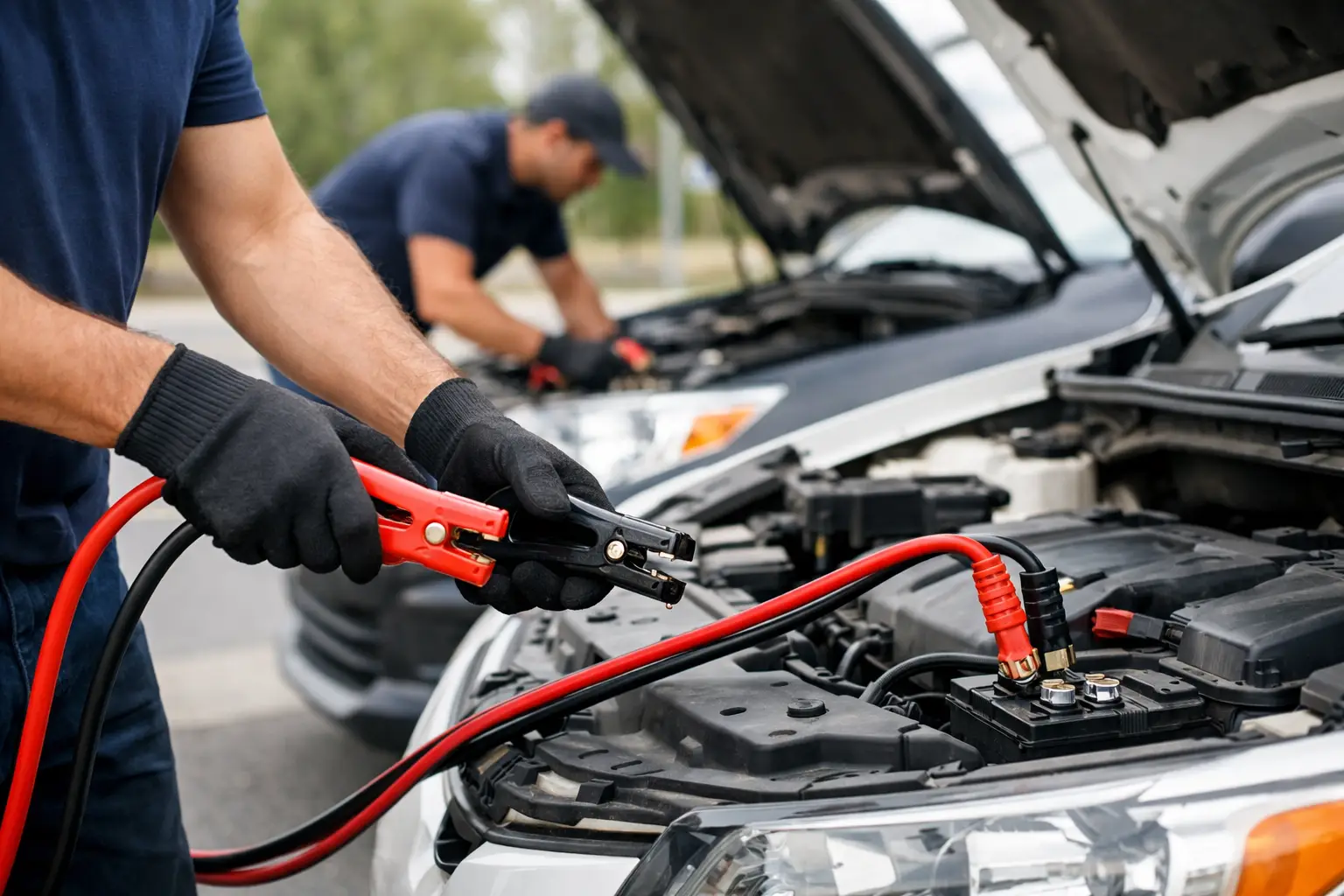
A professional jump start is about more than getting the engine running for five minutes. The first step is confirming the battery is the likely issue and checking for anything obviously unsafe, such as damaged leads, leaking battery acid, or severe terminal corrosion.
Once the jump start is carried out correctly, the vehicle should be assessed to see what happens next. Does it restart on its own after being switched off? Is the charging system doing its job? Are the battery terminals secure? Those checks help tell the difference between a one-off flat battery and a battery that is ready for replacement.
This is where local garage support makes a difference. If the car starts but the battery is clearly weak, you need a straightforward next step, not guesswork. If replacement is needed, it should be fitted with the right specification battery for the vehicle, using quality parts and proper fitting procedures.
When a jump start is not enough
Sometimes a jump start gets the engine running, but the problem comes straight back. That usually points to one of three things.
The first is a battery that can no longer hold charge. This is common on older batteries. You can jump it today, drive somewhere, switch off, and find yourself stuck again ten minutes later.
The second is a charging fault. If the alternator is not replenishing the battery while you drive, the car may run for a short time and then lose power again. You may also notice a battery warning light, dim lights, or electrical systems behaving unpredictably.
The third is an electrical drain. Some component may be pulling power when the car is parked. This can be harder to spot because the battery may test fine at first, yet still go flat overnight or after a day or two.
In all three cases, the jump start is only the immediate solution. The real fix is diagnosis and repair. That matters if you rely on one car for work, school runs, or daily life. Repeated breakdowns cost more in time than sorting the fault properly.
Can you do it yourself?
You can, but it depends on the vehicle, your confidence, and the circumstances. On older cars with easy battery access, good quality jump leads, and clear instructions, it may be straightforward. On newer vehicles, things can be less simple. Some batteries are tucked away, some cars have designated jump points, and incorrect connection can risk electrical damage.
Safety is the main issue. If you are not sure where to connect leads, if the battery casing is swollen or leaking, or if the car is stopped somewhere awkward, it is better not to guess. A rushed DIY jump start on a busy road, in poor weather, or in the dark is not worth it.
There is also the question of what happens after it starts. If you do not know whether the battery is still serviceable, you may just be delaying the same problem until later that day.
What to expect from a local garage service
If you need help quickly, you want a simple process. Phone, explain the symptoms, confirm location, and get a clear next step. No vague promises. No surprise extras.
That is how we approach urgent battery and non-start issues at AutoFix4u. If a jump start service for flat battery trouble is the right call, we focus on getting you moving safely and then telling you honestly whether the battery is likely to be fine, close to failure, or in need of further checks. If replacement or diagnostics are needed, we explain that in plain English before any work goes ahead.
For drivers around Lowestoft and nearby areas, that local support matters. You are not dealing with a faceless call centre or waiting days for answers. You are speaking to a garage that handles jump starts, battery replacement, diagnostics, and related electrical faults as part of the same job.
How to reduce the risk of another flat battery
If your battery has gone flat once, it is worth changing a few habits. Longer drives help recharge it properly. If the vehicle is mostly used for short local trips, the battery may never fully recover between starts.
Check that lights are fully off when you leave the car, especially interior and boot lights. If the battery is more than a few years old and the car has started to feel sluggish, do not wait for total failure before having it checked. It is usually better to replace a failing battery on your schedule than during a rushed morning when you need the car most.
If the flat battery happened without an obvious cause, pay attention. One-off incidents do happen, but repeat failures nearly always mean something needs testing. That is where proper diagnostics make more sense than repeated jump starts.
The right fix depends on the cause
There is no point pretending every flat battery needs the same answer. Sometimes a jump start is enough and you carry on. Sometimes the battery needs replacing that day. Sometimes the battery is fine and the actual fault sits with charging or electrical drain.
What matters is getting the right diagnosis quickly, with clear pricing and no guesswork. If your car will not start and you need a dependable local response, act early rather than hoping it sorts itself. A flat battery is inconvenient. Being stranded twice for the same fault is worse.
If you are stuck, get it checked properly, get told the truth about what is wrong, and get the fix that actually keeps the car reliable after today.