Fault Code Reading Lowestoft Drivers Can Trust
A warning light comes on when you are already late, the car starts driving differently, and suddenly you are guessing. That is usually when people start looking for fault code reading Lowestoft services. The problem is, a code on its own does not always tell you what part needs replacing. It points us in the right area, but proper diagnosis is what finds the real cause.
At our garage, we see this every week. A car comes in with the engine warning light on, or it has gone into limp mode, or it keeps cutting out now and then. In most cases, the fault code is the starting point, not the finish line. Read the code properly, check the symptoms, test the system, and then repair what is actually wrong. That saves time, money, and repeat visits.
What fault code reading actually tells you
Modern vehicles store fault codes when the system detects something outside its normal range. That could be an emissions fault, a sensor reading that does not make sense, a fuel issue, an electrical problem, or a gearbox fault. The code gives a clue about where the issue sits.
What it does not do is guarantee that the named part has failed. For example, a code may point to an EGR valve, but the real cause could be wiring, carbon build-up, a vacuum issue, or another fault affecting the reading. We often see this issue when someone has already replaced a part based on the code alone, only to find the warning light comes back.
That is why proper diagnostics matter. A scan tool reads the codes, but experience is what turns those codes into a sensible repair plan.
Fault code reading in Lowestoft – when to book it
If your engine warning light is on, do not ignore it and hope it clears. The same applies if the glow plug light is flashing on a diesel, the ABS light stays on, or the vehicle has lost power. These are the sorts of faults that can get worse if they are left too long.
You should also book fault code reading if the car is using more fuel than normal, struggling to start, idling roughly, or going into limp mode. Sometimes there is no warning light at all, but the vehicle is clearly not right. In those cases, a proper diagnostic check is often the quickest way to stop guessing.
For local drivers around Lowestoft, Oulton Broad, Carlton Colville, Kessingland and nearby areas, this usually comes down to one simple question – can the car still be used safely, or does it need checking now? If a warning light is flashing, the engine is misfiring, or the vehicle feels unsafe, get it looked at as soon as possible.
Common problems we find after a code scan
A lot of faults look similar from the driver’s seat. The car feels sluggish, the light comes on, and that is all you know. Once we scan and test the vehicle properly, the causes can vary quite a bit.
We often find DPF faults on diesel cars that mainly do short trips. This usually happens because the filter cannot complete a proper regeneration. The fault code may mention soot levels, pressure readings, or emissions performance, but the real fix depends on why the DPF has blocked in the first place.
We also see sensor faults, especially with airflow, temperature and exhaust systems. Sometimes the sensor has failed. Other times, it is reading bad information because of another issue in the system. That is where proper checks make the difference.
Electrical faults are another common one. Loose connections, damaged wiring, battery voltage issues and module communication faults can all trigger warning lights. These can be hard to pin down without the right equipment and a methodical approach.
Then there are performance faults – loss of power, hesitation, poor starting, or rough running. These can come from ignition issues, fuel delivery problems, air leaks, turbo faults, or emissions components. One symptom can have several possible causes, so a quick code read without follow-up testing only gets you so far.
Why warning lights should not be ignored
Some faults stay minor for a while. Others do not. A car in limp mode may still move, but it is doing that to protect itself from further damage. An emissions fault can lead to heavier soot build-up. A misfire can damage other components if it carries on. ABS and braking system warnings need particular care because they affect safety.
There is also the MOT side of it. If the engine warning light is on, or there is an emissions issue stored in the system, the car may fail. We often see people book in after an MOT failure when fault code reading could have picked up the issue earlier and saved time.
That does not mean every warning light is a disaster. Some faults are straightforward. The key thing is finding out which type of problem you have before it turns into something bigger.
What happens during a proper diagnostic check
A proper diagnostic visit should be clear and practical. First, we ask what the car is doing – warning lights, noises, lack of power, poor starting, anything unusual. That matters because the symptoms often point us towards the root cause faster than the code alone.
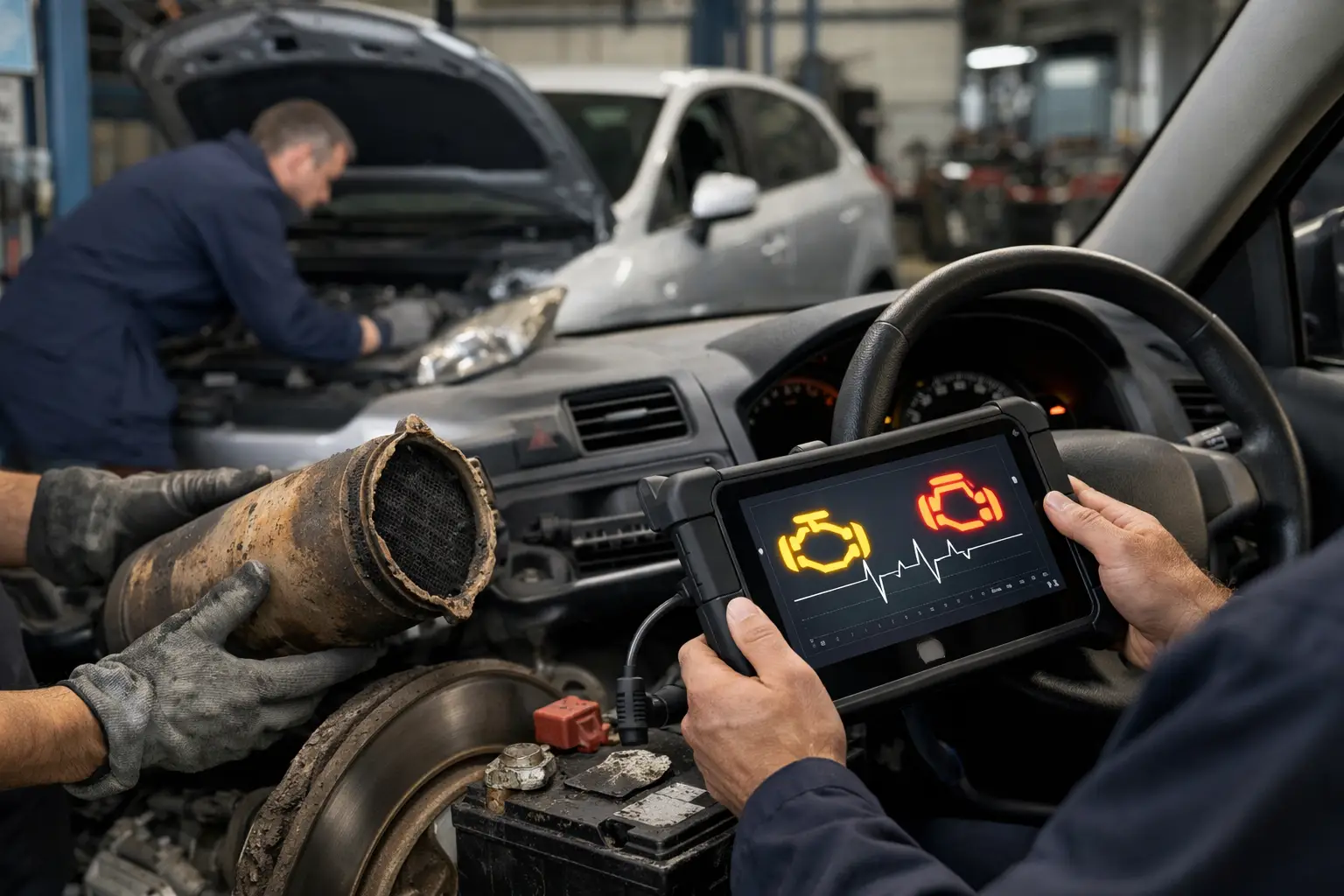
Next, we carry out the fault code scan and check the live data. Live data shows what the system is seeing in real time, which helps us spot readings that are out of range or behaving oddly. If needed, we then move on to physical checks, electrical testing, pressure checks, or road testing.
After that, we explain the fault in plain English. If the problem is confirmed, we can advise on the repair and the next step. If more testing is needed, we tell you that clearly as well. The aim is simple – no guesswork, no surprise extras, and no replacing parts just for the sake of it.
Fault code reading Lowestoft motorists often ask about
One of the most common questions is whether a cheap handheld scanner gives the same result as a garage diagnostic. The honest answer is not really. Those tools can be useful for basic code reading, but they are limited. They may miss manufacturer-specific faults, and they do not test the car for you.
Another question is whether clearing the code fixes the problem. Usually, no. If the fault is still there, the code will come back. Clearing it without repairing the cause just resets the warning for a while.
People also ask if they can keep driving. It depends on the fault. If the car is running normally and the warning light is steady, it may be safe for a short period, but it still needs checking. If it is flashing, losing power badly, overheating, or affecting braking or steering, stop using it and get advice straight away.
Choosing a local garage for diagnostics
When you need fault code reading, speed matters, but so does accuracy. The right garage should not just plug in a scanner and hand you a code number. They should explain what it means, what still needs confirming, and what the sensible repair options are.
That is especially important if you rely on one car for work, school runs or family travel. You do not want to spend money on the wrong fix and still have the same problem next week. A proper local workshop will look at the whole fault, not just the dashboard light.
At AutoFix4u, the focus is on fast diagnostics, honest advice and repairs that deal with the cause, not just the symptom. If you are in Lowestoft or nearby and your car has a warning light, running fault or sudden loss of power, get it checked before it becomes a bigger job.
The next step if your car is showing a fault
If something has changed with the way your car starts, drives or idles, do not leave it to chance. Fault codes are there for a reason, and early diagnosis usually gives you more options. In many cases, it also helps keep the repair smaller and the downtime shorter.
If you need fault code reading in Lowestoft, contact https://autofix4u.co.uk/ to book diagnostics or ask for advice. Same-day slots may be available depending on workload. A clear answer now is usually better than a bigger repair later.