
Does Servicing Protect Warranty? The Real Answer
A dashboard warning light comes on just after a service, or the car loses power on the way to work, and the first question is often: does servicing protect warranty? In most cases, regular servicing helps you keep your manufacturer warranty valid. But the service itself is not a blank cheque. It must be done at the right time, using the correct oil, filters and parts, with clear proof of what was carried out.
That matters when a warranty claim is being assessed. If there is no service record, the wrong engine oil has been used, or a problem has been ignored for months, the manufacturer may question a claim that could otherwise have been straightforward.
Does servicing protect your warranty?
Yes, provided the vehicle is maintained in line with the manufacturer’s service schedule and the work is properly documented. You do not normally have to use a main dealer for routine servicing simply to preserve the manufacturer warranty. A competent independent garage can service your car, as long as it follows the required schedule and uses suitable parts and fluids.
We often see drivers assume that a dealer stamp is the only thing that counts. That is not usually the case. What counts is whether the work was completed correctly and whether there is evidence of it.
A proper service invoice should show the vehicle registration and mileage, the date, the work completed, the oil specification used, and the parts fitted. Keep this with the vehicle’s service history. If the car has a digital service record, make sure the garage can update it or gives you documentation to support the service.
Servicing is also about preventing avoidable damage. Low or degraded oil, old brake fluid, blocked filters and overdue cambelts can all lead to faults that are not likely to be covered if poor maintenance has caused or contributed to the failure.
An independent service does not automatically void cover
A manufacturer cannot normally reject every warranty claim just because you used a local independent garage. If the radio fails, for example, an independently serviced car should not lose cover for that unrelated electrical fault.
The position can change if the fault is connected to poor servicing or incorrect parts. Say an engine develops a lubrication problem and the wrong grade of oil was used at the last service. The manufacturer may investigate whether that caused the damage. Or, if an incorrect timing belt kit has been fitted and it fails, responsibility may sit with the garage that carried out the work rather than the vehicle manufacturer.
This is why the cheapest-looking service is not always the best value. A service needs to match your vehicle, not just involve changing oil and ticking boxes. Modern engines can be very particular about oil standards, especially diesel vehicles with DPF systems.
The service schedule matters
Your handbook or digital service record will state when the car needs attention. Some vehicles run on fixed annual intervals. Others calculate service timing from mileage, journey type and engine conditions.
Short local trips, heavy traffic, towing and frequent stop-start driving can be hard on oil and filters. If your car is due a service, do not wait for a warning light or an MOT failure to deal with it. A service indicator is there for a reason, and overdue maintenance can make a later warranty conversation more difficult.
If you are unsure whether your car needs an interim, full or major service, check the service history rather than guessing. The right level depends on the vehicle’s age, mileage and what has already been replaced.
What a warranty claim assessor may look for
When a serious fault develops, a manufacturer or warranty provider may ask for service records before authorising repairs. They are looking for signs that the vehicle has been cared for according to its requirements.
That does not mean every missed date automatically ends all cover. It depends on the fault and the circumstances. A service that is slightly late may have no relevance to a failed door lock. A missed oil change could be much more relevant where there is engine damage, turbo trouble or loss of power.
The useful paperwork is simple: invoices, service schedules, MOT certificates and any reports relating to warning lights or faults. Receipts for work such as cambelt replacement are particularly worth keeping. If you sell the car later, this history also gives the next owner more confidence.
Be cautious with warranty products that are separate from the original manufacturer warranty. Extended warranties, used-car warranties and maintenance plans can have their own terms. Some require approval before repairs begin, place limits on labour rates, or exclude wear-and-tear items. Read those terms before booking non-routine repairs.
Servicing will not fix an existing fault
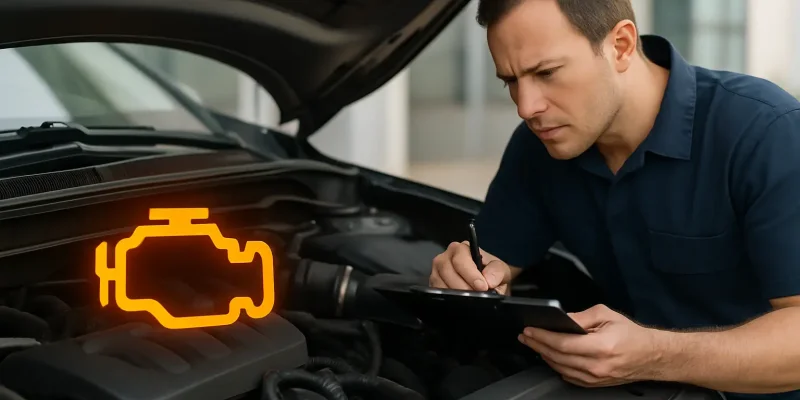
A service is preventative maintenance, not a cure for every problem. This is where misunderstandings happen. A customer may book an oil and filter change because the engine warning light is on, then find the light remains afterwards.
That usually happens because the fault is separate. The cause could be a sensor, wiring issue, air leak, DPF restriction, ignition problem or fuel-system fault. Changing the oil may still be due, but it will not diagnose the root cause.
The same applies to brakes, clutches and suspension. A service can identify worn components, but it does not include replacing them unless that work has been agreed. If you hear grinding from the brakes, feel a clutch slipping, notice a knock over bumps, or the car has gone into limp mode, ask for diagnostics or an inspection alongside the service.
Dealing with faults early is sensible for warranty protection too. Continuing to drive with an engine warning light, overheating issue or oil-pressure warning can turn a smaller fault into expensive damage. A provider may reasonably question a claim if the vehicle was used after a serious warning appeared.
Parts, oil and workmanship make the difference
Quality does not always mean branded packaging from the vehicle dealer. Suitable parts can be original-equipment quality or equivalent, but they must be correct for the vehicle. The same applies to fluids. The oil grade on the bottle is not enough on its own – the required manufacturer approval can matter just as much.
At AutoFix4u, the starting point is the vehicle’s service requirements, not a one-size-fits-all package. We check what is due, explain what we have found in plain English, and make sure you know what has been fitted. That gives you a clear record and avoids surprise extras.
Workmanship matters after the service as well. If a warning light appears, there is an oil leak, the car runs poorly or a service indicator has not been reset, contact the garage promptly. Do not assume it will settle down. A good garage should investigate the issue and put it right.
Before you book a service, ask these questions
For a newer car still under manufacturer warranty, it is reasonable to ask whether the garage will follow the manufacturer schedule, use the required oil specification and provide a detailed invoice. You can also ask whether a digital service record can be updated where applicable.
Tell the garage about anything unusual before work starts. That includes warning lights, a difficult start, a burning smell, poor air conditioning, reduced power or an upcoming MOT. This avoids the common problem of treating a service as though it includes fault-finding.
Finally, check whether your car has a service plan, extended warranty or lease agreement with separate rules. Leasing companies can be stricter about approved servicing and records, even where the manufacturer warranty itself would allow independent servicing.
Keep the proof, and act on faults early
The practical answer is simple: servicing protects your position when it is done properly, on time and backed by paperwork. It does not guarantee every repair will be covered, and it cannot hide damage caused by an ignored fault or unsuitable maintenance.
If your service is due, or you have a warning light and need to know whether it could affect a warranty claim, book an inspection with a local garage that will check the fault properly. For drivers in Lowestoft and nearby areas, AutoFix4u can provide clear servicing advice, diagnostics and honest recommendations before a small concern becomes a bigger repair.