
Car Air Con Leak Guide for UK Drivers
You usually notice an air con leak on the worst possible day. The fan is blowing, the controls seem fine, but the air never gets properly cold. If you are searching for a car air con leak guide, the main thing to know is this – a regas on its own is not always the answer. If the petrol has escaped, there is usually a reason, and finding that reason matters.
We see this quite a lot with daily-use cars. A customer comes in because the air con was cold last month and now it is barely doing anything, or it worked after a regas and then faded again soon after. In most cases, that points to a leak somewhere in the system, and the right next step is proper testing rather than guessing.
What an air con leak actually means
Your car’s air conditioning system is sealed. Refrigerant petrol circulates through pipes, seals, valves and components such as the condenser, compressor and evaporator. If the petrol level drops, the system cannot cool properly.
That loss does not usually happen by accident overnight. It normally means the refrigerant has escaped through a worn seal, a damaged pipe, a corroded condenser or a failed valve. Sometimes the leak is very small and takes months to show itself. Sometimes it is larger and the cooling disappears quickly.
The important point is simple. Low petrol is a symptom. The leak is the fault.
Common signs in this car air con leak guide
Most drivers do not need specialist knowledge to spot the early signs. You just need to pay attention to what the system is doing differently.
The most obvious sign is weak cooling. The air may start cool for a minute and then turn warmer, or it may never get cold at all. You might also notice the air con clutch not engaging properly, the system cutting in and out, or a light hissing sound after the engine is switched off.
In some cars, the engine warning light or a related fault code can appear if the system pressure is too low. In others, there may be no warning light at all. That is why air con faults often get left until summer, when the problem becomes impossible to ignore.
If the windows are not clearing as well as they used to, that can also point to an air con issue. Drivers often think only about cold air, but the system also helps remove moisture from the cabin.
Signs the problem may be more than low petrol
If the air con stopped working soon after a recent regas, that is a strong clue there is a leak. If the system has never been very cold, there could also be a pressure problem, a faulty compressor or an electrical fault.
We often see this issue when a driver has already tried the quick fix first. That is understandable. But if the refrigerant has escaped once, simply topping it up again can end up costing more in the long run.
Where car air con systems usually leak
Some leaks are more common than others. The condenser is a regular one. It sits at the front of the car, so it takes the full force of road dirt, moisture and stone damage. Over time, corrosion or impact damage can create tiny holes.
Pipe joints and seals are another common area. Rubber seals harden with age, especially if the air con is not used regularly through the colder months. Service ports can also leak, and occasionally the compressor shaft seal is the issue.
The evaporator can leak too, though that is often more awkward to confirm and repair because it is buried behind parts of the dashboard. That is where proper diagnostics really matters. There is no point replacing the easy part if the fault is hiding elsewhere.
Why a regas is not always the fix
A regas has its place. If the system has gradually lost some efficiency over time and there is no leak, restoring the correct refrigerant level can bring it back to normal. But if there is an active leak, a regas is only a temporary refill.
This usually happens because the petrol escapes again, sometimes within days, sometimes within weeks. The result is the same. The air con warms up, the money is spent, and the original fault is still there.
That is why we take a diagnostic-first approach. Before recommending a repair, the system needs to be checked properly. Pressure readings, leak detection and component testing give a much clearer picture than assumptions ever will.
How a garage should diagnose an air con leak
A proper inspection is about more than seeing whether the system feels cold. First, the existing refrigerant is recovered and measured. That helps show whether the petrol level is significantly low. The system can then be vacuum tested and checked for pressure loss.
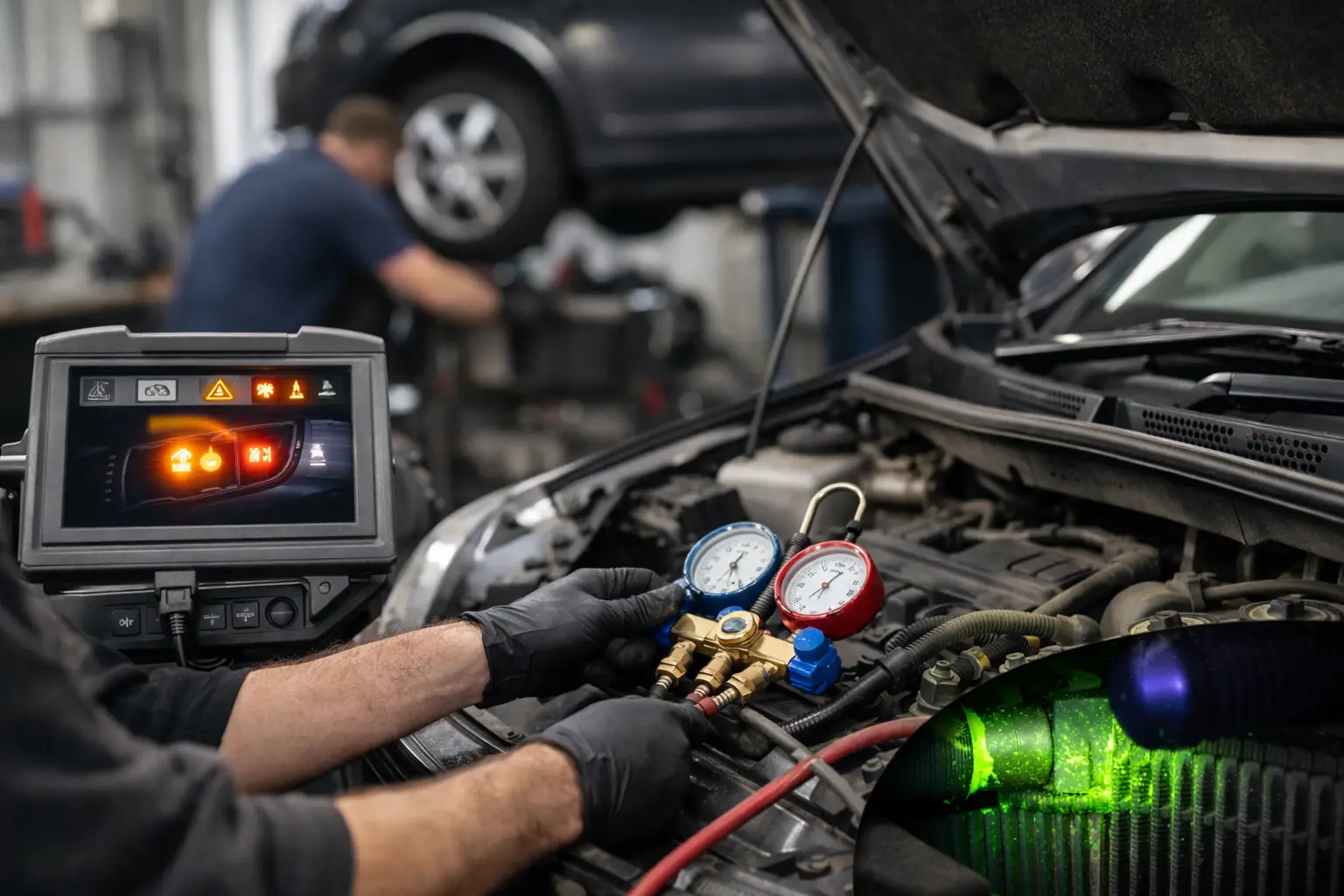
Depending on the fault, a technician may use UV dye or specialist leak detection equipment to trace where the refrigerant is escaping. Visual checks also matter. A corroded condenser or oily residue around a joint can be a strong clue.
This part matters because air con faults can overlap. A system might have low petrol and a weak compressor. Or it might have no leak at all, with the real issue being electrical. Skipping diagnosis can lead to the wrong repair.
Can you drive with an air con leak?
Usually, yes, in the sense that the car will still run. But that does not mean it should be ignored for long. If the system is low on refrigerant, the compressor may not be lubricated as intended, and prolonged use in poor condition can risk further damage.
There is also the comfort and safety side. In warm weather, poor cabin cooling is unpleasant. In wet or colder weather, reduced demisting can become a real nuisance. If you rely on your car every day, it makes sense to deal with it before it turns into a bigger repair.
What the repair depends on
The right repair depends entirely on where the leak is and how bad it is. A leaking valve or pipe seal may be a relatively straightforward job. A damaged condenser is also a common repair. If the compressor or evaporator is leaking, the work can be more involved.
This is where honest advice matters. Some faults are worth repairing straight away because the part has clearly failed and the rest of the system is sound. In other cases, especially on older vehicles, it is sensible to weigh up the cost of the repair against the age and condition of the car.
A good garage should explain that in plain English. What has failed, why it has failed, what needs replacing and what the next step is. No vague answers. No surprise extras.
When to book in
If your air con is blowing warm, fading quickly, or has stopped working after a recent regas, it is worth getting it checked rather than waiting for it to sort itself out. It usually will not. Leaks tend to get worse, not better.
The earlier the fault is found, the better the chance of keeping the repair straightforward. A small leak caught early is generally easier to deal with than a system that has been run low for months and developed extra problems.
For drivers around Lowestoft and nearby areas, the practical next step is simple. Book an air con diagnostic, get the system tested properly, and find out whether you need a regas, a leak repair, or a deeper fix. That is the fastest route to cold air again and the best way to avoid paying twice for the same problem.
A few sensible habits that help
Using the air con regularly, even in winter, can help keep seals in better condition. It also keeps the system moving rather than sitting unused for months. That will not prevent every leak, but it can help.
It also pays to act on early changes. If the air is not as cold as it used to be, or the demisting is getting weaker, have it checked before summer arrives. These faults are often easier to manage when they are picked up early rather than after the system has been struggling for a long time.
If you want a clear answer without guesswork, AutoFix4u can test the system, explain the fault properly and advise on the right repair. Same-day slots may be available depending on workload.
Cold air is not just about comfort. It is one of those small things you only miss when it stops working, and fixing the actual leak is what gets it working properly again.


